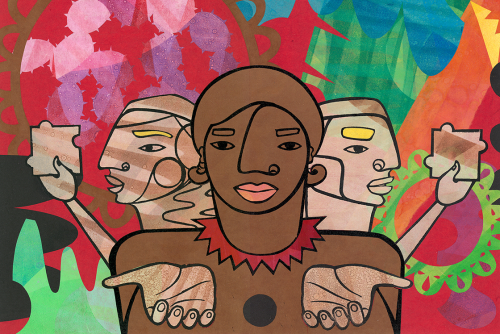
“How can we think (and rethink and rethink) care laterally, in the register of the intramural, in a different relation than that of the violence of the state?”1
The Trouble with “In Our Care”
The project of troubling care is an especially urgent one today.2 Indeed, the title of this special issue can and should be read in two ways: first, as a comment on the troubling use of the language of “care” by state and corporate actors in order to soften and sell violent forms of relation, such as incarceration, deportation, surveillance, and exploitation; and second, as an effort to trouble these discourses and, as a consequence, to reconsider feminist theories and stories about care’s history and politics. In this special issue our contributors both confront troubling forms of care and trouble how we think about care six years after an efflorescence of radical, creative projects that, in response to the disruptions of the COVID-19 pandemic and mobilizations in opposition to anti-Black state violence, offered a glimpse of how people could construct collective infrastructures for living amidst adverse conditions. However, while it is difficult to imagine how to open this issue without invoking this recent history, we also do so with a significant degree of caution, not least because of the distorting effects that follow from starting the narrative of care’s critical importance here. Certainly, the practices of mutual aid and resource sharing that developed at that time reimagined care in grassroots, nonhierarchical, and non-transactional ways. As a turning point, 2020 elevated discourses of care, proliferated practices of care, and generated possibilities for a new state care infrastructure. But it simultaneously masked both the long history of mutual aid in marginalized communities and the way that the state and corporate sector has historically generated the care crisis, especially for Black and brown people.
In short, a central premise of this special issue is that how we narrate care matters a great deal for how we theorize it, how we practice it, and how we understand its place within a cycle of liberation struggles and within the series of countervailing disciplinary practices that recuperate and instrumentalize it. Troubling care, then, is necessarily a project of struggling over, with, and through narratives of care — that is, with inherited assumptions, frameworks, and ideologies that provide prefabricated answers to the questions of the origins and nature of the care crisis, who cares, under what conditions they care, for what and whom they care, and how to develop a liberatory politics of care.
This issue’s reflections on narratives and counternarratives of care are in immediate dialogue with recent decolonial feminist and queer efforts to theorize how care labor and caring practices are embedded with racial capitalism, settler colonialism, anti-Blackness, white nativism, and apartheid. Each of these violent structures is constituted by gender essentialist and heteropatriarchal assumptions of human being and worth that, as we write this introduction, are asserting themselves with vicious energy globally.3 As Christina Sharpe’s epigraph suggests, care is a discourse woven through the state and its violence, and a major feminist and queer task of the present is to ask (and reask and reask) both what kinds of analyses can help us trace that relation and what narratives can fray its edges and sever its threads. As a case in point, consider several recent reports on the political economy of immigrant detention, some of which speak to the enclosure of care within and by the logic of the capitalist state and others of which aim to break out of that enclosure.
The first comes from an account of a recent earnings call for CoreCivic, one of the largest for-profit prison contractors in the United States. On that call Patrick Swindle, the President and COO, told a story that extolled the company’s longstanding and flourishing relationship with Immigration and Customs Enforcement (ICE): “ICE was our first customer forty-three years ago, and has been our largest customer for over a decade. From the end of 2024 through the end of 2025, ICE populations in our care increased 5,903 individuals, to just over 16,000 or 58 percent.”4 On the surface level, Swindle’s use of “in our care” to describe CoreCivic’s practice of incarcerating immigrants invokes the common association of this phrase with supervision, guardianship, and protection. But on another level, “in our care” functions as a rhetorical device that launders the acts of kidnapping that are now part of the state spectacle of mass deportation into a different story, one that connects the company’s profit motive to its articulation of civic responsibility: “CoreCivic is committed to providing high quality, compassionate treatment to all those in our care,” as they state on their website, and this can also be a profitable service for an authoritarian nation-state.5 On this second level, then, the preposition “in” marks care’s enclosure and mobilization in the service of a white nationalist custodial and capitalist project. Let us call this logic carceral care.
But under and against this narrative CoreCivic tells itself and its shareholders, what is the nature of this care as it is experienced by the kidnapped immigrant? What, in other words, are the understories of carceral care, the narratives that lie below and capacitate the one that can be heard on that earnings call? We do not need to look far to learn about several. Dilley, a detention facility operated by CoreCivic outside of San Antonio, Texas, has seen outbreaks of measles as an exploding prison population is jammed into closer, dirtier quarters.6 Across multiple sites of detention, the incarcerated immigrant population’s dramatic rise in numbers confronts its inverted image in the skeletal medical staff and services maintained at these facilities. In one case, recently deported women describe an almost total absence of pre-natal care for pregnant detainees; in another, a fired nurse maintained that CoreCivic employed as few as two medical staff for as many as fifteen-hundred people.7 Such stories of medical neglect also sit alongside and intersect with others that speak to the overt, intentional hostility that carceral care entails, like those of the recently modified contracts between ICE and private prisons that revoke the already meager safety measures and medical care for trans captives.8 CoreCivic’s human rights policy, which it has invoked in response to reporting on the immiseration of trans people imprisoned in their facilities, offers little relief in a context in which it is complying with an administration that sees trans identity as something that violates a “biological” and binary definition of the human altogether.9
The easily anticipatable outcomes of carceral care go beyond the actions of one company and exceed neglect and abandonment. As evidenced by a class-action lawsuit filed against the GEO Group, also a for-profit prison and CoreCivic’s largest competitor, another outcome is coerced social reproductive labor. In that suit Alejandro Menocal and other detainees in an Aurora, Colorado facility accused the company of forcing them to clean the bathrooms, floors, walls, and yards of the prison, serve food, and cut each other’s hair, for only $1 per day. Those detainees who refused to be conscripted into this captive domestic labor faced not only an inability to contribute even paltry amounts to their commissary funds, but they also faced an escalating series of punishments from guards, who moved from suspending inmates’ television and phone privileges to issuing physical threats and forcing immigrants into solitary confinement.10 This is an example of what Sarah Haley and Emily Thuma call in the previous issue of S&F Online the “carceral capture of life sustainment.”11 As a site of social reproduction, the prison, through the exploitation of labor and the extraction and manipulation of life into a carceral state labor resource, sustains both the lives of people on the inside and the system itself. It is the reproduction of life for the carceral state’s own proliferation — and the profit of the carceral state’s corporate partners.
These accounts reveal that the story of carceral care furnished by the capitalist state’s corporate partners in the business of locking up immigrants competes with many others: ones that revolve around experiences of captivity, cheapened human life, and subsidized maintenance costs; ones that expose how a group of people, legally differentiated within an apartheid immigration regime, are forced to maintain the conditions of their own incarceration, which produce vulnerability to premature death for themselves and profits for their “guardians”; and ones that illuminate the caring practices of survival and resistance that emerge from and exceed capitalist structures.12 These counternarratives of carceral care are, to be clear, more than pluralistic variations on or corrections of Swindle’s narrative, which, despite his own intentions, so clearly indexes the relationship between care and state violence. Rather, these counternarratives fray Swindle’s tale at its edges, taking its exposed threads as starting points for weaving together an account of the collusions between racial capital and the state and oppositional practices of care and solidarity.
This issue asks how these counternarratives not only fray but sever the threads that connect care and state violence and, as a result, narrate care from radically different sources and within lateral social relations. What are the characteristics and qualities of narratives that reframe belonging, movement, and social relations outside of the disciplinary confines of state citizenship and the capitalist work ethic? What past visions and possibilities do they insist into the dimmed horizons of the present? How do they work against the political foreclosures that appear so dominant as we write this introduction? How else do they articulate care outside of CoreCivic’s carceral logic?
Mahmoud Khalil’s public letter from a detention facility in Louisiana (operated by the GEO Group) offers one example of how these questions might be answered.13 In his observation that “being Palestinian is an experience that transcends borders,” he articulates a standpoint from which the settler logics of rightlessness, detention, and elimination snap into focus; and from this standpoint, he weaves a radically different articulation of belonging, relation, and kin formation that includes those with whom he is detained.14 Orisanmi Burton similarly argues that, in opposition to “a repertoire of warfare that aims to foreclose Black collectivity/family and political possibility simultaneously,” incarcerated Black men have cultivated forms of intergenerational kinship and care work, including fathering, mentorship, storytelling, and rituals of mutual support within the prison, that may be understood as rebellion against carceral capture and the tactics of war.15 From a different angle, Olga Rodríguez-Ulloa’s “Mourning and Migrancy” works within and beyond the genre of the memoir to tell a story about her mother, an immigrant domestic worker, whose life and death were shaped by long histories of Indigenous movement and dispossession in Peru, imperial immigration practices in the US, and capitalist devaluation.16 Her rendering of what exceeds the forms of capture and degradation that those systems inflict upon racialized immigrants concludes with a vision of caring outside of the nation-state and capital: “We impose our contaminated, unruly bodies, our precarious cosmopolitanism from below . . . Perhaps our own way of reimagining a stateless borderless future is to constantly practice nonbelonging to all nations. Maybe in the face of uncertainty, we need to practice immigration as marronage.”17 Efforts such as these, operating within the narrative genres of prison letter writing, scholarship, and memoir, break that enclosure that is represented by Swindle’s custodial phrase “in our care” and nourish the possibility of identifying a history and future of care that exceeds its carceral logic.
A handful of examples cannot exhaust the necessarily broad range of ways it is possible to answer (and reanswer and reanswer, to echo Sharpe) the questions we pose about how to sever the relationship between care and state violence. But the three that we name stand out for the way they construct narratives of care, caring practices, and ethical care relations that rupture the conventions of empire and capital. It is to this broader project of developing counternarratives, which are themselves new narratives that take the measure of both power and resistance, that this special issue aims to make a contribution.
Narratives and Theories of Care
Undergirding every story is a theoretical intervention. In this way narrative is not an alternative to theory, but a different form of theory. Our aim in presenting these counternarratives of care is to distill how they recast, disrupt, alter, and contribute to theoretical understandings of care, social reproduction, and racial capitalism. They are in conversation with dominant stories about care that rely on exclusionary, disciplinary, and extractive processes and reflect and reinforce racialized, gendered, and class differentiation.
Over the last fifty years feminist theorists and activists have attempted to raise the political and conceptual salience of care to the same level of importance that it occupies within everyday life. But how theorists have approached care as a matter of concern for gender, racial, and sexual justice has varied. For feminist philosophers like Joan Tronto, Virginia Held, and others, to act and think with care is to bring a complex ethical orientation to questions of morality, justice, and politics.18 In their elaboration of a feminist ethic of care, these philosophers have been especially keen to dismantle the construct of “woman’s morality,” or the hegemonic narrative that attributes the capacity for caring to femininity.19 Such an approach also, as María Puig de la Bellacasa puts it, makes it possible to remain attuned to care’s political ambivalence: “the persistent idea that care refers, or should refer, to a wholesome or unpolluted pleasant ethical realm” collides with the feminist imperative to “constantly [reclaim it] from idealized meanings, from the constructed evidence that, for instance, associates care with a form of unmediated work of love accomplished by idealized caregivers.”20 Care here, understood in this tradition as an ethical disposition, simultaneously levels critiques of moral philosophy’s abstractions and reroots philosophical reflection on autonomy, rights, and justice in the unevenly gendered and racialized terrain of concrete practices and antagonisms.
Since the 1970s, a broad range of Marxist feminists have elaborated theories of the relationship between care and capitalism. Inspired in part by a burgeoning Wages for Housework movement, these theorists analyzed the devaluation of women’s unpaid household labor, which they theorized resulted from a historical process of control of women’s bodies and labor and the occluded contribution of unpaid reproductive labor to the production of capitalist value.21
Building upon this work, as well as departing from it in important respects, a more recent group of feminist theorists have understood care in terms of social reproduction, which they have interpreted as the material and biological work of maintenance and regeneration that takes place in a broader social field, including domestic work, childcare and eldercare, nursing, education, and more. But while these may be the most commonly analyzed examples of care as socially reproductive labor, they should be regarded ultimately, as Tithi Bhattacharya suggests, as a way of mapping the capitalist totality with a sharpened analysis of race and gender oppression and a deeper, more complex understanding of the necessary preconditions of capitalist profit. To track specific labors of care, then, is to find strategic points from which to observe and intervene in the “myriad social capillaries of social relations extending between workplace, home, schools, hospitals — a wider social whole, sustained and coproduced by human labor in contradictory yet constitutive ways.”22
Theorist Susan Ferguson argues that the labor of social reproduction sits “in a necessary but contradictory relation to the capitalist drive to produce and accumulate surplus value.”23 It is necessary, that is, because capital still needs particular human qualities, capacities, and attributes to be reproduced as labor power. But it is also contradictory insofar as that essential labor of reproducing humans simultaneously sits outside of capitalist social relations and is conditioned by capital’s inhuman drive to accumulate. These different, but often conflated, approaches to care mask an important political and conceptual division within feminist theories of capitalist work on the question of whether and how the labor of reproduction produces value for capitalism. If it is impossible, then, to speak of a unified theory of care as labor, it may still be possible and generative (narratively, theoretically, and politically) for feminists to exploit care’s construction within capitalism. By doing so, writes Silvia Federici — whose political, historical, and theoretical work sits firmly on the side of understanding reproduction as value-producing labor — feminists can chart “the unstable, potentially disruptive character of the work . . . [bringing] out the tension . . . and [suggesting] a world of conflicts, resistances, [and] contradictions that have political significance.”24
While the two approaches to care that we have sketched above are characterized by different debates and have directed their attention to distinct objects and levels of social and cultural analysis, more often than not they have been imbricated with each other within feminist scholarship and activism. Indeed, there is no shortage of work that observes that capital’s need to circulate through and reproduce relations of severe inequality produces problems for the expansive capacity for caring that feminist moral philosophy seeks to articulate, just as there are many Marxist feminists who have maintained that the critique of social reproduction is a necessary step in the project of building more ethical bases for human and extra-human relations.
But if it would be a mistake to treat these two tendencies as easily separable theories and narratives of care’s complex place in the world, then it would be equally mistaken to assume that they have been without their critics. Indeed, many of the most powerful critiques of not just a hegemonic care discourse but also critical feminist theories of care come from those who have identified the contradictions at the intersection of these tendencies.
Uma Narayan, M. Murphy, and Amrita Banerjee, for instance, have identified how the concepts of responsibility, reciprocity, and dependency favored by care ethicists have long been in circulation through colonial rights discourse, troubling the possibilities that even a critical account of care represents for transnational and anticolonial feminisms. As Narayan puts it, “strands in contemporary care discourse that stress that we are all essentially interdependent and in relationship, while important, do not go far enough if they fail to worry about the accounts that are given of these interdependencies and relationships . . . Notions of differences in vulnerabilities and capabilities should be recognized as contested terrain, requiring critical attention to who defines these differences as well as their practical implications.”25
From a different angle, feminist theorists and historians of racial capitalism have put immense pressure on the conceptual distinction that social reproduction theorists assume between value-productive labor and labor that reproduces life. Much like the excavation work by feminists to name, quantify, and recognize unpaid household labor, Black and other women of color feminists have for decades narrated stories of paid domestic labor and the devaluation of motherhood, stories of care that have been submerged and are rarely afforded the same level of narrative power in contemporary discourses of care.26 Guest editor Premilla Nadasen, in her recent book Care: The Highest Stages of Capitalism, makes the point that social reproduction theory’s distinction between value-productive labor and life-making activity breaks down in the context of chattel slavery and its afterlife, where enslaved Black women’s reproductive labor was an immediate, brutally maintained source of value. Nadasen simultaneously deconstructs the ideological obfuscations of contemporary popular care discourses that hinge the recognition of caregivers’ rights and moral worth on their apparent feelings of compassion for their charges rather than the fact that they are workers.27 Indeed, as analysts of the gender and sexual politics of racial capitalism have maintained, Black women and women of color have borne the contradictions of care, as both labor and ethical disposition, in instrumentalized ways that are rarely charted within the coordinates of radical political theory. “Those of us who have been ‘touched by the mother,’” writes Saidiya Hartman in her survey of the void that Black women’s labor represents in the Black radical tradition’s canonical texts, “need acknowledge that her ability to provide care, food, and refuge has placed her in great jeopardy and, above all, required her to give with no expectation of reciprocity or return.” She continues,
The forms of care, intimacy, and sustenance exploited by racial capitalism, most importantly, are not reducible to or exhausted by it. These labors cannot be assimilated to the template or grid of the Black worker, but instead nourish the latent text of the fugitive. They enable those “who were never meant to survive” to sometimes do just that. This care, which is coerced and freely given, is the black heart of our social poesis, of making and relation.28
We highlight these specific critiques in part because they each point to the roles of narrative in either consolidating or rupturing our understanding of the feminist politics of care. Note Narayan’s emphasis on the contested character of accounts of dependency, Nadasen’s attention to the distortions of popular care discourses, and Hartman’s description of care as worldbuilding: each calls us to reflect on the entanglements of our theories and our narratives of caring and caregiving.
Any narrative begs the question of whose story is this? How do different stories offer different theoretical interventions in thinking about care? Narrative also raises the question of for whom do we narrate? These are crucial questions to ask since the audience necessarily shapes the stories we tell. Narrative, then, is an epistemological intervention into how we think about care. It offers a new way to imagine care ethics and a new angle to critique capitalism from other preexisting frameworks and starting points. If the origin story of care begins not with the gendered division of labor and formation of the nuclear family household, if it begins not with the corporation or the state, we generate very different analyses of care. All of the essays in this issue draw on practices of resistance, refusal, and reclamation by organizers and people on the ground to offer new narratives of care, new critiques of capitalism, and new elaborations of a liberatory politics of care.
The Issue
The first three essays contextualize care in the context of colonialism and slavery. Care work in the Caribbean is inseparable from colonial and imperialist logics: structural violence, the plantation economy, forced displacement, and labor migration. Trotz and Mullings’ argument that a “permanent crisis” characterizes the post-slavery Caribbean disrupts narratives of the care crisis as a recent development or a product of neoliberal restructuring and instead locates it in the long history of racial capitalism. It places front and center the urgent question of survival in a context of dispossession, slavery, and colonialism. Because of the Caribbean’s extensive capitalist entanglements, they argue that the Caribbean is more than a case study, but an anticipatory vantage point. The permanent crisis exposes the “impossibility of making life work” in the context of climate disaster while simultaneously creating imperatives for new forms of caring. Women’s labors in relationship- and community-building as traders and provisioners is the collective response that nurtures “the grounds upon which care work is produced.” Geographically mobile, it fosters lateral connections, as Christina Sharpe urges us to do, moving beyond and across borders transterritorially.
In her essay on eldercare work in Israel, Rachel Brown analyzes the mutually reinforcing goals of what she calls the longevity industry: preservation of memory, nation-building, and profit extraction, where care for the elderly has turned into “a multi-billion-dollar financial opportunity” that justifies and enables the practice of settler colonialism. For Brown aging is one facet of eugenic management and biopolitical governance: in this regard, she situates the longevity industry as the biopolitical obverse to the necropolitical “annihilation of resources for Palestinians.” In making this argument Brown builds upon Bayan Abusneineh’s recent essay in S&F Online about reproductive genocide and the destruction of Palestinian futurity to argue that the pathologization and containment of Palestinian reproduction results in memoricide.29 Brown draws us to the place of a eugenic and economized articulation of eldercare, where “the transformation of the human capacity for life into an object of financial speculation and a site of future capital returns.”
Lisa Jahn’s contribution chronicles the practice of radical care in the context of Hurricane Maria’s climate disaster in Puerto Rico and the ensuing care crisis among Puerto Ricans traveling to New York. In contrast to violent, exclusionary, and extractive forms of state care, radical care as practiced by disaster case managers is relational, dependent on personal sacrifice, and interwoven with “joy, mutual care, and laughter,” offering not only material aid but support and community. “Radical care thus refers to the material and affective strategies and solidarities co-created by diasporic women to mitigate immediate crisis and the potential for precarious futures set in motion because of climate displacement.” As Jahn observes, this radical care, while essential for life-making among those displaced by colonially-produced climate disasters, is simultaneously put under erasure by the bureaucratic demand for data consolidation, which parasitically relies upon the unpaid, gendered, and racialized labor of disaster case managers even as it smooths over their labors in the interest of producing a “disguise of efficiency.” Jahn’s counternarrative of radical care, then, draws together the problems of environmental emergency and the resourceful navigation of state agencies by women of color.
The next three articles shift to a different but related question: the work of mothering. The welfare rights movement and the International Wages for Housework Campaign in the 1960s and 1970s were critical sites of defining unpaid domestic labor as socially necessary labor. These movements challenged long-held assumptions that equated work with the white male industrial worker and unveiled the multiple forms of unwaged and undervalued labor that undergirded capitalism but were not recognized as such by economists, theorists, or public policy analysts. They shifted the gaze from the factory to the kitchen, disrupting the false binary between public and private and the attendant assumptions that the presumably private space of the home is a site of nurture and the factory is the primary site of labor activity. Selma James, one of the architects of the Wages for Housework movement, wrote and circulated a pamphlet in 1972, “Women, the Unions, and Work, or What Is Not to Be Done,” arguing that women did not need to join the wage labor force and unionize in order to participate in class struggle because they were already workers — “unwaged workers” in the home. Unwaged workers, she argued, had political power because of their economic contributions, whether or not those contributions were recognized with a wage. James, Maria Dalla Costa, and Silvia Federici co-founded the International Wages for Housework Campaign, which had bases in the US, Italy, and the UK and called for women to be paid a wage for unpaid household labor.30 This movement was emblematic of a broad swath of organizing by working people in the 1960s and 1970s that interrogated and expanded a category core to capitalism: who is a worker? Enslaved people, colonial subjects, informal workers, peasants, farmworkers, and housewives were distinct from the prototypical factory worker but were essential to the economic growth and wealth of the nation. These activists transformed how we understand labor, who comprises the working class, and who is a revolutionary subject. The three essays in this section trouble any static and normative understanding of unpaid mothering labor.
Carmen Winant shares a powerful art installation produced at the height of COVID that emerged from her interest in Silvia Federici’s Wages for Housework archive. She recounts the process of trying to produce art about Wages for Housework while simultaneously doing childcare during lockdown, which resulted in a new artistic creation forged in a nearly improvisatory manner after one of her children began scribbling on top of a series of printouts from Federici’s archive. Taking this unexpected cue, Winant began printing more of Federici’s archival material on top of children’s artwork, literally layering the professional and the personal. The final product that emerged from the happy accident of her child’s creativity illustrates the inseparability of home and work and visibly manifests the demands of childcare, all in an aslant dialogue with a political movement that insisted on recognition and compensation for this essential labor. For Winant, the collective nature of the piece, which relied on donations of children’s art, embodies her belief that “artwork must be paired with groundwork.”
Gwendolyn Fowler’s essay discusses “Mother Power,” an ideology that centers the needs of Black mothers and their children as articulated by welfare rights activists such as Johnnie Tillmon. The welfare rights movement made a claim to motherhood in the context of state mandates requiring poor women on welfare to work outside the home, reflecting the devaluation and denial of Black women’s status as mothers. Fowler argues that mother power signifies social reproduction theory’s analytical frame about the importance of the labor of social reproduction — that is the production of labor power and the birthing and raising of human beings — which sustains capitalism. As she sums up, “If social reproduction is the theory, Mother Power is that theory in motion.” Fowler’s reclaiming of the welfare rights movement as part of the trajectory of social reproduction theory offers a new chronological narrative, an articulation of the importance of mothering long before academic theories emerged.
Finally, Viviana Guevara and Michelle E. Grier’s interview with Joyce Macmillan exposes the role of state violence in the systemic destruction of Black families and communities and the ensuing care crisis. The long history of forced family separation, they argue, manifest through mechanisms of surveillance, mandated reporting, and investigations in the contemporary foster care system, which Macmillan refers to as the family policing system.31 Since the forced separation of her own family, Macmillan, with steadfast courage, has called for the abolition of foster care and has dedicated her life to keeping families together through the family advocacy movement.
Together these essays illuminate the power of the state to generate or resolve the crisis of care and to create or deny conditions for family and community formation and viability. Some mothers are denied the opportunity to care for their own children, while other women grapple with the burdens of paid employment without the necessary care infrastructural support. These essays thus analyze unpaid care labors as both an object of state control essential to capitalism and as a crucial site for family and kin formations that sustain life-making, human survival, and joy.
Stories of resistance — how people survive and cope, how they challenge and redefine community, and how they cultivate alternative modes of caring — are woven throughout this issue. The final cluster of essays builds upon the preceding ones while foregrounding stories of care and the experiences of immigrant women and people of color in organizing, as well as articulating new imaginaries of care that expand our sense of the political and what it means to struggle for rights and dignity beyond the structures of the capitalist state. Organizing by domestic workers, for example, transformed the landscape of labor organizing, forging new models that met the moment of a reconstituted labor force under neoliberalism. These movements mobilized precarious immigrant women of color as service sector workers who were administratively and legally excluded from labor protections and left outside the boundaries of mainstream labor organizing. They relied on common spaces as sites of organizing, publicly shamed employers, demanded state rather than employer-based protections, and brought together documented and undocumented workers. The movement also confronted a normative framing that cast household workers as akin to family members, for whom emotional investment and compassionate devotion presumably structured the occupation, and insisted instead that they were workers who performed essential labor and deserved rights.
Damayan Migrant Workers Association, which Linda Oalican co-founded and which Riya Ortiz, Linda’s daughter, currently directs, embodies this collective power. For over twenty years Damayan has served labor trafficking survivors, many of whom are care workers, fighting for their legal status, back pay, and family reunification. Damayan works to leverage and transform the law and create collective care communities to meet the everyday needs of members. Although a labor rights organization, the foundation of Damayan’s organizing is not the labor process per se. Nor, as a worker-led organization, is it abstract solidarity. Perhaps Damayan’s organizing strategy can be described as what Miriam Ticktin, in her contribution to this issue, calls “association.” Like the migrants, or “people-on-the-move,” discussed by Ticktin, Damayan’s organizing is based on contingent formations with workers hailing from different parts of the Philippines who find themselves in harrowing labor and immigration conditions in the US.
Association, Ticktin argues, is one promising way to move from caring for to caring with. Writing about people-on-the-move in the context of a global refugee/displacement crisis and “panic” over migration in France, she reimagines care as transversal and non-exclusionary. Solidarity, based on shared values and recognition, can be an abstraction that masks hierarchy and difference. By way of contrast, association, as a method and contingent formation, is premised on activity and common cause as a basis of collectivity: on how people come together and how everyone is implicated, albeit differentially, in the system of racial capitalism. People-on-the-move build collective infrastructures and spaces to support life, offering structural care capable of addressing structural harms. Association, then, moves us away from caring for/about suffering towards caring for/about dignity and equality.
The life of Myrtle Witbooi, memorialized here by feminist scholar Jennifer N. Fish, reflects another understory of care. Witbooi for decades organized domestic workers in the context of the South African apartheid regime, which relied heavily upon Black women’s labor to sustain the reproduction of white families as well as the reproduction of an economic and racialized apartheid system. Later as president of the International Domestic Workers Federation, she became a symbol and a voice for domestic workers globally. As she believed, stories of domestic workers, like her own, undergirded mobilization of this international movement and will continue to do so.
Finally, the anonymous photo essay draws on images from the Columbia University Gaza Solidarity Encampment and brings us back to emerging care structures in the very local within the context of the global. The student-led Palestine solidarity movement powerfully exposed the university’s complicity in the genocide and demanded divestment and accountability. In a context of heightened university repression, students created makeshift encampments on the lawn outside the university library to make visible their solidarity with the Palestinian people. The photo essay offers a window into the spaces of care and support in the student encampments, which constitutes an important rejoinder to the more common narratives of the student encampments as obstructions to essential university functions. As the author writes, “this encampment taught the wider Columbia and Barnard community about the coterminous relationship between care and violence.” Students’ care within the encampment “was made possible by the same flows of wealth and power that starve and oppress Palestinians.” Even as students considered “their own place in the machinery of imperialism,” they asked fundamental questions about life and care, resistance and solidarity. The photos capture the work of organizing and collective mobilization that emerge from the human connections and relationships built in the process, which may be, in their words, a “new roadmap for caring in the belly of the beast.”
The essays in this issue complicate standard narratives and offer insight into resistance and life-making in the context of multiple crises, all of which, as products of racial capitalism and settler colonialism, render inadequate any simplistic understanding of care as contradictory to capitalism or state violence or cynically position caring practices as adjuncts to control and exploitation. By refusing to idealize care, the essays in this issue invite us to reflect on how counternarratives engage in a process of “protagonism,” that is, a process of transforming value systems and communal- and self-understandings that can only be gained through participation in struggles.32 As such, the articles collected here do not close the question of how to narrate and theorize care but instead prompt us to ask how to keep care as a political and conceptual challenge open as we orient ourselves toward liberated horizons.
Endnotes
- Christina Sharpe, In the Wake: On Blackness and Being (Duke University Press, 2016), 20.[↑]
- This issue emerged out of a conference, Care, Racial Capitalism, and Social Reproduction, hosted by the Barnard Center for Research on Women and funded by the Columbia University Center for Political Economy. The editors would also like to thank Sandra Moyano-Ariza and Beck Jordan-Young for their careful editorial guidance on this introduction; and the participants in “Radical Care: Struggle and Worldmaking,” a 2024-2025 Willen Seminar funded by the Committee on Faculty Development and Diversity at Barnard College.[↑]
- In addition to the contributions we discuss throughout this introduction, see the special issues, “Radical Care,” ed. Hiʻilei Julia Kawehipuaakahaopulani Hobart and Tamara Kneese, Social Text 38, no. 1 (March 2020); “Reproductive Racial Capitalism,” ed. Jennifer Morgan and Alys Weinbaum, History of the Present 14, no. 1 (2024); and “Complexities of Care and Caring,” ed. Linda Blum and Amber Jamilla Musser, Signs 49, no. 1 (Autumn 2023). Monographs that have made formative contributions to a critical theory of care include Emma Amador, The Politics of Care Work: Puerto Rican Women Organizing for Social Justice (Duke University Press, 2025); Grace Kyungwon Hong, Death Beyond Disavowal: The Impossible Politics of Difference (University of Minnesota Press, 2015); Joshua Chambers-Letson, After the Party: A Manifesto for Queer of Color Life (New York University Press, 2018), Neferti Tadiar, Remaindered Life (Duke University Press, 2022); Beverly Mullings, “Caliban, Social Reproduction and Our Future Yet to Come,” Geoforum 118 (2021): 150-158; Hil Malatino, Trans Care (University of Minnesota Press, 2020).[↑]
- Jesse Fox Mayshark, “CoreCivic, Annotated,” The Progressive South, March 3, 2026, https://theprogressivesouth.org/corecivic-annotated/. Emphasis added.[↑]
- “What We Do, What We Don’t Do,” CoreCivic, https://www.corecivic.com/what-we-do-what-we-dont-do. In a fourth quarter 2025 report Swindle says, “We anticipate 2026 will be a continued period of increased demand from our federal, state, and local government partners.” It won new contracts at four of the nine facilities “that were idle at the beginning of the year.” See “CoreCivic Reports Fourth Quarter and Full Year 2025 Financial Results,” CoreCivic, released February 11, 2026, https://ir.corecivic.com/news-releases/news-release-details/corecivic-reports-fourth-quarter-and-full-year-2025-financial.[↑]
- On the unhealthy conditions of detention at Dilley and other CoreCivic facilities, see Katie Thomas, Jessica Silver-Greenberg, and Melena Ryzik, “Sick Detainees Describe Poor Care at Facilities Run by ICE Contractor,” The New York Times, February 14, 2026, https://www.nytimes.com/2026/02/14/business/ice-health-care-corecivic-immigrants-detention.html.[↑]
- On the lack of pre-natal care for pregnant immigrants, see Shefali Luthra, “Detained pregnant people are entitled to full medical care. They say it’s not happening,” The 19th, March 18, 2026, https://19thnews.org/2026/03/pregnant-people-immigration-detention-medical-care/. [↑]
- Whitney Currah Wimbish, “ICE Deletes Rape Protection for Trans Immigrants,” The American Prospect, January 14, 2026, https://prospect.org/2026/01/14/ice-trump-rape-protection-trans-immigrants/.[↑]
- The incoherence of the Trump administration’s conception of the human, which frequently invokes immutable biological differences between sexes without referring to research on biological variation, is on full display in Executive Order 14168 of January 20, 2025, “Defending Women from Gender Ideology Extremism and Restoring Biological Truth to the Federal Government,” https://www.federalregister.gov/documents/2025/01/30/2025-02090/defending-women-from-gender-ideology-extremism-and-restoring-biological-truth-to-the-federal. [↑]
- In February 2026 the Supreme Court of the United States rejected GEO Group’s attempt to dismiss the suit out of hand, although it is still making its way through lower courts and may come back to the Supreme Court. See Ronald Mann, “Court rejects ICE contractor’s right to immediate appeal,” SCOTUSBlog, February 26, 2026, https://www.scotusblog.com/2026/02/court-rejects-ice-contractors-right-to-immediate-appeal/. For more on the GEO Group’s efforts to exploit immigrant detainees as sources of cheap domestic labor, see McKenzie Funk, “An ICE Contractor Is Worth Billions. It’s Still Fighting to Pay Detainees as Little as $1 a Day to Work,” ProPublica, March 19, 2025, https://www.propublica.org/article/geo-group-ice-detainees-wage.[↑]
- Sarah Haley and Emily Thuma, “Introduction: Abolition Feminism and the Politics of Reproduction,” S&F Online 21, no. 1 (Fall 2025), https://sfonline.barnard.edu/introduction-21-1/. [↑]
- This sentence riffs on Ruth Wilson Gilmore’s famous definition of racism as the “legal and extra-legal production and exploitation of group differentiated vulnerability to premature death,” from The Golden Gulag (University of California Press, 2007). On border control as a practice of global apartheid that institutes separate legal regimes to differentiate citizens and non-citizens who otherwise live and work in close proximity, see Nandita Sharma, “White Nationalism, Illegality, and Imperialism: Border Controls as Ideology,” in (En)gendering the War on Terror: War Stories and Camouflaged Politics (2006): 121-43.[↑]
- Mahmoud Khalil, “Mahmoud Khalil’s Letter from an ICE Detention Facility,” Jacobin, March 20, 2025, https://jacobin.com/2025/03/khalil-letter-detention-gaza-rights.[↑]
- Khalil, “Mahmoud Khalil’s Letter.”[↑]
- Orisanmi Burton, “Captivity, Kinship, and Black Masculine Care Work Under Domestic Warfare,” American Anthropologist 123, no. 3 (2021).[↑]
- Olga Rodríguez-Ulloa, “Mourning and Migrancy,” Ill Will, December 19, 2025, https://illwill.com/mourning-and-migrancy.[↑]
- Rodríguez-Ulloa, “Mourning and Migrancy.”[↑]
- For example, see Joan Tronto, Moral Boundaries: A Political Argument for an Ethic of Care (Routledge, 1993); and Virginia Held, The Ethics of Care: Personal, Political, Global (Oxford University Press, 2007).[↑]
- This is a key aim of Joan Tronto’s widely cited essay, “Beyond Gender Difference to a Theory of Care,” Signs 12, no. 4 (1987).[↑]
- María Puig de la Bellacasa, Matters of Care: Speculative Ethics in More than Human Worlds (University of Minnesota Press, 2017), 8.[↑]
- Maria Dalla Costa and Selma James, The Power of Women and Subversion of the Community (Falling Wall Press, 1975). Maria Mies, Patriarchy and Accumulation on a World Scale: Women in the International Division of Labour (Zed Books, 1986). Lise Vogel, Marxism and the Oppression of Women (Rutgers University Press, 1983). Barbara Laslett and Johanna Brenner, “Gender and Social Reproduction: Historical Perspectives,” Annual Review of Sociology 15 (1989): 381-404.[↑]
- Tithi Bhattacharya, “How Not to Skip Class: Social Reproduction of Labor and the Global Working Class,” Social Reproduction Theory: Remapping Class, Recentering Oppression, ed. Tithi Bhattacharya (Pluto Press, 2017), 74.[↑]
- Susan Ferguson, “Social Reproduction: What’s the Big Idea?” Pluto Books Blog, https://www.plutobooks.com/blog/social-reproduction-theory-ferguson/. See also Susan Ferguson, Women and Work: Feminism, Labour, and Social Reproduction (Pluto Press, 2020).[↑]
- Silvia Federici, “The Reproduction of Labor Power in the Global Economy and the Unfinished Feminist Revolution (2008),” in Revolution at Point Zero: Housework, Reproduction, and Feminist Struggle (PM Press, 2012), 99.[↑]
- Uma Narayan, “Colonialism and Its Others: Considerations on Rights and Care Discourses,” Hypatia 10, no. 2 (Spring 1995): 137. See also M. Murphy, “Unsettling Care: Troubling Transnational Itineraries of Care in Feminist Health Practices,” Social Studies of Science 45, no. 5 (October 2015), and Amrita Banerjee, “A Transnational Intervention into an Ethic of Care: Quandaries of Care and Ethics for Transnational Feminisms,” Feminist and Queer Theory: An Intersectional and Transnational Reader, ed. L. Ayu Saraswati and Barbara L. Shaw (Oxford Press, 2021), 92-7.[↑]
- Early examples include Claudia Jones, “An End the Neglect of the Problems of the Negro Woman” (1949), Angela Davis, Women, Race, and Class (Random House, 1981), Bonnie Thornton Dill, Across the Boundaries of Race and Class: An Exploration of Work and Family Among Black Female Domestic Servants, (Garland, 1994), Dorothy Roberts, Killing the Black Body: Race, Reproduction, and the Meaning of Liberty, (Pantheon Books, 1997), Tera Hunter, To ’Joy My Freedom: Southern Black Women’s Lives and Labors after the Civil War (Harvard University Press, 1998), Jennifer Morgan, Laboring Women: Reproduction and Gender in New World Slavery (University of Pennsylvania, 2004), and Daina Ramey Berry, The Price for Their Pound of Flesh: The Value of the Enslaved, from Womb to Grave, in the Building of a Nation (Beacon 2017).[↑]
- Premilla Nadasen, Care: The Highest Stage of Capitalism (Haymarket Press, 2023), 43-4.[↑]
- Saidiya Hartman, “The Belly of the World: A Note on Black Women’s Labors,” Souls 18, no. 1 (2016): 171.[↑]
- Bayan Abusneineh, “Reproductive Genocide, Disabling Futures, and Carcerality in Gaza,” S&F Online 21, no.1 (Fall 2025), https://sfonline.barnard.edu/reproductive-genocide-disabling-futures-and-carcerality-in-gaza/.[↑]
- Emily Callici, Wages for Housework: The Feminist Fight Against Unpaid Labor (Seal Press, 2025).[↑]
- Dorothy Roberts, How the Child Welfare System Destroys Black Families–and How Abolition Can Build a Safer World (Basic Books, 2022).[↑]
- We first encountered this term, which combines the words protagonist and antagonism, in Tal-Hi Bitton, “Decolonialism as Social Reproductive Class Struggle,” in Making Death and Life in Palestine: Social Reproduction in Settler Colonialism, ed. Tithi Bhattacharya and Susan Ferguson (Pluto Press, 2025).[↑]