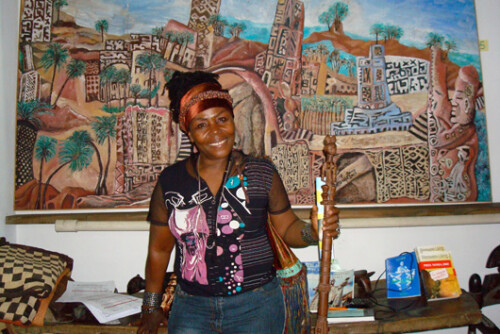
Myrtle Witbooi
Founding President of the International Domestic Workers Federation
Mother of the South African Domestic Workers Union
Global Human Rights Figure
1947-2023
“If anyone says that cannot do it, just look at me. Under the apartheid years, we had to put a piece of tape over our mouths.”1
“If anyone would have told me, forty-five years ago today, that I would be here, I would not have believed them. But I will continue fighting for domestic workers rights every day of my life, as I remember those early days that led me to this particular struggle which has now made its place in world history.”2
The revolutionary leaders of the domestic workers movement embody what this issue’s editors term the “understory of care.” Within the severe systemic barriers of apartheid South Africa, Myrtle Witbooi began organizing domestic workers in employers’ garages, risking her own life to build a movement of forty-five thousand women. She endured multiple arrests and a bomb attack under the heightened violence of a police state in Cape Town’s 1980s height of political violence. As she resisted simultaneous injustices in her own experience of live-in domestic work, she built South Africa’s largest national union for care labor. Her voice became a direct tool of resistance to the particular power inequalities of a colonial apartheid labor system where domestic work and farm labor comprised the only legal avenues of employment for Black women. In 1971, The Clarion Newspaper called her “a maid with a mind of her own.”3 Myrtle’s leadership tied domestic worker rights to a global anti-apartheid movement. Like so many of her comrades, she placed the collective pursuit of justice above her personal and family life. Deeply attuned to the daily balance of vision and everyday acts of resistance, she recounted, “We wanted freedom, but it was not going to be given to us on a golden platter.”4
With South Africa’s 1994 democratic transition, Myrtle made sure that the celebrated human rights protections would extend to domestic workers. She held her former comrades sitting in the country’s new parliament to their struggle promises, reminding them, “you would not be here today without a domestic worker ironing your shirt.”5 For nearly thirty years to follow, Myrtle never let government leaders off the hook on the assurance of policies and enforcement protections for domestic workers. She led five major policy campaigns in South Africa, which grounded her culminating activism at the global level.
In 2010 Myrtle became the president of the International Domestic Workers Network, which played a major part in establishing the world’s first set of standardized protections through the International Labour Organization of the United Nations. Alongside the formal policy-making process, Myrtle led the first transnational movement of domestic workers in a series of aligned campaigns to advocate for fair working conditions, regular hours of labor, maternity benefits, and protections from human trafficking and child labor. After the 189th Convention of Decent Work for Domestic Workers victory in 2011, she advocated for the formation of the International Domestic Workers Federation, where she served as president of the first and only global union led by women, which now represents 670,000 members of the care labor force.
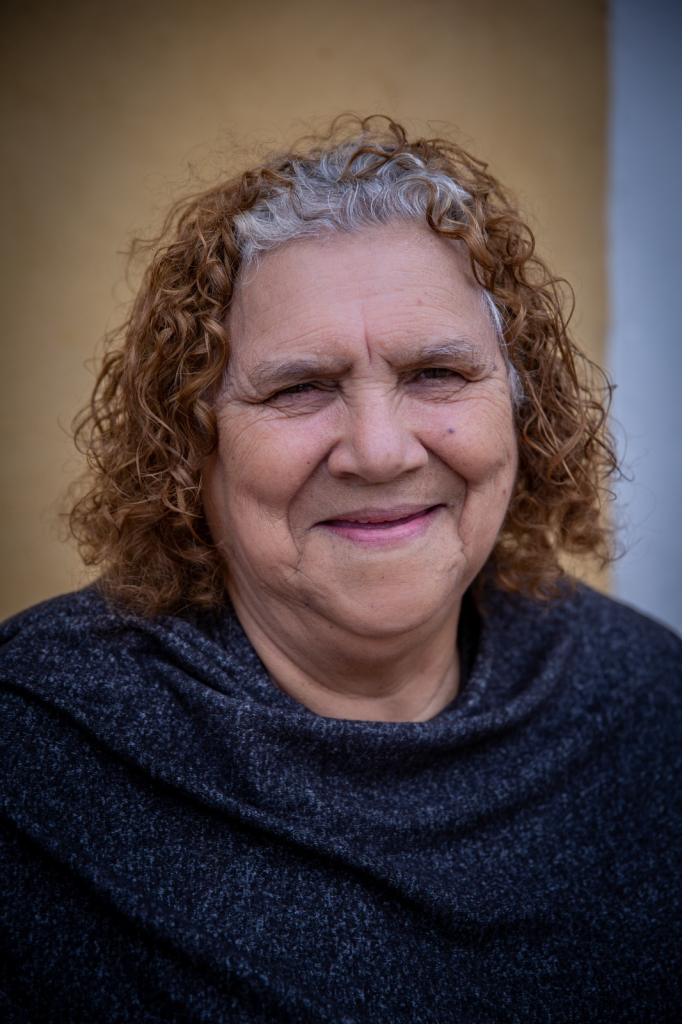
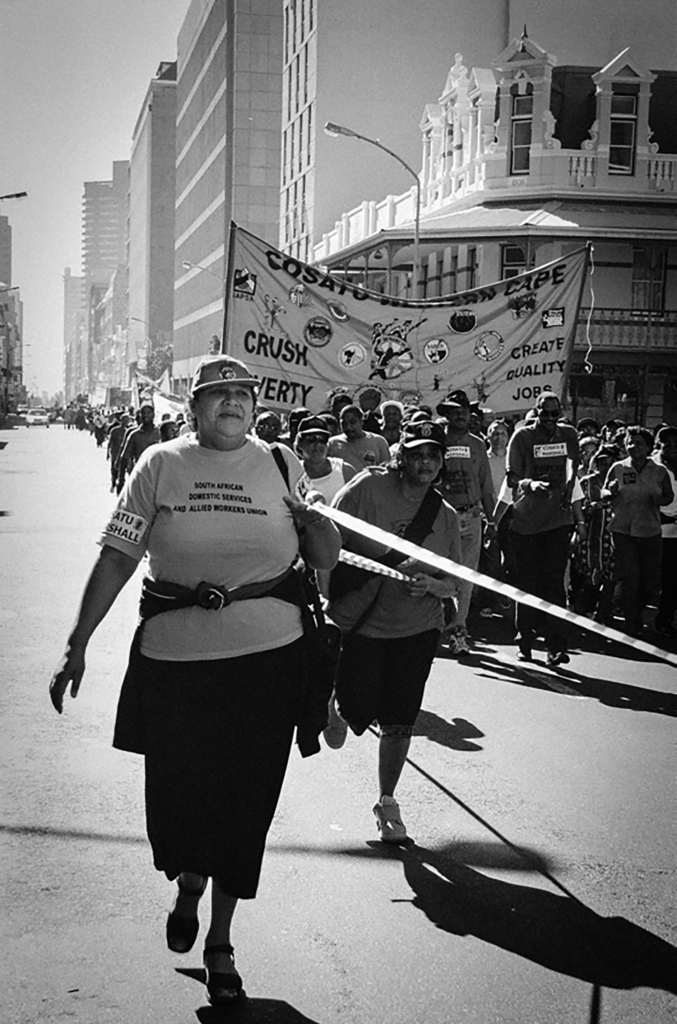
A domestic worker activist of fifty-two years who traveled to forty-eight countries to advocate for the rights of women “in the backyard,” the measure of Myrtle’s impact is recollected by movement leaders in the qualities that so tangibly reflected her life commitment to social justice. Her three children described a “certain softness” and diplomatic ease that persistently balanced their mother’s fierce grit and determination.6 In her direct engagement with thousands of domestic workers, she modeled a practice of speaking from a place of pride and equality, whether in the household, the streets, or the chambers of governance. She is widely remembered for the way she lifted domestic workers up individually as a means to embolden a resistance revolution. “When[ever] a domestic worker said, ‘But I am not educated,’ I said, ‘Don’t let education stop you for what you believe in.’”7 A steadfast model of humility, as she realized international recognition she so often countered by asserting, “I got my degree in the kitchen.”8
Myrtle considered the life stories of the domestic workers she met around the world to be her greatest source of inspiration, and she believed deeply in the need to document and archive as many stories as possible. As her international recognition grew, she would often respond with surprise coupled with a persistent reminder to focus on domestic workers over personal gain. In 2019 she decided to share her own journey as a biography “not for fame,” rather, as a way to inspire other workers and reinforce her life belief that “nothing is impossible.”9
In 2022 Myrtle received a devastating diagnosis of a rare and aggressive cancer which took her life just seven months later. She never paused her engagement with the movement, with domestic workers being the focus of her very last words. In the months preceding her death, she offered several hopes for the future of the care movement as a way to link the reach of her own life to an unwavering hope for a radical new day for domestic workers.
“I want you to remember me, unite, and organize. I want you to remember; if I can do it, you can do it, and together we can sing, Amandla!”
Endnotes
- Myrtle Witbooi, interview by author, March 15, 2021.[↑]
- Myrtle Witbooi, interview by author, May 1, 2022.[↑]
- “Maid Myrtle’s Dream,”Clarion Newspaper, June 26, 1971.[↑]
- Myrtle Witbooi, George Meany-Lane Kirland, Human Rights Award Reception Speech, September 8, 2013, unpublished.[↑]
- Myrtle Witbooi, speech to Department of Labour, South African Parliament, March 8, 2001.[↑]
- Jacqui Michels, interview by author, December 10, 2022.[↑]
- Myrtle Witbooi, interview by author, May 1, 2022.[↑]
- Myrtle Witbooi, interview by author, September 9, 2001.[↑]
- Myrtle Witbooi, interview by author, March 15, 2021.[↑]