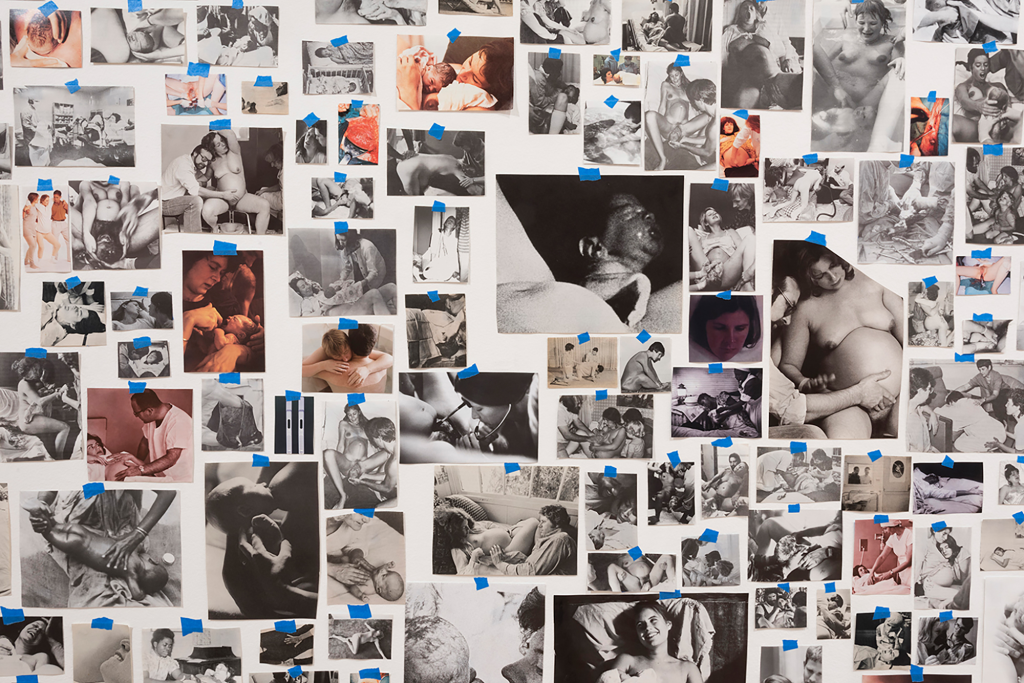
In late 2019 I received an invitation from two Mexico City-based curators, Alejandra Labastida and Helena Chávez Mac Gregor, to participate in their forthcoming exhibition about reproductive labor at el Museo Universitario Arte Contemporáneo (MUAC). They wanted to include an existing work, My Birth (2018) — a wall-size installation that holds over three thousand found photographs of women and birthing people in the process of labor and childbirth. I had created the work for an exhibit the year before, in 2018, at The Museum of Modern Art (MoMA). Since that time, the piece had attracted a lot of notice. The rolling invitations that followed came as a shock to me: I was surprised that a work so physically funky and physiologically exposing would launch my career as an artist. Helena, Ale, and I — all mothers of small children — spoke about the public response to that artwork, how I found my source material, and my interest in feminist healthcare networks alternating between English and Spanish (their English was far better than my Spanish). “What interesting choices,” they said. “You must be interested in reproducción social.”
This text seeks to pick up from that conversation, taking its cues from these two young, feminist curators and their process-based lines of inquiry. In the spirit of decentering myself as an expert and highlighting material experimentation as a form of knowledge-making, this piece offers up description of studio experimentation rather than intellectual argument. I hope to demonstrate through this writing how I wrestle my politics into artwork, or at least work to draw them closer together. I also hope to account for how relationship-building serves as both an engine and reward of that same making.
As it would turn out, My Birth was not available to be shared. MoMA acquired the work after it was shown in 2018 and was reticent to lend it.1 Found photographs are very materially unstable; the more those pictures are handled, the quicker they break down, turn to dust. Part of me felt some relief at this outcome. While I was grateful for the opportunities coming my way after showing My Birth, it was clear that most requests were prompts to make a version of that same artwork. Despite my eagerness to receive exhibition invitations, that idea felt pricky to me; I did not want to be pigeonholed as an artist who only has one move. But more importantly, and as I told anyone who would listen: My Birth was always intended to be read as a work that was larger than its subject. Yes, it centered childbirth as a phenomenologically dynamic experience, concurrently ecstatic and agonizing, verging on the metaphysical. But also, I hoped that My Birth — images from which I collected from across feminist books and pamphlets designed to disseminate information to women and birthing people about their bodies and reproductive options — was a project in and about feminist coalition-building. More than biological families, I am interested in how we build kin.
With My Birth no longer on the table, I seized on the opportunity to create a new work for the exhibition in Mexico City that made that collective political project more explicit. I pitched a then-underbaked idea to Helena and Ale in a second Zoom meeting, about a month before the initial COVID-19 lockdown (an impending reality of which we were not yet aware). I wanted to work with Silvia Federici’s archive, to bring her material history in contact with my body. In doing so, I hoped to revisit the radical proposals of Wages for Housework in 2020, to make sense of the space between our lives and the demands of our relative feminist movements in relation to care work. But I didn’t know Silvia. I didn’t know how to gain access to her self-assembled photographs and documents; I didn’t even know what I would do with them. “¿Será suficiente?,” asked Ale. Is that enough? I wasn’t sure, but I remained hopeful. Through organizing, I knew something about the strength of weak ties.
A week later I was on the phone with Silvia, my voice trembling with nervousness. She was kind and listened closely, and eventually put me in contact with Arlen Austin, her assistant and collaborator. Arlen related that Silvia’s papers — encompassing material from 1922–2019 — were in the process of being transferred to the Pembroke Archives at Brown University but were not yet processed and would not become publicly accessible for a few years.2 It was at once a stroke of luck (such papers did exist, Silvia has been assiduous in her saving) and bad timing, as it seemed I would be unable to access them. Then something amazing happened, without which there would have been no project: Arlen offered to share thousands of scans of Silvia’s Wages for Housework papers that he’d made over the course of several years. This part of the story is not an aside but a centerpiece: in demonstrating non-territoriality over the material that he had worked so hard to procure and reproduce, I consider Arlen’s act to be profoundly feminist and methodologically aligned with Wages for Housework’s own ethos.
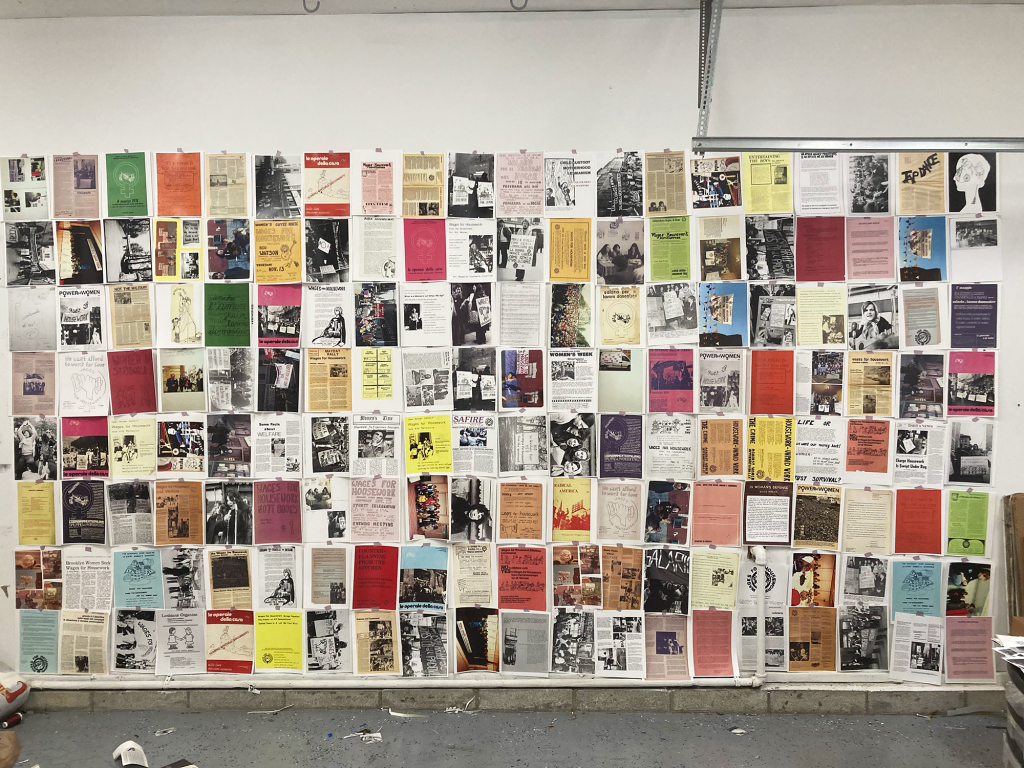
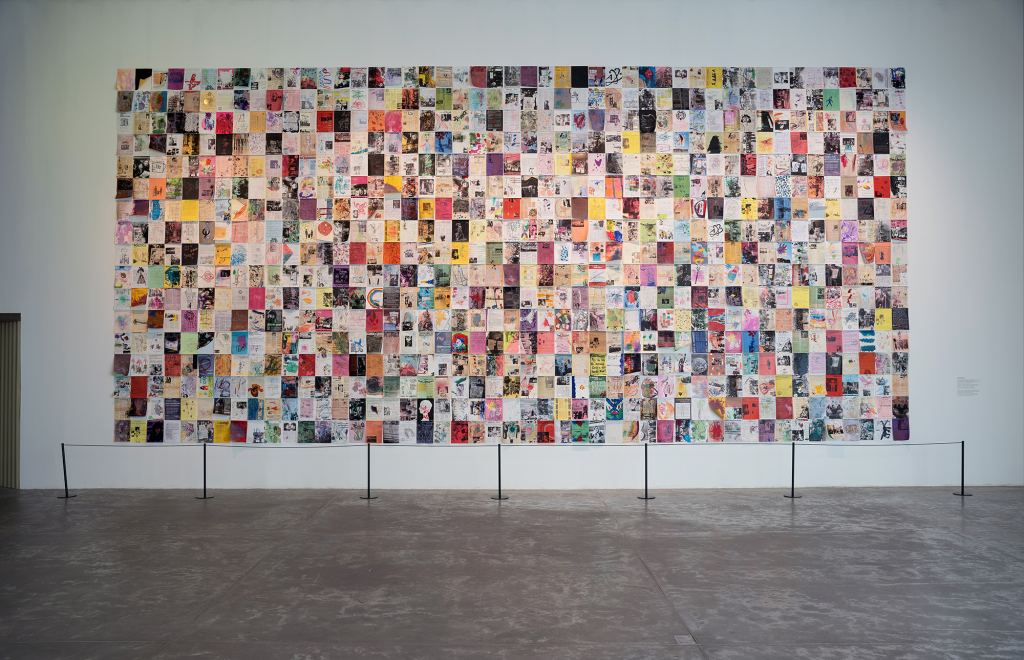
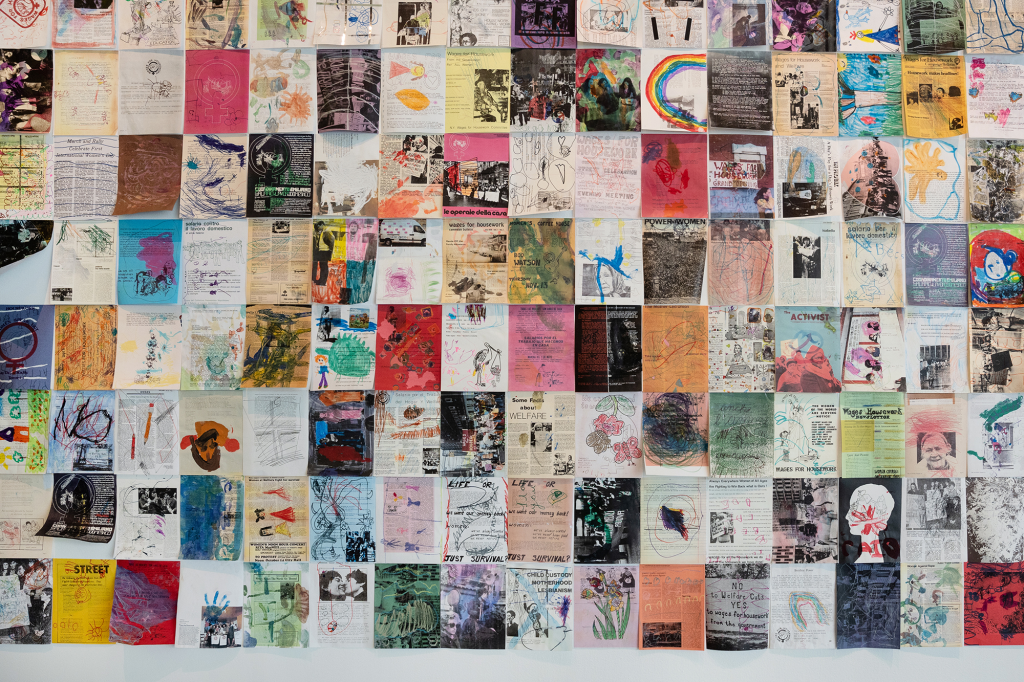
When the files came in a few days later, I could see that they were organized according to place — Mexico, the United States, Italy, Canada — and then further subdivided according to event. There were meeting notes, letters, drawings, recruitment fliers, and informational pamphlets and bulletins. And there were so many photographs: of Wages for Housework actions, seminars, meetings, parties, and protests. I’m not sure of the exact amount, but I’d estimate that Arlen sent well over two thousand files. I printed them out at FedEx in colored ink on printer paper, putting the cost on my credit card. Then I taped up as many as I could fit on my longest studio wall — about fifteen feet across and nine feet tall — and as high up as I could reach while standing on a rickety stepstool. I was attempting to visualize a strategy and solution. What should I do here, with the wealth of material? I hadn’t a clue.
The pandemic was now upon us; my children’s preschool was locked down (they were then two and three years old) and, like everyone else, my partner and I were caring for them around the clock. I stared at my teetering stacks, waiting for the print-outs to announce their intention. Surely one morning I would wake up and know how to handle them, receive some intuitive signal? But I was really tired all the time from changing diapers, making meals, doing laundry, and general COVID stress; ideas were coming slower than ever. The appropriateness — or was it irony? — of living with the Wages for Housework archive as I drowned under my unsupported attempts to be at once a parent and a professionalized worker was not lost on me. But that recognition alone was not enough to feel inspired or clever. As a dear friend of mine says, being a mother gets in the way of making work about being a mother.
I revisited texts by Silvia, alongside essays by Nancy Fraser, Hortense Spillers, Tithi Bhattacharya, Lise Vogel, Dorothy Roberts and other Marxist feminists, feeling around for a hook. I positioned Kathi Weeks’ book The Problem with Work on my bedside table and made nightly passes through the text, making notes on my phone about her arguments for basic income and her widening of the term “social reproduction” to all affective labor that supports wage work. I borrowed back my water-stained copy of Feminism for the 99% (which I once left out in the pouring rain and subsequently dried, with great care, over a radiator), flipping to the lines I’ve already underlined, my notes in the margin. I read sporadically for months, trying to wake myself up to the urgency — and the imagination — inside of the books that brought me to this point, that line my sagging shelves.
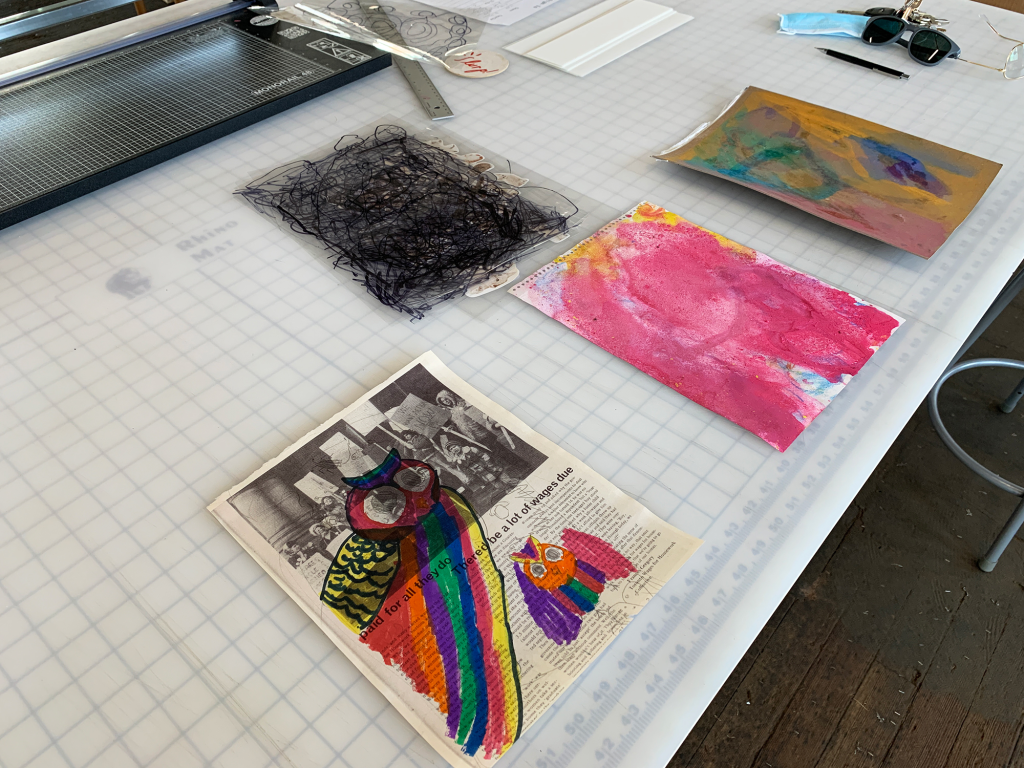
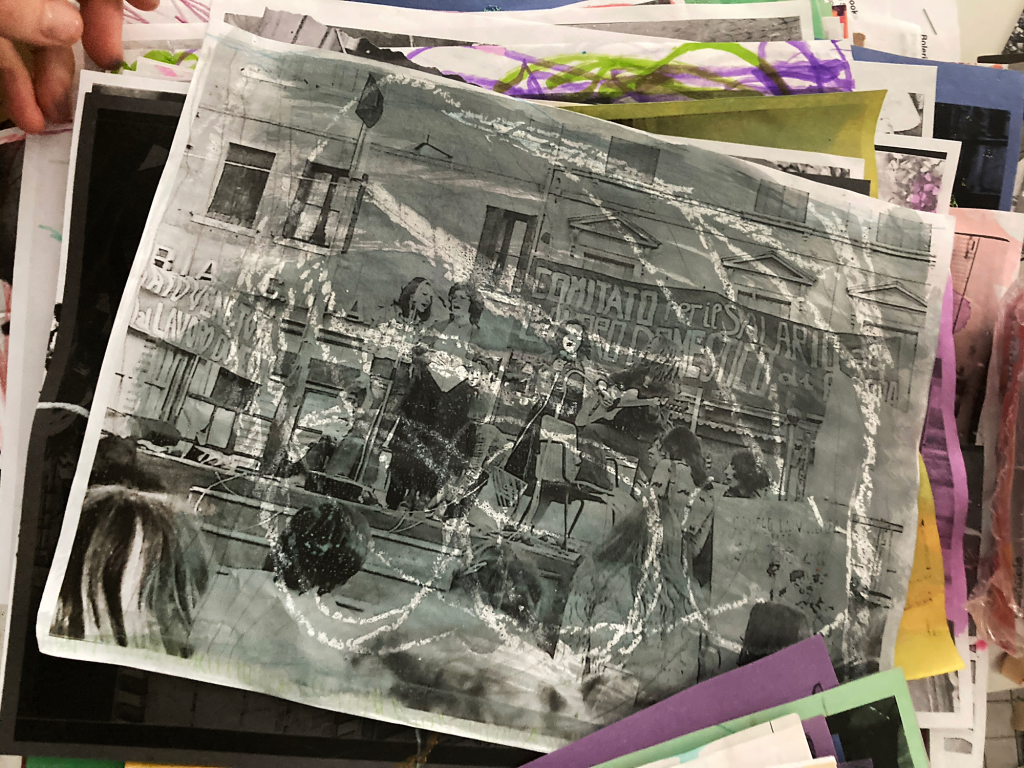
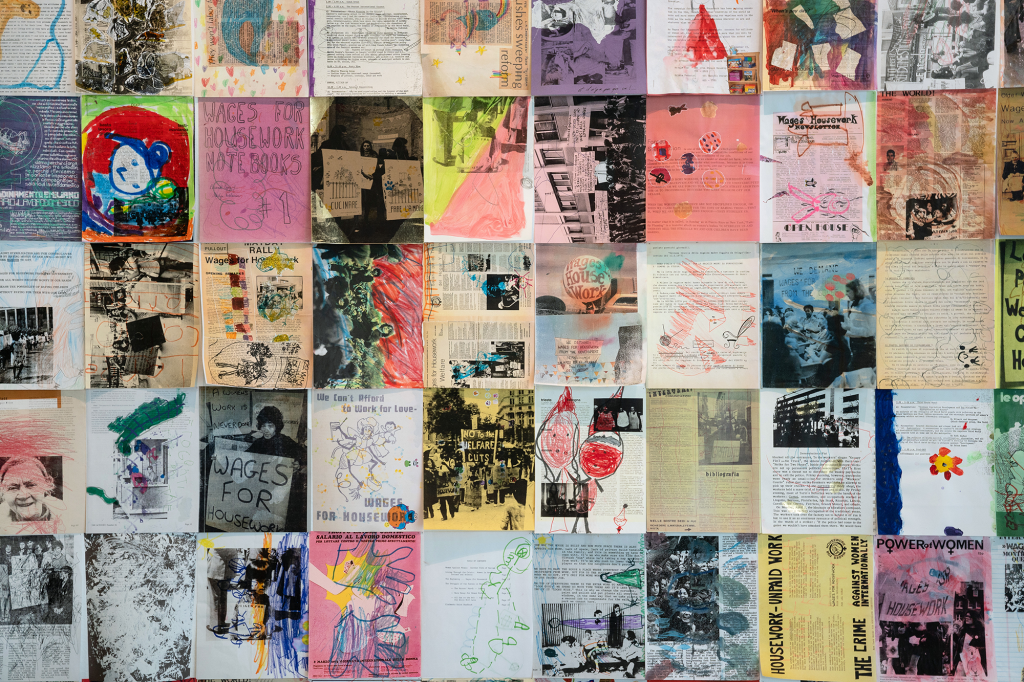
Void of an idea, I moved the stack of Silvia’s printouts from room to room in my house in Columbus, Ohio. My studio is in the attached two-car garage and, much to my partner’s chagrin, material often drifts fluidly between spaces. And then a gift struck like lightning from an unlikely source: as I briefly made a phone call in the other room, my older child took a marker to a handful of printouts. Atop images of women holding signs that read “NO TO WELFARE CUTS, WE DEMAND WAGES FOR HOUSEWORK FROM THE GOVERNMENT, A WOMAN’S WORK IS NEVER DONE, EVERY MOTHER IS A WORKING MOTHER, THEY SAY IT IS LOVE, WE SAY IT IS UNWAGED WORK” — something happened, something like praxis. I tried to nudge my son to do more. “Keep going,” I prompted, “Keep doing that!” But he refused, too freaked out that I was urging him to draw on my artwork after so much general instruction to do the opposite. So instead I began to reverse engineer the accident by collecting their art — our principal activity at home over the course of the pandemic spring and summer — and printing Silvia’s papers atop the sheets.
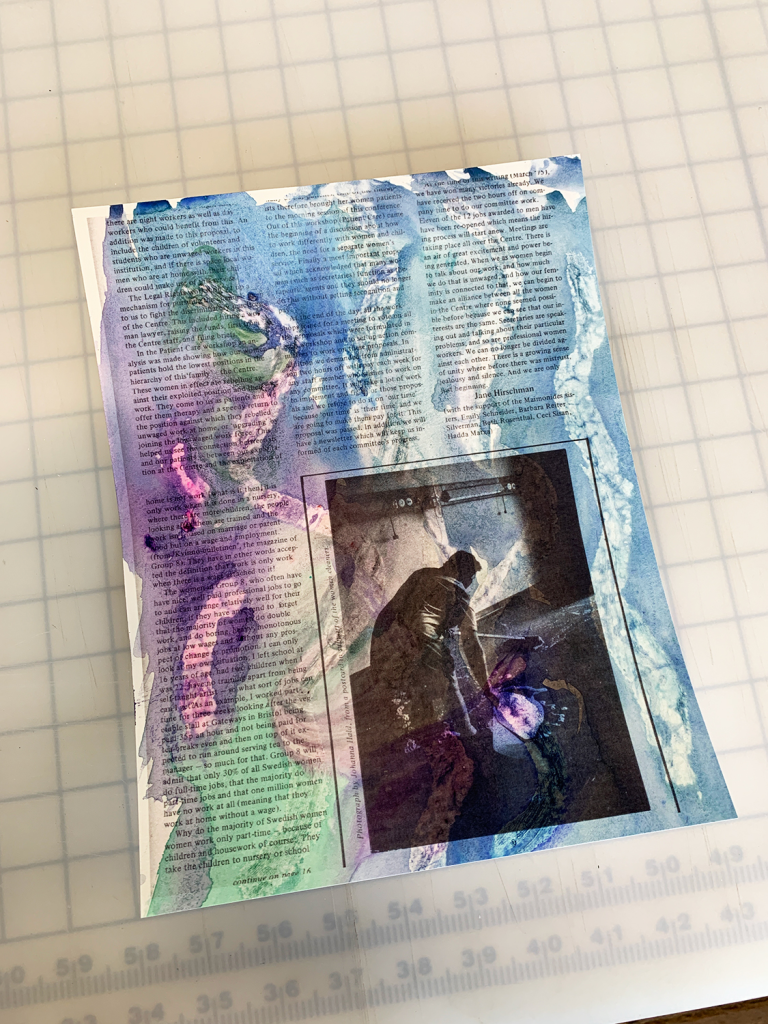
We progressed this way, fast and steady, for over a year. My kids finger painted with acrylics and watercolors, used glitter glue, stickers, and temporary tattoos. They drew with crayons, colored pencils, markers of every sort. We pulled material from my studio to experiment with: tape, powdered graphite, gauche, gold leaf; applying material to the various papers and flat surfaces we had on hand: copy, vellum, graf, tracing. One particularly inventive piece included their cut fingernails and toenails glued to the surface of a legal pad, another smeared toothpaste on construction paper. Unlike all the other care work that my partner and I were engaged in (going on scooter rides, reading books out loud, brushing teeth and bathing bodies, etc.), here was an activity that left a residue. Here was something that art was capable of. Here was that most elusive thing: a physical manifestation of care — a recursive act that, when done well, otherwise renders itself invisible.
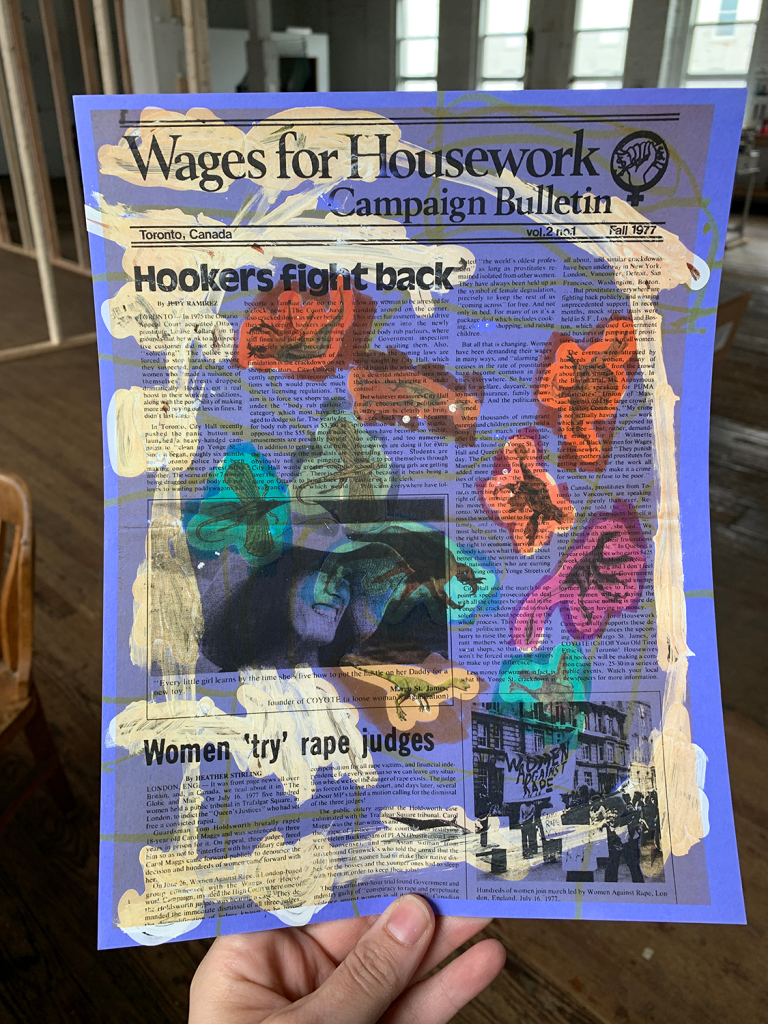
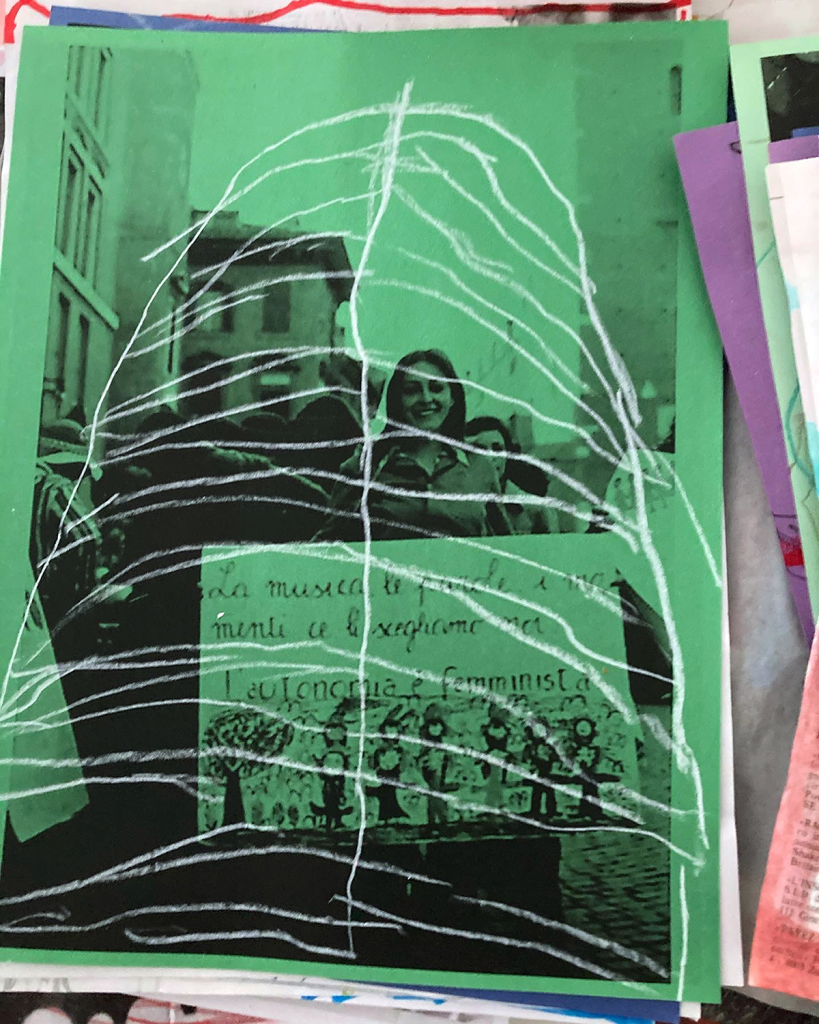
About once a month I would gather their artwork and bring them to my friend Elisa Smith, another artist and mother of small children, who co-operates a community print space here in Columbus called The Center for Print and Collaborative Arts. There she ran each one through the printer, dragging Silvia’s pictures across the existing surfaces. The result is less one kind of image atop the other and more of a material and conceptual co-mingling: the powdered charcoal, heated up by the printer’s fuser, bleeds into the image of women walking the streets below it; white chalk on green paper has the effect of skeleton ribcage atop an image of a woman at an Italian protest; a metallic pen atop dinosaur stickers obfuscates a manifesto by creating a mirrored surface; a circular whiteout drawing creates a delicate, decorated frame for a picture of Margo St. James and a campaign bulletin that reads: “Hookers fight back.” They were materially dialogical and alchemic, each revealing some new secret by virtue of their unlikely combinations.
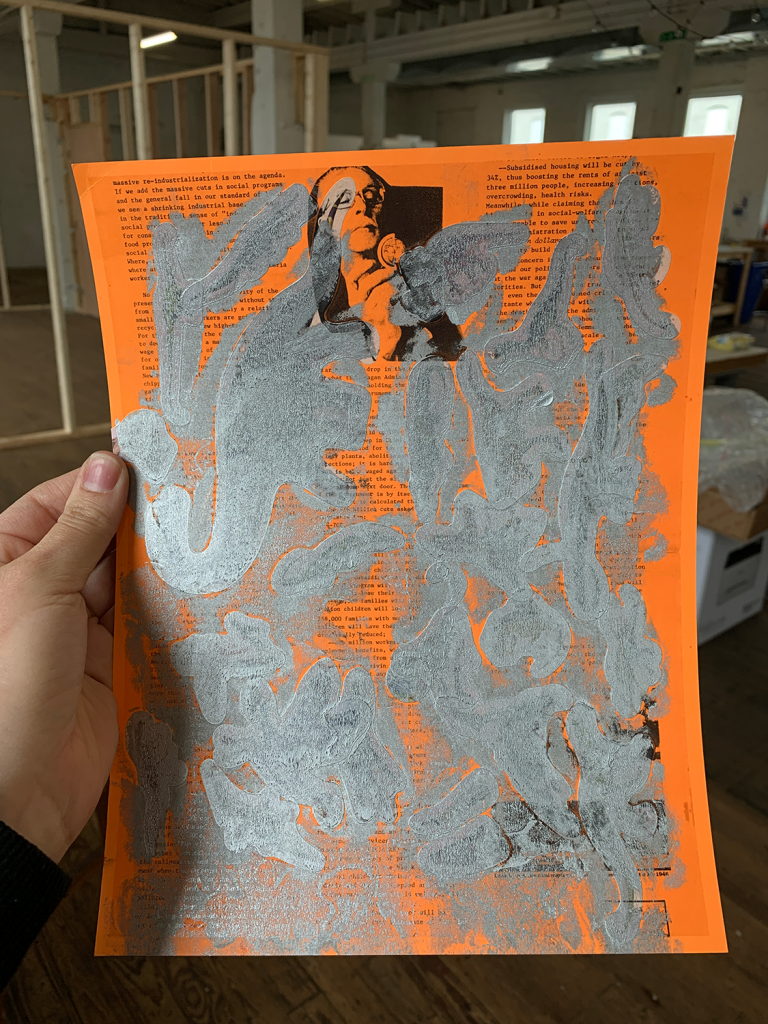
As the project neared its end, it became clear that I would be about a hundred sheets short of filling the museum wall. I put out a call to friends and friends of friends: did their children have artwork they might share? Perhaps they’d also taught their kids how to do crayon resist painting, or make Rorschach-style ink blots? Had they also sat on the floor, glueing glitter and plastic gems to scrap paper while composing work emails via voice transcription as I did? Did they still have this artwork — produced during what sociologist Arlie Russell Hochschild would describe as the perpetual “second shift,” the unpaid domestic labor that occurred concurrent with our paying jobs?3 The email I drafted included information about the project, the International Wages for Housework campaign, and Silvia’s yet-unseen archive. I ended the note with an offering of solidarity; artwork or not, we were all exhausted, unremunerated caregivers during a pandemic, and it felt meaningful to share in that fact.
At first nothing happened. And then, about two weeks later, kid’s artwork started arriving in the mail. Tubes and envelopes with scraps of kid art came from Minnesota, California, New York, and Western Europe. There was no expectation of repayment; these were gifts from loved ones and, in a few cases, unknown friends of friends. While the artwork of these other kids makes up a small portion of the overall installation, this final, generous act bears mention. That gesture of demonstrative collectivity underscored the work’s charge: to center mutual aid as a force of anti-capitalist feminism. A creative act, indeed. (From Feminism for the 99%: “Solidarity will be our weapon”).4 Among my favorites from that set were a series of watercolor resist crayon drawings — a process I learned and loved as a child — on top of which I printed my final few images from Italy and the United States. More and more, and in ways I hadn’t anticipated, the work was writing itself as a story of radical care. In the spirit or reposition and refusal, I gave it the title Why Are These Our Only Alternatives, and What Kind of Struggle Will Move Us Beyond Them?, the final line of Silvia’s 1974 essay “Wages Against Housework.”5
As I told Helena and Ale in our first meeting — now six years and an eternity ago — I am an artist and a feminist who is often skeptical about the efficacy of my medium to perform my politics. I’ve come to believe that artwork (which is too often confined to rarified spaces or owned and proffered by the uberwealthy) must be paired with groundwork. But life can be overwhelming and local organizing takes real energy; I don’t always achieve that goal. As a result, there are days I feel frivolous in my choice of profession. But Why Are These Our Only Alternatives… ? stands apart for me, or at least offers me a way forward. Perhaps because it draws on the wild, unbridled creativity of children (blended, as it is, with the envisioning done by feminist radicals) this work has continued to bolster my sense of what art can do — the meaningful role that it can play the larger project of world-building. Making this work reminded me that artists and activists share an essential ability and charge: to materialize that which does not yet exist and act on their transformative imaginations.
Endnotes
- I went to visit My Birth after the MoMA acquired it. Unlike the rest of the museum’s storage, which is housed in a warehouse in Queens, the photography holdings are on site, in the Museum in midtown. To get to the color print storage, one must first put on a down jacket, warm hat, and scarf. I was led through the “refrigerator,” a large room which held black and white prints, and into the “freezer,” a room beyond which holds color prints (these need to be stored at lower temperatures). I don’t know what the degree was, but it felt like deep winter, and my teeth were chattering. There the curator and registrar showed me how they were keeping the thousands of small, found images, which I had excised with scissors just months before in my studio: each was held in place with archival pieces of tape on archival sheets of vellum in archival photographic boxes. As I touched them with cotton-white-gloved hands – a requirement for handling prints in the museum as not to leave oily fingerprints – I thought of how I walked on them on the studio floor, how I witnessed my small child licking them from the corner of my eye.[↑]
- Silvia Federici papers, 1922–2019 (bulk 1970–2019), Feminist Theory Archive, Brown University Library Collections Annex, Providence, RI, https://library.brown.edu/collatoz/info.php?id=554. Silvia Federici’s collection at Brown consists of personal and professional papers from 1922-2019. The documents are wide-ranging, spanning her academic career, personal life, and feminist activism. In addition to her co-founding of Wages for Housework and organizing with the International Wages for Housework campaign, her research focused on questions of colonialism, capital punishment, immigration and emigration, globalization and global market inequality, food politics, elder care and capitalism, and academic freedom in Africa; these engagements are also reflected in the archive.[↑]
- Arlie Russell Hochschild and Anne Machung, The Second Shift: Working Families and the Revolution at Home. (Penguin, 1989; repr., 2012), 45.[↑]
- Cinzia Arruzza, Tithi Bhattacharya, and Nancy Fraser, Feminism for the 99%: A Manifesto (London: Verso, 2019), 7.[↑]
- Federici, Silvia, “Wages Against Housework,” in All Work and No Pay. Women, Housework, and the Wages Due, ed. Wendy Edmond and Suzie Fleming (Power of Women Collective and the Falling Wall Press: 1975).[↑]