Listening is shaped by regimes of audibility: the political, legal, technological, and cultural arrangements that govern who and what can be heard, and what forms of sonic expression and experience become intelligible within a given social order. States shape these conditions through censorship, surveillance, and the regulation of media and communications infrastructures. Courts determine which sounds, voices, and forms of testimony count as evidence and which remain legally inaudible;1 they likewise decide which forms of sonic violence are recognized as harmful and which remain unadjudicated.2 Colonial and imperial projects impose sensory orders that authorize some forms of listening and sounding while rendering others illegible, illegal, or suspect.3 Policing, militarization, racial capitalism, patriarchy, and heteronormativity further shape the conditions under which subjects and histories become audible. Listening, in other words, is profoundly political. It is not only shaped by political power; it is also a key tool through which power is accrued, maintained, and exercised.
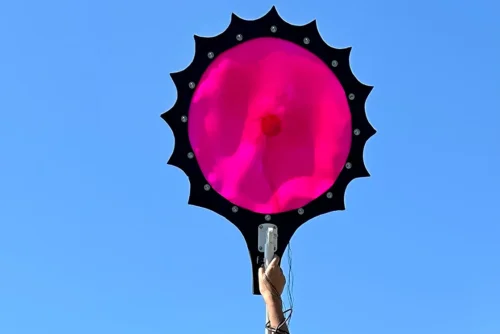
The cover of this special issue offers one compelling illustration of these dynamics. It depicts the Chilean artist Nicole L’Huillier holding La Orejona (XS), a bright pink, rubbery microphone that seeks to “[weave] independent signals into a collective and inseparable noise, a thick mass of convoluted muddy sound.”4 L’Huillier cultivates a “poetics of unintelligibility,” one that “fuzzes” signals together rather than separating them; her device attunes not to individual voices but to entangled vibrational worlds. Its conspicuous form stands in marked contrast to the invisibility of the surveillant microphone, openly announcing itself in public space. In this sense, La Orejona (XS) troubles the operations through which listening technologies render sounds and subjects identifiable, separable, and available to knowledge, gesturing towards forms of listening that are relational and reparative. As such it offers a striking image of the proposition that animates this collection: listening is always organized through particular socio-technical and political logics, yet it can also intervene in and reconfigure those very logics, opening possibilities for resistant forms of listening.
This special issue tackles the role of sound and listening in mediating contemporary and enduring forms of violence and resistance, with particular attention to feminist, queer, antiracist, and anticapitalist struggles and critiques. Across diverse geopolitical contexts and disciplinary formations, contributors explore how regimes of audibility are produced, contested, and transformed. The works assembled here offer what we think of as counterlistenings: practices of listening that contest dominant regimes of audibility and the structures of power that sustain them. Building on Gascia Ouzounian’s earlier formulation of “counterlistening,” the plural term emphasizes the heterogeneous, situated, and often divergent forms such practices take across different political and cultural contexts.5 It allows us to bring into relation varied approaches to listening against repressive regimes, unequal social relations, and systems of power without collapsing their differences. How do collectives, activists, artists, researchers, and others enact counterlistening in their work? What can counterlistening reveal about power relations, political projects, and interwoven histories that remain otherwise obscured? Together, the contributions offer a collectively produced, shareable critical-aesthetic and sensory toolkit for analyzing sonic strategies of resistance and repair.
This move is also an invitation to move past “silencing” and “voicing” as a diagnostic framing for epistemic and sensory violences, and as a strategy to redress these. The contributions in this issue challenge the dichotomy and a pre-existing value system in which, roughly, silencing can be equated with oppression and voicing with liberation. We do not, however, discount the evocative power of these formulations, which have often been at the center of practices of countering hegemonic formations in feminist and decolonial critique. These continue to have an allegorical power and are present here — for example, Falak’s contribution engages the “silencing” frame in a recognizable way — even as we simultaneously shift the focus toward the mechanics and politics of listening. We see the horrors and pitfalls of “voicing” through the “fetal heartbeat fiction” (Lentjes), and in spatial-sonic traps that allow speech only in order to deactivate it (Zuazu and Cohen); we see sonic chaos and agglutination as disciplining forces (Ouzounian), and the generative power of activating and creating sites for listening-as-agency and intervention (e.g., Lie, L’Huillier, KMRU), which, we hope, this issue as a whole can embody. Our claim that the silencing-voicing formula is insufficient is, then, to be taken literally: it means that, in order to be efficacious, it must interrogate and intervene in existing regimes of listening because, otherwise, it is not enough.
In advancing this intervention, this issue builds on and is in dialogue with emergent critiques that have expanded, and in many cases fundamentally reconfigured traditional conceptions of listening by challenging the historically assumed able-bodied hearing subject as well as a universal subject, typically imagined as a white cis-male listener, even if this is not always explicitly stated.6 These interventions have rethought listening through Indigenous and settler colonial “critical listening positionalities”; as an “ethics of the encounter”; as a tactical and political act; as speculative; as impeded by weaponized “technologies of not listening”; as a critical spatial practice; or as a queer minoritarian praxis of “listening incommensurably.”7 More recently scholars have developed d/Deaf historiographies of sound as well as critiques of audism.8
The essays, artworks, and creative interventions in this issue are organized into three thematic movements: “Counterlistening Against Empire,” “Counterlistening Against Institutional Violence,” and “Fugitive Auditions.” These groupings are offered as one possible way of reading the issue but not as fixed or mutually exclusive categories. Many of the works relate to each other across multiple sections; they are brought together here because reading them alongside one another highlights thematic affinities among projects, across different expressive formats and modes of practice, without foreclosing other pathways.
Counterlistenings do not constitute a singular method or political position; they designate a plurality of practices that interrogate the political organization of listening itself. Such practices ask how listening becomes implicated in structures of colonial domination, occupation, racialization, gendered governance, and capitalist extraction, while also enacting ways of listening that expose and reconfigure these formations. Counterlistenings thus operate both as critique and proposition: they reveal the mechanisms through which particular sounds, voices, and forms of experience are recognized and made consequential while opening alternative possibilities for relation and solidarity.
Against Empire
Questions of territory, sovereignty, and dispossession are core to the first movement, “Counterlistening Against Empire.” These contributions investigate the relationship between listening and violence in conditions of war, genocide, and military occupation. Rather than understanding violence solely as spectacular events or moments of rupture — or locating sonic violence merely in its effects on the ear — these works attend to its atmospheric, infrastructural, and enduring dimensions.
Rayya Badran reflects on listening under bombardment in Beirut, describing the collapse of distinctions between commercial flights, war planes, vibrational incursions, and the “incessant rumble of generators.” Slipping between past and present frames, Badran engages what she describes as an “erratic listening,” one that “refuses stillness and the cochlear study of violence.” In dialogue with Badran’s work, Gascia Ouzounian suggests that Beirut is a city governed through a “reign of noise,” where sonic residues produce an atmospheric occupation that accumulates over time. Drawing on the work of Badran, artist and “private ear” Lawrence Abu Hamdan and the sonic investigation agency Earshot, sonic/spatial researcher Mhamad Safa, and others, she argues that listening can register forms of atmospheric violence that exceed the evental logics through which war is often understood. Rather than appearing only in moments of explosion or attack, violence “becomes atmospheric”:9 dispersed through infrastructures, saturating everyday environments, and sustained through the diffuse temporalities of ambient warfare.
Uzma Falak’s essay on state-imposed communications blackouts in occupied Kashmir examines the circulation of nationalist music celebrating the revocation of the region’s autonomy. Against the tendency to characterize war as noisy and peace as silent, Falak argues that silence, far from being an index of peace or stability, is foundational to the material and discursive consolidation of occupation.10 The carceral logics of India’s occupation, she suggests, produce forms of “obedient listening,” coerce subjects into silence, and make dissent inaudible. Falak unmasks the gendered and racialized settler logics of this silence, showing how Hindutva pop fills the regional blackout with a “phallic nationalism” that celebrates the revocation as an entitlement to both Kashmiri land and women’s bodies.
Against Institutional Violence
The second movement, “Counterlistening Against Institutional Violence,” tackles the centrality of listening and sonic regulation within institutional formations that ration life and death, political participation and belonging, focusing on the United States. Moving between intimate lived realities and more formal encounters with spectacular and everyday state violences, these contributions trace how policing, law, and reproductive governance organize racialized and gendered regimes of audibility all the while attending to, or directly enacting, counterlistening practices within and against these arrangements.
Shana Redmond’s contribution offers a powerful account of listening as witnessing. Reflecting on the practice of remaining on the phone with loved ones during police stops in the United States, Redmond describes forms of “audio witnessing” — “a listening to and with those imperiled” by structures of white supremacy and anti-Blackness. Rather than listening to analyze violence after the fact, Redmond reorients forensic listening toward life itself: listening for signs of life, attending to vulnerability, and sustaining the possibility of survival. As she writes, “The audio witness leans into the scene in order to labor at the frequency of need, to hear what the vulnerable say between and beyond text, and to interpret at the level of Black being.” Audio witnessing thus exemplifies counterlistening as a practice that redirects listening away from surveillance and evidence-gathering toward collective survival and mutual responsibility.
María Zuazu and Elena Cohen’s contribution draws on their sound studies–civil rights law collaboration in Edrei v. City of New York, the case contesting the NYPD’s use of the Long Range Acoustic Device (LRAD) during Black Lives Matter demonstrations and the first case on the LRAD to be fully litigated in the US court system. This led to a settlement requiring the city to disable the LRAD’s deterrent tone and revise its protocols. And yet, they argue, the fundamental questions raised by the policing of sound and protest space remain unsolved. They trace the racialized foundations of both the technology and the legal frameworks governing its use, exposing the entanglement of corporate, policing, and judicial interests. They show how authorities’ professed care for citizens’ ears makes it impossible to listen to speech that is conspicuously not being silenced. Elsewhere in the issue recordings, phone calls, and sonic residues emerge as forms of testimony that exceed conventional evidentiary frameworks, revealing both the possibilities and limits of juridical listening.
Rebecca Lentjes interrogates the “fetal heartbeat fiction” and the weaponization of ultrasound technology in so-called “heartbeat bills.” Lentjes maps out how this fiction authorizes, and is in turn validated through, the legislative landscape leading to and following Dobbs in the United States, where these “heartbeats” become a primary mechanism for six-week abortion bans and the criminalization of pregnant bodies. Through sonification, electrical activity is “conflated with an actual human heartbeat;” this “concoction” of sonic vitalism produces “a sense of fetal personhood” at the expense of pregnant people. As Lentjes puts it: “the fetal heartbeat allows abortion opponents to listen more closely to the potential product of pregnancy than to pregnant people themselves” while subjecting individuals to “nonconsensual listening under the label of “Women’s Right to Know” and “Informed Consent” legislation and regulations.” What is being heard, Lentjes proposes, is the ultrasound machine itself as it is weaponized to serve the US white Christian nationalist project.
Olani Ewunnet contributes fragments of a “queered traveler’s diary” from her Land Vocalization series. These drawings and poems are “pulses transmitted from land to paper,” recorded while in motion in Brooklyn’s Eastern Parkway. In We, rainbow serpent, slither beyond the quiet zone and Bass memory 0902, Ewunnet practices a counterlistening where “bone conducts what the ear misses,” reclaiming a “sound (we)” that slithers past the police-imposed “quiet zone” as her hands “scribe the encounter” with the “bass memory” and ancestral pulses of the West Indian Day Parade.
Fugitive Auditions
The final movement, “Fugitive Auditions,” centers on practices of repair and historical recovery. Contributors here mobilize reparative listening and creative resistance through performance, counterarchives, and sonic practices that work against the grain of inherited technologies and histories of extraction and erasure.
In Temporary Stored sound artist KMRU engages historical recordings from Africa that have been digitized and made newly accessible while remaining under the ownership of European institutions, interrogating the afterlives of colonial recording practices and the legacies of the “ethnographic ear.”11 By juxtaposing contemporary Maasai commentary and archival recordings of the Aka people in Cameroon, the work draws attention to how recording technologies severed sounds from the social worlds that produced them, transforming living sonic practices into objects of collection, classification, and study. Counterlistening here becomes a form of listening back to the colonial archive, unsettling the histories of extraction, ownership, and epistemic authority upon which it rests.
Siv Lie “listens to, and with” Marie “Tchaya” Hubert, a French Manouche survivor of the Romani genocide. Bringing together an interview with and a multilayered musical recording made by Tchaya, Lie engages and amplifies her storytelling, through “conversation, writing, and singing,” as a form of repair. Against the myth of Manouche silence, which French dominant culture has manufactured not to take responsibility for a history it does not want to hear, Tchaya “channels an array of voices” to “transform our understanding of” and exercise her own Romani agency. The musical recording — an “intermundane” collaboration in which Tchaya sings in Romani over a digitized 1933 German vinyl recording — is one such exercise of agency and memory work.12 Lie describes this, building on Martin Daughtry, as an “acoustic palimpsest” whose accumulated mediations extend from the original record to its reproduction within this issue.13
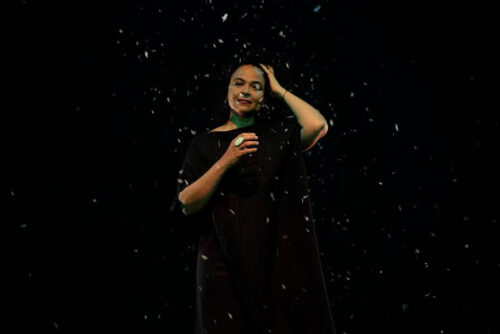
Across the issue, counterlistenings challenge dominant forms of knowledge production. Contributors draw upon decolonial, feminist, queer, antiracist, and anti-imperialist traditions that interrogate the sensory orders imposed by colonial and patriarchal power while opening space for alternative epistemologies. The closing contribution, L’Huillier’s discussion of La Membrana and her proposal for a “Surlogical” approach to sounding and listening, brings this dimension into focus.
Looking retrospectively and prospectively, these contributions make clear three things that, in closing, we would like to highlight. First, counterlistening is not solo work. It is no accident that this work cannot be confined to a single discipline or a solitary modality of action; it is a practice driven, above all, by a deep commitment to the issues at stake. Whether through archival intervention, legal advocacy, audio witnessing, artistic practice, or scholarship, the contributions collected here enact and point toward forms of collective labor.
Second, repressive regimes of audibility are never total; even the most oppressive situations, histories, and assemblages remain contested. Throughout this issue, contributors identify the cracks and openings in regimes of power where agency persists. We see this in Ouzounian’s engagement with the artists, researchers, and residents who contest and track Beirut’s sonic “urban airs”; in Tchaya’s storytelling; in Redmond’s listening and witnessing; in the inefficiencies and weaknesses of the sonic weapons that Zuazu and Cohen reveal; in Ewunnet’s land listening; and beyond. These interventions point to modes and tools of resistance that are empowering and humbling — modes that can be shared, learned from, and further developed.
Finally, these contributions are anchored in a profound attachment to, and love for, places and communities. Although contributors work from and about different parts of the world, often addressing structures that exceed any single location, their work remains grounded and attentive to the specificities of place. It is our hope that this issue offers resources for thinking and practicing counterlistenings in the many contexts where listening remains entangled with power. We are deeply grateful to all the contributors, whose generosity, intellectual rigor, and creativity have made this collective project possible, as well as to the S&F Online team for their thoughtful editorial guidance and support throughout.
Acknowledgements
We especially thank Sandra Moyano Ariza for her encouragement to propose this issue and for all her support and work in making it happen. It has been a pleasure to have the opportunity to collaborate with her on this project. This article has received funding from the European Research Council (ERC) under the European Union’s Horizon 2020 research and innovation program as part of the project Sonorous Cities: Towards a Sonic Urbanism (Grant Agreement No. 865032).
Endnotes
- See Lawrence Abu Hamdan, “The Freedom of Speech Itself: A Contemporary Chronology of Forensic Listening,” Cabinet, no. 43 (Fall 2011), https://www.cabinetmagazine.org/issues/43/abuhamdan.php; James E. K. Parker, “Sonic Lawfare: On the Jurisprudence of Weaponised Sound,” Sound Studies 5, no. 1 (2019); Nomi Dave, “Audio-Visibility in a Guinean Trial: Sexual Justice and the Procès du 28 Septembre,” PoLAR: Political and Legal Anthropology Review 48, no. 2 (2025).[↑]
- María Edurne Zuazu, “Acoustic Hailing Devices: Securitisation and Sound Technologies,” Sound Studies 10, no. 1 (2024). See also Lawrence Abu Hamdan and Earshot, Air Pressure, 2022, https://www.airpressure.info/.[↑]
- Peter A. McMurray and Priyasha Mukhopadhyay, eds., Acoustics of Empire: Sound, Media, and Power in the Long Nineteenth Century (Oxford University Press, 2024).[↑]
- Nicole L’Huillier, “La Orejona (XS),” https://nicolelhuillier.com/portfolio/la-orejona-xs/.[↑]
- Gascia Ouzounian, “Counterlistening,” ESC: English Studies in Canada 46, no. 2–4 (2020).[↑]
- Marie Thompson, “Whiteness and the Ontological Turn in Sound Studies,” Parallax 23, no. 3 (2017).[↑]
- Dylan Robinson, Hungry Listening: Resonant Theory for Indigenous Sound Studies (University of Minnesota Press, 2020); Salomé Voegelin, Listening to Noise and Silence: Towards a Philosophy of Sound Art (Continuum, 2010); Hardi Kurda and Gascia Ouzounian, “Urgent Listening: A Conversation with Hardi Kurda,” openwork 1, no. 1 (2023), https://journals.library.columbia.edu/index.php/openwork/article/view/8604. Shannon Mattern, “The Pulse of Global Passage: Listening to Logistics,” in Assembly Codes: The Logistics of Media, ed. Matthew Hockenberry, Nicole Starosielski, and Susan Zieger (Duke University Press, 2021), 205–24; María Edurne Zuazu, “Be Heard: Acoustic Hailers as Technologies of Not Listening,” Musicology Now, July 5, 2021, https://musicologynow.org/be-heard/; Julia Udall, Jonathan Orlek, and Alex De Little, Sonic Acts of Noticing: Future Architecture Rooms, audio, 2021, Sheffield Hallam University Research Archive (SHURA), https://shura.shu.ac.uk/31485/; Yun Emily Wang, “Listening Incommensurably: Or, the Impossibilities of Minoritarian ‘Sounding Out’,” Resonance 5, no. 4 (2024).[↑]
- Mara Mills, “Deafening: Noise and the Engineering of Communication in the Telephone System,” Grey Room 43 (2011); Michele Friedner and Stefan Helmreich, “Sound Studies Meets Deaf Studies,” The Senses and Society 7, no. 1 (2012); Viktoria Tkaczyk, Mara Mills, and Alexandra Hui, eds., Testing Hearing: The Making of Modern Aurality (Oxford University Press, 2021); Jonathan Sterne, Diminished Faculties: A Political Phenomenology of Impairment (Duke University Press, 2021).[↑]
- Marina Peterson, Atmospheric Noise: The Indefinite Urbanism of Los Angeles (Duke University Press, 2021), 83.[↑]
- Ana María Ochoa Gautier, “Silence,” in Keywords in Sound, ed. David Novak and Matt Sakakeeny (Duke University Press, 2015), 185–188.[↑]
- Ana María Ochoa, Aurality: Listening and Knowledge in Nineteenth-Century Colombia (Duke University Press, 2014). See also Robinson, Hungry Listening and Alejandro Madrid, The Archive and the Aural City: Sound, Knowledge, and the Politics of Listening (Duke University Press, 2025).[↑]
- Jason Stanyek and Benjamin Piekut, “Deadness: Technologies of the Intermundane,” TDR: The Drama Review 54, no. 1 [205] (2010).[↑]
- J. Martin Daughtry, “Acoustic Palimpsests,” in Theorizing Sound Writing, ed. Deborah Kapchan (Wesleyan University Press, 2017).[↑]