Introduction: “Best Sound I’ve Ever Heard”
In December 2017, a popular pregnancy vlogger documented her six-week ultrasound appointment with a video titled “Six Weeks Ultrasound- Baby Heartbeat.” The video was one installment among many that chronicled her pregnancy journey. During the ultrasound visit, the vlogger asks the doctor “How many beats per minute?,” to which he responds, “Oh, about 155 beats per minute.”1 While presumably well-intentioned, the doctor is maintaining an illusion — namely an embryo’s capacity for a “lifelike” human bodily function — that has been cultivated and circulated by the antiabortion movement.2 The doctor conceals a scientific and technological reality: the ultrasound machine is not transmitting the sounds of a fully-formed beating heart, but rather the earliest murmurs of electric cellular activity.
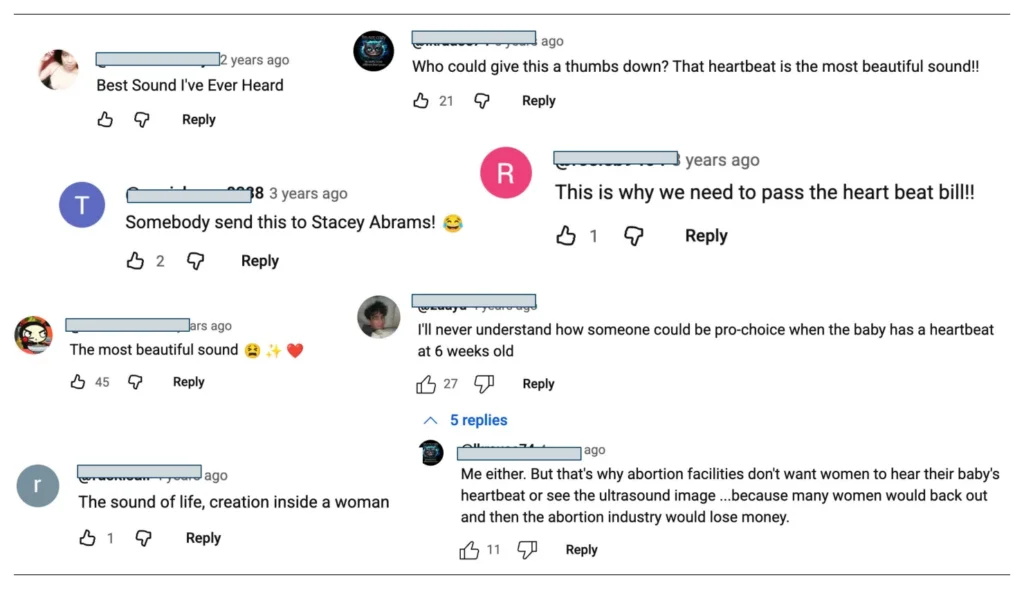
Still, much of the fascination with this particular video revolves around the manufactured heartbeat rather than the vlogger’s overarching pregnancy narrative. Comments include: “Who could give this video a thumbs down? That heartbeat is the most beautiful sound!!” and, more succinctly, “Best Sound I’ve Ever Heard.” These comments, among others reveling in the sound of the so-called heartbeat, appear alongside more politically charged comments such as “this is why we need to pass the heart beat bill!!” and “that’s why abortion facilities don’t want women to hear their baby’s heartbeat . . . because many women would back out and then the abortion industry would lose money.”3 Although seemingly innocuous, these comments indicate the ubiquity of the insidious multimodal antiabortion rhetoric that pervades everyday encounters with ultrasound technology.
Evidently these YouTube commenters are convinced that the sound of the embryonic “heartbeat” can alter the legal landscape of abortion access in the United States, and they are not wrong. Conservative politicians, backed by evangelical antiabortion lobbyists, have for years relied upon so-called “fetal heartbeats” as a mechanism through which to sonically notate fetal personhood, and these “heartbeats” are one of the primary strategies for propounding fetal personhood to a public they assume will be sympathetic to the implied animacy of an embryo that is roughly the size of a pomegranate seed.4 “Heartbeat” bills ban abortion roughly four weeks after fertilization, or six weeks since someone’s last menstrual period. At this point the pregnancy is considered an embryo; it is not considered a fetus until eight weeks after fertilization (ten weeks after the last menstrual period). Furthermore, the ultrasound machines are detecting electric cellular impulses, not heartbeats. Such is the significance of “heartbeat” bans that within the first three days of President Trump’s second term, Congress introduced a national heartbeat bill.5 Abortion has already been banned at the state level for millions of people across the United States due to the June 2022 Supreme Court decision Dobbs v. Jackson Women’s Health Organization, which overturned Roe v. Wade. As of this writing, one in four Americans lives in a state with a total abortion ban, and nearly one in ten lives in a state with a six-week “heartbeat” ban.6
How did acoustic technology such as ultrasound, and the interrelated notion of the embryonic “heartbeat,” help ensnare us in a landscape where so many Americans live in states with restrictive abortion bans? This article examines the ways in which prenatal technology, such as ultrasound, catalyzes a process I term “sonic vitalism,” wherein sound’s animating and individuating techniques are used to enliven embryos and fetuses at the same time that they diminish the autonomy of pregnant people.7 While I acknowledge the positive uses of this technology, this article focuses on the nefarious production and deployment of the embryonic “heartbeat” within antiabortion contexts in the medical sphere, sociocultural discourse, and the legislative realm. Antiabortion sonic vitalism enlivens not only the figure of the fetus, but also ultrasound technology itself, such that this technology becomes weaponized as an affective tool. The sonification of pregnancy legitimizes and amplifies a sense of fetal personhood, since mere electrical activity becomes aurally conflated with an actual human heartbeat. When we listen closely to the animating and vitalizing tactics of the antiabortion movement, we can hear how they assemble oppressive notions of the body and of personhood.
I argue that the antiabortion movement wields sonic vitalism in service of their large-scale political agenda of reproductive oppression. Antiabortion rhetoric and legislative initiatives vitalize the ultrasound wand such that it becomes not only a machine that transmits sound waves, but also a mechanism for acoustically aggrandizing embryos at the expense of pregnant people. This article first elaborates on the history of ultrasound technology and its uses within the field of maternal-fetal medicine. Then, following Michel Foucault, Mel Chen, Sara Ahmed, and Jennifer Denbow, I demonstrate how these biomedical uses of ultrasound are inherently linked to regulatory projects circumscribing pregnant people’s emotions and behavior, and I contextualize the concept of sonic vitalism within a broader intellectual tradition of biopolitical theory and affect theory. I then shift into a discussion of how abortion opponents have exploited sonic vitalism in their legislative endeavors. Antiabortion sonic vitalism engenders not only a discursive construction of the fetus-as-person, but also a lived reality in which pregnant people are literally denied healthcare because of sonic vitalism’s misogynist misconstrual. Accordingly, after these explorations of the medical, affective, and legislative trajectories of ultra/sound, I conclude with a summary of antiabortion sonic vitalism’s real-world ramifications and what can be done to ameliorate them.
Ultra/Sound: A Brief History
Over the past fifty years, technological and medical advances such as ultrasound have opened “the window to the womb,”8 an unveiling that has been key for abortion opponents as it facilitates the visualization of embryos and fetuses.9 But just as significantly, this technology can be used to sonify the earliest crackles and whooshes of cellular activity, ushering these frequencies into the realm of human perception and amplifying the biological process as the conceptus’s cells and organs begin to form. Although this amplification of intra-uterine biological movement is assumed to be scientifically objective (and therefore apolitical), the antiabortion movement has carefully and calculatedly instrumentalized these technological advances. In fact, tracing the phenomenon of fetal patienthood back to the 1970s, medical anthropologist Janelle Taylor writes that “medical uses of ultrasound simply cannot be separated definitively from the politics of abortion.”10
During the use of medical ultrasound technology, a tool called a transducer — also referred to as a probe or wand — projects sound waves with frequencies higher than the range of human hearing. These sound waves move through or deflect off of tissue (depending on its density), and then the returning echoes are recorded by an ultrasonic scanner.11 In other words, the ultrasound machine translates sound waves into a moving image of internal bodily entities. In the instance of a fetal cardiac activity test, the ultrasound machine is not transmitting the sounds of a fully-formed beating heart, but rather electric cellular impulses captured by the transducer. Dr. Nisha Verma of the American College of Obstetricians and Gynecologists explains, “When I use a stethoscope to listen to an [adult]’s heart, the sound that I’m hearing is caused by the opening and closing of the cardiac valves.” In contrast, the use of ultrasound technology during early pregnancy is very different. As Verma explicates, “The flickering that we’re seeing on the ultrasound that early in the development of the pregnancy [at six weeks] is actually electrical activity, and the sound that you ‘hear’ is actually manufactured by the ultrasound machine.”12 Moreover and even more crucially, the sense of “aliveness” produced by the ultrasound machine — its sonic vitalism — persists beyond the bounded time of the ultrasound appointment.
In the case of fetal ultrasound, the sound waves are perpetually (re)generated into what I think of as “ultra/sound,” wherein sonic excess manifests as affects that are marshaled into the political domain and frequently transmuted into shame and guilt. To that end, anthropologist Rebecca Howes-Mischel comments on how medical claims to fetal personhood are “enrolled within existing public health discourses that intertwine medical and moral imperatives for women to affectively relate to their fetuses through diagnostic technologies.”13 In the same spirit, scholars Erin Frost and Angela Haas articulate how, because of such public health discourses, medical technology such as ultrasound is often thought to be more trustworthy than a pregnant person’s own embodied experience. They elucidate how ultrasound technology serves a role beyond merely bouncing sound waves off of what’s inside a body and producing an image of it; it also mediates between the “technosphere” of expert technicians such as doctors and sonographers, and the “demosphere” of ordinary people.14 Ultrasound imparts not only an impression of visible and audible “aliveness” but also of objective biological truth or certainty: within the technosphere, the potential personhood of the embryo or fetus evolves into a scientific reality. Frost and Haas further argue that
the predominant myth enforced by reproductive surveillance is that ultrasound benefits the fetus, and thus the ‘good’ mother is expected to submit to this body-monitoring technology. The dominant rhetoric . . . suggests that a woman who refuses a fetal ultrasound screening is a bad mother for shirking her responsibility, regardless of evidence suggesting that fetal ultrasounds do little, if anything, to prevent harm to the mother and fetus.15
Additionally, as I will discuss later on, the institutionalization of ultrasound and other body-monitoring technology has had a disproportionate effect on marginalized people, especially women of color, as their pregnancies become scrutinized, surveilled, and policed.16
Despite these negative offshoots, prenatal sonography has become routinized over the past forty years. Ultrasound technology was not widely used until the 1970s, at which point the field of ultrasound experienced a “sonic boom.”17 Janelle Taylor explains how the normativization of ultrasound is historically and socially constructed, and an ultrasound appointment is comprised of an extensive cultural formation encompassing not only the pregnant person and their conceptus but the sonographer, the doctor, and prenatal technology that has been designed, assembled, operated, and interpreted within a ritualized “social practice.” Through the repetition (and conventionalization) of this scene, sonograms have become fully customary and even commodified in the form of purchasable keepsake photos.18 Strikingly, at the same time that the fetal sonogram commodifies the fetus into a “keepsake object,” it also fabricates a sense of individualism and (sonic) selfhood, paradoxically personifying the fetus. And even beyond the visual commodification that Taylor describes, ultrasound fueled a reformulation of the key medical milestone delineating fetal life: instead of “quickening” — the first fetal movement felt by the pregnant person — the milestone has been shifted several weeks earlier, to the first ultrasound screening. In contrast to quickening, ultra/sound externalizes a process that is undetectable to the pregnant person themself, but that the patriarchal medical institution has insisted upon as a technoscientific imperative.
Over time, the fetal ultrasound appointment has become regularized as a pivotal life event in a way that a kidney or intestinal ultrasound has not. And indeed the medical institutionalization of often unnecessary fetal testing has established the fetus as a second, separate patient, bolstering antiabortion claims of fetal personhood; as political scientist Jennifer Denbow explains, antiabortion political entities “have deployed ultrasound to help constitute the fetus as an individual person separate from the pregnant woman.”19 To that end, a 1983 letter in the New England Journal of Medicine was critical for the antiabortion movement. In the two-page memo (which was not peer-reviewed), physicians John Fletcher and Mark Evans encouraged further research on the possibilities afforded by ultrasound technology based on their hypothesis that ultrasounds “accelerated bonding” between parent and fetus.20 The two physicians’ evidence primarily consists of personal anecdotes regarding their own conversations with their pregnant patients about their ultrasound experiences. Fletcher and Evans conclude that “viewing the fetal form in the late first or early mid trimester of pregnancy, before movement is felt by the mother . . . may result in fewer abortions and more desired pregnancies.”21 Through this and similar seemingly neutral scientific literature, in combination with the routinization of ultrasound testing, we can observe the sedimentation of two harmful narratives: firstly, as stated, that the fetus is a second patient who is owed the attention of the doctor and the pregnant person (even if it is to the pregnant person’s own detriment). The second harmful narrative, inextricably linked to the first, is that women who do not forge proper bonds with their fetuses are bad mothers.
Since the fetus has become a separate medical patient, it naturally follows that concerns for this innately lovable, vulnerable entity would coalesce into a neoliberal cocktail of self-surveillance, self-responsibilization, and self-optimization. Sound studies scholar Marie Thompson writes about how these neoliberal narratives play out in the sonic and musical realm. Prenatal sound systems such as BabyPod and BabyPlus focus on optimizing the gestating fetus by cultivating a learning environment where the fetus can maximize its future potential. These technologies “imply an intense maternal obligation to invest in and impress upon the pre-born as future-child, while also envisioning the pregnant person’s body as an occupied, resonant space.”22 I have already mentioned the numerous fetal-heartbeat-centric videos that proliferate on YouTube — from vlogs documenting individual ultrasound visits, to instructional videos demonstrating how to use at-home fetal Doppler technology, to fetal heartbeat “white noise” sleep and study aids. In these instances, the fictional “fetal heartbeat” is crucial to the sonic vitalism these technologies generate; in Thompson’s examples specifically, sonic vitalism comes into play as these technologies transmute fetuses into fully autonomous people: proto-schoolchildren capable of learning through listening. Thompson acknowledges that these prenatal sound systems could very well be used in ways that counter their intended neoliberal purposes, but she stresses the importance of considering how the relationships between auditory culture, technology, and reproductive politics can be located within the broader patriarchal project of managing and controlling pregnant people.23
Affective Effects
Through these multisensory technological innovations, it is clear that the visual aspect of fetal representation that most scholars have focused on operates in tandem with the auditory, catalyzing the affective process of sonic vitalism. My conception of sonic vitalism builds on affect theory and feminist science studies within a longer lineage of biopolitical thought stemming from that of Michel Foucault. The feminist Foucauldian intellectual tradition concerns itself with the governance of life, death, and bodies, informed by Foucault’s analysis of biopolitics as a disciplinary and regulatory technology that categorizes, medicalizes, manages, and measures the life of populations in terms of statistics, ratios, birth rates, and so on.24 As I have indicated, prenatal technology is in fact intertwined with deep-rooted histories of medicalization, regulation, and management. The US biopolitical project fixates upon governance over populations through a denial of reproductive autonomy, whether through eugenics programs or abortion bans. This biopolitical project achieves its goals in part through its capacity to manage, medicalize, and quantify various aspects of human life. The antiabortion movement therefore sustains itself not only through rhetoric, popular culture, and claims to moral high ground, but also through (junk) science such as prenatal sonography and the theory of “ultrasound bonding.”25 Ultrasound technology translates acoustic resonance into the sort of quantitative value that bestows biopolitical personhood on the embryo.26 The embryo metamorphoses into a rights-bearing subject once its presence has been made legible within the language of biopolitics — numbers, rates, statistics — and its presence can be expressed as a ratio (e.g. “155 beats per minute”).
Mel Chen’s concept of animacy is helpful when dissecting antiabortion approaches to science and technology.27 Chen investigates the ways in which historical trajectories of governance have constructed hierarchies of animacy endowing nonhuman (and “nonliving”) entities with racialized and gendered qualities. These histories deem animacy a “slippery” value that complicates categorizations of living vs. dead. The sounds of fetal heartbeats are implicated in this hierarchy of animacy, since the technologization and romanticization of the fetal heartbeat allows abortion opponents to listen more closely to the potential product of pregnancy than to pregnant people themselves. In other words, antiabortion legislation hinges on the animating capacity of sound to enliven embryos and fetuses, with the goal of broadcasting embryonic and fetal cellular activity so loudly that it silences the pregnant person. Chen cites Foucault in their understanding of affect, which they state is “a study of the governmentality of animate hierarchies.”28 My own conceptualization of affect is inspired by Chen’s linguistic and biopolitical perspective, as well as by scholars such as Sara Ahmed; Ahmed writes about affect in terms not of private emotions, but rather of feelings and sensations that circulate in public and political life and that function in concrete ways, interweaving the individual and the collective. Ahmed theorizes that emotions do things — rather than residing within people — as they circulate between and among bodies in the form of “affective economies” that are “emotional and material as well as psychic.”29
Ahmed also writes of “happy objects” that uphold the white middle-class heteronormative family as an idealized exemplar of “happiness” and that marginalize and suppress those who do not conform to the constraints of this ideal.30 Jennifer Denbow, conceptualizing the fetal sonogram as a “happy object,” draws on Ahmed’s work to critique the widely accepted scientific and sociocultural belief that maternal-fetal attachment is not only an inherent social good, but also an ethical imperative.31 This ethical imperative for “mother love” is reinforced by technoscientific discourse that pathologizes sub-optimal attachment as a problem in need of being rectified in order to avoid medical consequences. Denbow describes scientific studies, carried out in the US throughout the 1980s and 1990s, that measured maternal-fetal bonds via self-assessment questionnaires. These studies were used to indicate a positive correlation between psychological preoccupation with fetal vulnerability — as well as self-surveillance during pregnancy — with a “healthy attachment” to the developing fetus.32 Denbow additionally references a 2005 article in which the authors “naturalize” a desire to “see and know” the fetus, while neglecting to mention that such “natural” phenomena might be socially and technologically constructed.33 Along these lines, Janelle Taylor observes that if maternal love were actually automatic and biologically preordained — as is claimed by theories of ultrasound bonding and maternal-fetal attachment — then ultrasound and other technological interventions would not be necessary.34
Denbow contends, as discussed above, that ultrasound technology “has played a key role in bringing about the separation of the fetus from woman.”35 It was only through the conceptual separation of the pregnant person from the fetus into two distinct patients that the requirement for proper emotional attachment could arise. Denbow also posits that the medical management of pregnancy, whether through state-mandated ultrasounds or through the more subtle “measurement of” maternal-fetal attachment, by necessity also functions as the medical management of life itself.36 These maternal attachment scales, as well as the ultrasound testing they typically accompany, serve to medically demarcate pregnant people with sufficiently “protective” attitudes towards their pregnancy from people who feel ambivalent, anxious, or not selfless enough in maintaining their body as a satisfactory environment for their developing pregnancy. (Reflecting on Thompson’s work, we hear how prenatal sound systems encourage pregnant people to transform their uteruses into classroom-like environments: for example, “BabyPlus children achieve earlier developmental milestones, improved school readiness, enhanced intellectual abilities and greater creativity”).37 Studies on maternal-fetal attachment, and the norms they have contributed to, induce feelings of shame and guilt in pregnant people who deviate from these attitudinal expectations.
Consequently scientific literature, ostensibly neutral and apolitical, is wielded as a tool for managing emotions themselves — and due to the affective entanglements I have described, management of emotions is also accompanied by management of bodies and behaviors. Taylor suggests that the theory of ultrasound bonding is so persuasive
not because it is grounded in sound science, but because it both emerges out of and contributes to a discourse that links visual images, via the maternal imagination, to the physical form and health of the fetus, in a manner that radically decontextualizes women’s emotions and authorizes efforts to control women’s behavior.38
These behavior-monitoring efforts began as far back as the “discovery” of fetal-alcohol syndrome in 1973, which shifted the public perception of maternal risk and responsibility and laid the foundation for increasing frenzy over what has become known as “maternal-fetal conflict.”39 Within this conflict, the pregnant person is imagined to be potentially dangerous — ironically ignoring the fact that childbirth is in fact far more dangerous for a pregnant person than abortion is. As an offshoot of the politicized maternal-fetal conflict, ultra/sound transfigures an acoustic, affectual, invisible entity into a medicalized representation of fetal personhood, and abortion opposition capitalizes on the affective potentialities that this representation affords.
Through the process of animacy as described by Chen, sonic vitalism animates the ultrasound wand, the sonogram image, and the murky, muffled sounds of electric cellular activity, charting the so-called “fetal heart rate” and kindling ultra/sound. This multimodal enactment of agency validates an imagined fetal personhood that relies on sonic vitalism as a temporal and affectual process that resonates with fraught histories of reproductive politics as well as potentialities for idealized bodies and citizens. Although an in-depth inquiry into the global implications of antiabortion sonic vitalism lies beyond the purview (and word count) of this article, it is important to consider how antiabortion hierarchies of animacy shape transnational hierarchies of personhood rooted in white nationalist US imperialism. Karen Barad argues that a sonogram does not map out only bodily terrain but also geopolitical, economic, and historical trajectories. They also point out that technoscientific developments have reduced pregnant people to an “environment” in relation to the “rights-bearing” embryo or fetus.40 Through the sonification and quantification of pregnancy, the antiabortion movement confers rights, subjecthood, and moral status onto the conceptus, thus enabling sonic vitalism to culminate in the composition and enforcement of literal laws.
Legislative Effects
The antiabortion fixation on fetal heartbeats is evident in the movement’s successful sociopolitical efforts over the past several years. Perhaps most notably, in September 2021, the state of Texas enacted S.B. 8, which declares that “A physician may not knowingly perform or induce an abortion on a pregnant woman if the physician detected a fetal heartbeat for the unborn child.”41 S.B. 8 was the most egregious of similar state-level legislative acts that had become more and more commonplace across the United States, and it laid the foundation for the Dobbs ruling nine months later. Because of the variability of fetal cardiac activity tests, and because of the purposefully vague and misleading way that this legislation is written, these laws essentially function as six-week gestational bans. These “heartbeat” bans, in addition to hundreds of state-level reproductive health bills, laws, and provisions, have gradually chipped away at reproductive healthcare access over the past several decades and have contributed to our current landscape of reproductive injustice. In the years since Dobbs, five states — Georgia, South Carolina, Florida, Iowa, and most recently Wyoming — have instituted six-week “heartbeat” bans on abortion, and over a dozen others have banned abortion entirely.42
Although it only started gaining traction in 2011, “heartbeat” legislation dates back to the 1980s, when antiabortion activist Janet Folger Porter conceived of the heartbeat ban as a stepping-stone towards constitutional recognition of fetal personhood.43 Porter devised the idea of criminalizing abortion at the point at which electric cellular activity could be detected, but policymakers deemed this unrealistic. Porter herself revitalized the idea in 2011, when she made her way to Ohio and collaborated with pro-life lawyers in drafting a new state-level “heartbeat” bill. The bill was thought of as so extreme that even Ohio Right to Life did not endorse it.44 During the bill’s legislative hearing at the state house, two pregnant women volunteered to “testify” by undergoing ultrasounds in front of the crowd. The images of their fetuses were projected onto a large screen and the faint sound of the “heartbeat” was amplified by the room’s sound system. One of these volunteers, who was nine weeks pregnant, was interviewed by a local newspaper, and she offered her rationale by explaining that “I just think every child has a right to life . . . They can’t speak for themselves, so somebody’s got to.”45 Despite Porter’s best efforts, the bill died in the Senate. However, her bill draft ultimately became the template for numerous later “heartbeat” bans, and by 2019, “copycat bills” had made their way into several states’ legislatures.46
The manipulative use of ultrasound technology advances the antiabortion playbook by using scientific apparatuses to redefine conceptions of life and personhood. According to an analysis of the South Carolina Fetal Heartbeat Protection from Abortion Act hearings in 2019, the antiabortion testimony misrepresented and even falsified science in order to undergird their moral claims. Antiabortion proponents employed the repetition of words like “heartbeat,” “baby,” and “unborn” alongside misinformation — such as the longstanding mythical correlation between abortion and increased suicide rates — under the guise of “scientific evidence” in order to distort definitions of life and personhood.47 During the hearings, a South Carolina representative stated, “we now know many more things about the unborn child that we did not know in the 1970s. So we’ve had so many advances in medical and scientific technology that have expanded our knowledge of prenatal life.”48 In this and similar scenarios, the far right avails itself of technoscientific rhetoric to justify policies that limit reproductive healthcare access. Through their careful exploitation of public perceptions of ultrasonography, the antiabortion movement successfully politicizes and weaponizes acoustic technology. And the “heartbeat” bans and other gestational bans are not the only policies falling under this umbrella.
The antiabortion movement has leveraged “routine” mandatory ultrasounds and mandatory counseling in order to subject pregnant people to nonconsensual listening under the label of “Women’s Right to Know” and “Informed Consent” legislation and regulations.49 Through the premise of “informed consent,” these legislative requirements mask themselves as informative while in fact being patriarchal and condescending, especially considering the fact that roughly 60 percent of people getting abortions already have children, so are familiar with the experience of pregnancy.50 Before and after Dobbs, pregnant people have been forced to undergo mandatory, medically unnecessary testing when seeking abortion care: twelve states require an ultrasound to be performed before an abortion; six of these states require the provider to display and describe the image. Likewise, fourteen states require a fetal cardiac activity test to be performed, and three of them require the provider to play sounds generated by the test.51 The prevalence of these policies is only one example of how the antiabortion movement engineers sound, (junk) science, medical patriarchy, and technology towards not only gestational bans but also towards their ultimate purpose of enshrining fetal personhood into national law. (Notably, Fletcher and Evans’s 1983 research note about anecdotal prenatal “bonding” was one of the only pieces of scientific literature that the Americans United for Life used in their model legislation advocating for mandatory pre-abortion ultrasounds).52
Kentucky is one of the three states that requires providers not only to perform a fetal cardiac activity test, but also to play the sounds it generates. This legislation went into effect in 2019, before abortion was fully banned in Kentucky after the Dobbs decision, and the law remains on the books should Dobbs ever be overturned. An abortion provider at the only clinic in the state of Kentucky shared her thoughts on the mandatory ultrasound bill with the ACLU:
H.B. 2 mandates that I display an ultrasound to every abortion patient, describe it in detail, and play the sound of the fetal heartbeat — even if the patient does not want it, even if in my medical judgment I believe that forcing it on them will cause them harm. The law forces me to do this to a patient who is half-naked on the exam table, usually with their feet in stirrups and an ultrasound probe inside their vagina. With my patient in this exposed and vulnerable position, the law forces me to keep displaying and describing the image, even when the patient shuts her eyes and covers her ears.53
Since 2019, antiabortion legislative endeavors have included S.B. 8 in Texas, the Dobbs decision, the newly proposed national fetal heartbeat ban, and Wyoming’s “Human Heartbeat Act” that was signed into law in March 2026, while I was in the process of revising this article.54
Yet another outcome of the fetal heartbeat fiction is its contribution to the ever-increasing criminalization of pregnant people — even those who are not seeking abortions. Scholars such as Michele Goodwin, Grace Howard, and Dorothy Roberts have written extensively about how separating fetus and mother as two distinct patients has made it easier to personify (and “protect”) fetuses while demonizing pregnant people.55 Throughout the 1980s, various medical studies and political campaigns declared that women were a threat to their pregnancies, whether by having inadequate emotions or attitudes, by not being self-sacrificing enough, or by consuming alcohol or drugs. Howard explains how the antiabortion concoction of fetal personhood has led to a legal landscape where “fetal rights” often supersede the rights of pregnant people, resulting in a phenomenon she calls “pregnancy exceptionalism, where pregnant people are defined as a separate and lesser legal class of person.”56 Illustrating the racist, classist, and sexist repercussions of the maternal-fetal conflict, Howard, Roberts, and Goodwin meticulously document hundreds of cases in which pregnant people have been arrested and incarcerated because of the widespread conservative logic that babies must be protected from their mothers. Pregnancy exceptionalism, the concoction of fetal personhood, and antiabortion policies have brought about catastrophic ramifications, not only in terms of abortion access but also in terms of prenatal healthcare more broadly, including incidences of tragic and avoidable deaths due to abortion bans.57
Conclusion: Counterlistening
What can we do when fetal subjecthood is constructed through affective economies and hierarchies of animacy that are integral to the far right’s project of bolstering a healthy white Christian national imaginary? We know that the heartbeat bans are only a stepping-stone in the direction of fetal personhood, which the far right defines as beginning at fertilization. Ultra/sound has served its purpose, and sonic vitalism’s next role in achieving fetal personhood seems to be “giving voice to the voiceless” in ways that vitalize embryos and fetuses even more vibrantly than the manufactured heartbeats do. Emblematic of this phenomenon are antiabortion protesters who besiege an abortion clinic in Atlanta, Georgia every week. Although a six-week “heartbeat” ban is in effect in Georgia, protesters play amplified recordings of babies crying as patients arrive for their appointments.58 The antiabortion movement harnesses sonic vitalism in many different domains, including the parking lots and exam rooms of abortion clinics, in order to lend credibility to the notion of fetal personhood.
Regarding the domain of the clinic exam room, Frost and Haas advocate for public and private critiques of fetal technologies, recommending that “the experiential knowledge of being pregnant . . . should be as privileged as — if not more so than — the knowledge acquired through ultrasound technology.”59 Outside the exam room, we can extend this feminist critique to our everyday interactions by, for instance, reporting antiabortion social media posts for medical misinformation; writing letters to the editor when we notice journalists using inaccurate terminology (such as “fetal heartbeat”); and educating our students about resources like Pregnancy Justice and the All Options talkline.60 And as students ourselves, we might adopt the sort of directed listening practices emphasized by Jonathan Sterne, who urged sound students not to isolate sound as an exceptionalized object of examination, but to consider when and where sounds are being heard, how the sounds are being made, and who is hearing them.61
In terms of our aural practices, feminist counterlistening practices would shape how, why, and to whom we listen. Antiabortion sonic vitalism elevates certain sounds over others, and doctors from the American College of Obstetricians and Gynecologists emphasize that during a fetal cardiac activity test the sound that we “hear” is not a heartbeat but rather electrical noise. How much of this sound is our collective imagination, informed by sonic vitalism, filling in the gaps? Feminist counterlistening resists antiabortion sonic vitalism by recognizing that noise, sound, and silence are never inherently “good” or “bad” but are contingent and relational.62 In the case of embryonic cellular activity, what to some individuals might sound like “the best sound I’ve ever heard” might strike others as upsetting, traumatic, or even violent, such as when abortion patients are forced to undergo mandatory ultrasounds. Confronting antiabortion sonic vitalism requires us to engage in feminist modes of counterlistening, and to acknowledge that nobody should be forced into a position of nonconsensual listening, especially not to the noisy, fabricated personhood engendered by sonic vitalism. Most significantly, nobody should be denied healthcare, autonomy, or personal liberty due to the antiabortion amplification of ultra/sound.
Endnotes
- Journey to Contentment, “Six Weeks Ultrasound- Baby Heartbeat,” December 22, 2017, YouTube, 3:19, https://www.youtube.com/watch?v=p0xuwMuba0c.[↑]
- The American College of Obstetricians and Gynecologists (ACOG), “ACOG Guide to Language and Abortion,” October 2024, https://www.acog.org/contact/media-center/abortion-language-guide. ACOG has stated that a true fetal heartbeat cannot be detected until sometime between seventeen and twenty weeks gestation, when the heart has fully developed, although this estimate varies from pregnancy to pregnancy, and ACOG states that their language guide is regularly reevaluated and updated.[↑]
- Journey to Contentment, “Six Weeks Ultrasound,” comments section. (I have redacted usernames.) [↑]
- Mary Ziegler, Personhood: The New Civil War Over Reproduction (Yale University Press, 2025). According to Ziegler, fetal personhood entails two core tenets: “first, that a fetus is a separate, unique human individual from the moment of fertilization, and second, that because of that biological and moral uniqueness, the Constitution gives (or at least should give) that individual rights” (Personhood, viii).[↑]
- US Congress, House, “H.R. 682 — 119th Congress (2025–2026): Heartbeat Protection Act of 2025,” January 23, 2025, https://www.congress.gov/bill/119th-congress/house-bill/682.[↑]
- Guttmacher Institute, “Interactive Map: US Abortion Policies and Access After Roe,” last modified March 27, 2026, https://states.guttmacher.org/policies/; Planned Parenthood, “Abortion Bans and State Population,” 2024, https://cdn.plannedparenthood.org/uploads/filer_public/cc/b6/ccb6d499-4a8f-4ccf-8b88-f84195b3bb58/june_2024_abortion_ban_population_analysis.pdf.[↑]
- Other than when quoting others, I generally use the term “pregnant people” (rather than “pregnant women”), since trans and gender-nonconforming people can and do get pregnant.[↑]
- Kristina Edvardsson et al., “Ultrasound’s ‘window on the womb’ brings ethical challenges for balancing maternal and fetal health interests: obstetricians’ experiences in Australia,” BMC Medical Ethics 16, no. 31 (2015).[↑]
- See, for instance, Rosalind Petchesky, “Fetal Images: The Power of Visual Culture in the Politics of Reproduction,” Feminist Studies 13, no. 2 (1987): 267; E. Ann Kaplan, “Look Who’s Talking, Indeed: Fetal Images in Recent North American Visual Culture,” in Mothering: Ideology, Experience, and Agency, ed. Evelyn Nakano Glenn, Grace Chang, and Linda Rennie Forcey (Routledge, 1994); Lynn M. Morgan and Meredith W. Michaels, eds, Fetal Subjects, Feminist Positions (University of Pennsylvania Press, 1999); and Janelle Taylor, The Public Life of the Fetal Sonogram: Technology, Consumption, and the Politics of Reproduction (Rutgers University Press, 2008).[↑]
- Taylor, The Public Life of the Fetal Sonogram, 167. The politics of abortion may have contributed to the obfuscation of clear definitions and descriptions of embryonic development that would help readers better understand these processes. This obfuscation (or under-examination) lends itself to the antiabortion movement’s authority over these definitions. For example, see Rachel Jenson et al., “Semantics Matter: Maternal–Fetal Medicine Physician Perspectives on Defining Abortion Care in the Post-Dobbs Southeast,” Journal of Women’s Health 34, no. 6 (2025).[↑]
- Rosemary Candelario, “Transvaginal Sound: Politics and Performance,” Scholar & Feminist Online 11, no. 3 (2013), https://sfonline.barnard.edu/transvaginal-sound-politics-and-performance/.[↑]
- Selena Simmons-Duffin and Carrie Feibel, “The Texas abortion ban hinges on ‘fetal heartbeat.’ Doctors call that misleading,” NPR (May 3, 2022), https://www.npr.org/sections/health-shots/2021/09/02/1033727679/fetal-heartbeat-isnt-a-medical-term-but-its-still-used-in-laws-on-abortion.[↑]
- Rebecca Howes-Mischel, “The ‘Sound’ of Life, or, how Should We Hear a Fetal ‘Voice’?,” in The Anthropology of the Fetus: Biology, Culture, and Society, ed. Sallie Han, Tracy K. Betsinger, and Amy B. Scott (Berghahn Books, 2017), 269.[↑]
- Erin A. Frost and Angela M. Haas, “Seeing and Knowing the Womb: A Technofeminist Reframing of Fetal Ultrasound toward a Decolonization of Our Bodies,” Computers and Composition 43 (2017), 88–105.[↑]
- Frost and Haas, “Seeing and Knowing the Womb,” 95.[↑]
- Dorothy Roberts, Killing the Black Body: Race, Reproduction, and the Meaning of Liberty (Pantheon Books, 1997).[↑]
- Taylor, The Public Life of the Fetal Sonogram, 30. Taylor also mentions that, between the years 1980 and 1987, the percentage of pregnancies that underwent ultrasound scanning increased from 35.5% to 78.8% (Public Life, 57).[↑]
- Taylor, Public Life, 29.[↑]
- Jennifer Denbow, “Good Mothering Before Birth: Measuring Attachment and Ultrasound as an Affective Technology,” Engaging Science, Technology, and Society 5 (2019), 2.[↑]
- John C. Fletcher and Mark I. Evans, “Maternal Bonding in Early Fetal Ultrasound Examinations,” The New England Journal of Medicine, February 17, 1983, 392.[↑]
- Fletcher and Evans, “Maternal Bonding,” 392.[↑]
- Marie Thompson, “‘Your Womb, the Perfect Classroom’: Prenatal Sound Systems and Uterine Audiophilia,” Feminist Review 127 (2021), 75.[↑]
- Thompson, “‘Your Womb, the Perfect Classroom.’”[↑]
- Michel Foucault, The History of Sexuality, Volume I, trans. Robert Hurley (Vintage, 1990); and The Birth of Biopolitics: Lectures at the Collège de France, 1978–1979, trans. Graham Burchell, eds. Michel Senellart, François Ewald, and Alessandro Fontana (Picador, 2010).[↑]
- Taylor, Public Life.[↑]
- For more on acoustics and biopolitics, see Robin James, The Sonic Episteme: Acoustic Resonance, Neoliberalism, and Biopolitics (Duke University Press, 2019).[↑]
- Mel Y. Chen, Animacies: Biopolitics, Racial Mattering, and Queer Affect (Duke University Press, 2012).[↑]
- Chen, Animacies, 12.[↑]
- Sara Ahmed, “Affective Economies,” Social Text 22, 2 (2004), 117–139.[↑]
- Sara Ahmed, The Promise of Happiness (Duke University Press, 2010).[↑]
- Denbow, “Good Mothering Before Birth.”[↑]
- Denbow, “Good Mothering Before Birth,” 6–7.[↑]
- Denbow, “Good Mothering Before Birth,” 12.[↑]
- Taylor, Public Life, 113.[↑]
- Denbow, “Good Mothering Before Birth,” 14.[↑]
- Denbow, “Good Mothering Before Birth,” 8.[↑]
- Thompson, “‘Your Womb, the Perfect Classroom,’” 74.[↑]
- Taylor, Public Life, 106.[↑]
- Taylor, Public Life, 14.[↑]
- Karen Barad, Meeting the Universe Halfway: Quantum Physics and the Entanglement of Matter and Meaning (Duke University Press, 2007), 194.[↑]
- Texas Legislature, “S.B. 8: Texas Heartbeat Act,” September 1, 2021, https://capitol.texas.gov/tlodocs/87R/billtext/pdf/SB00008F.pdf.[↑]
- Guttmacher, “Interactive Map.” Ohio also had a six-week abortion ban until that law was struck down in 2024.[↑]
- Ziegler, Personhood, 185.[↑]
- Dan Horn and Haley BeMiller, “‘They’re not gonna quit’: How Ohio anti-abortion activists shaped post-Roe America,” USA Today, October 26, 2022, https://www.usatoday.com/in-depth/news/investigations/2022/10/26/10-year-old-ohio-abortion-law-ban-roe-timeline/10530091002/.[↑]
- Julie Carr Smyth, “Anti-abortion groups adopt in-your-face tactics,” Statesboro Herald, March 3, 2011, https://www.statesboroherald.com/world/anti-abortion-groups-adopt-in-your-face-tactics/.[↑]
- Anne Ryman and Matt Wynn, “For anti-abortion activists, success of ‘heartbeat’ bills was 10 years in the making,” The Center for Public Integrity, June 20, 2019.[↑]
- Victoria C. Lambert, Emily E. Hackworth, and Deborah L. Billings, “Qualitative Analysis of Anti-Abortion Discourse Used in Arguments for a 6-Week Abortion Ban in South Carolina,” Frontiers in Global Women’s Health 4 (2023).[↑]
- Lambert et al., “Qualitative Analysis of Anti-Abortion Discourse.”[↑]
- Guttmacher Institute, “Counseling and Waiting Period Requirements for Abortion,” February 26, 2026, https://www.guttmacher.org/state-policy/explore/counseling-and-waiting-periods-abortion. For more on the concept of “nonconsensual listening,” see Lentjes et al., “‘The Ripping Apart of Silence’: Sonic Patriarchy and Anti-Abortion Harassment,” Resonance: The Journal of Sound and Culture 1, no. 4 (2020), 422–42.[↑]
- Guttmacher Institute, “Characteristics of U.S. Abortion Patients in 2014 and Changes Since 2008,” May 2016, https://www.guttmacher.org/report/characteristics-us-abortion-patients-2014. See also Margot Sanger-Katz, Claire Cain Miller, and Quoctrung Bui, “Who Gets Abortions in America?,” New York Times, December 14, 2021, https://www.nytimes.com/interactive/2021/12/14/upshot/who-gets-abortions-in-america.html, and Diana Greene Foster, The Turnaway Study: Ten Years, a Thousand Women, and the Consequences of Having—or Being Denied—an Abortion (Scribner, 2020).[↑]
- Guttmacher Institute, “Ultrasound and ‘Fetal Heartbeat’ Test Requirements for Abortion,” last modified February 6, 2026, https://www.guttmacher.org/state-policy/explore/ultrasound-requirements.[↑]
- Denbow, “Good Mothering Before Birth,” 9.[↑]
- Ashlee Bergin, “Kentucky’s Abortion Law Forces Me to Humiliate My Patients,” ACLU News & Commentary, September 26, 2019, https://www.aclu.org/news/reproductive-freedom/kentuckys-abortion-law-forces-me-humiliate-my-patients.[↑]
- Wyoming Legislature, “H.B. 0126: Human Heartbeat Act,” March 9, 2026, https://wyoleg.gov/Legislation/2026/HB0126.[↑]
- See, for instance, Michele Goodwin, Policing the Womb: Invisible Women and the Criminalization of Motherhood (Cambridge University Press, 2020); Grace Howard, The Pregnancy Police: Conceiving Crime, Arresting Personhood (University of California Press, 2024); and Roberts, Killing the Black Body.[↑]
- Howard, The Pregnancy Police, 54.[↑]
- See, for instance, Kavitha Surana, “Abortion Bans Have Delayed Emergency Medical Care. In Georgia, Experts Say This Mother’s Death Was Preventable,” ProPublica, September 16, 2024. In another tragic occurrence last year in Georgia, a woman named Adriana Smith, who was nine weeks pregnant, was declared brain dead after experiencing a medical emergency. Because Georgia has a six-week “heartbeat ban” in effect, and because cellular activity was detected on the ultrasound, Adriana was kept on life support despite being legally dead. Her family stated that they were given no choice in the matter; they started a GoFundMe to raise money to cover the medical expenses associated with keeping Adriana on life support. See, for instance, Jess Mador, “Does Georgia’s fetal ‘personhood’ law mean a pregnant woman must stay on life support?,” NPR, June 7, 2025.[↑]
- Lentjes, field notes, February 2026.[↑]
- Frost and Haas, “Seeing and Knowing the Womb,” 100.[↑]
- See pregnancyjusticeus.org and https://www.all-options.org/find-support/.[↑]
- Jonathan Sterne, The Sound Studies Reader (Routledge, 2012).[↑]
- Marie Thompson, Beyond Unwanted Sound: Noise, Affect and Aesthetic Moralism (Bloomsbury, 2017), 114.[↑]