“Song 1”
La Membrana, the Surlogical, and La Orejona – A Mixtape for a Noisy, Unstable, Resonant and Generative Vibrational Architecture
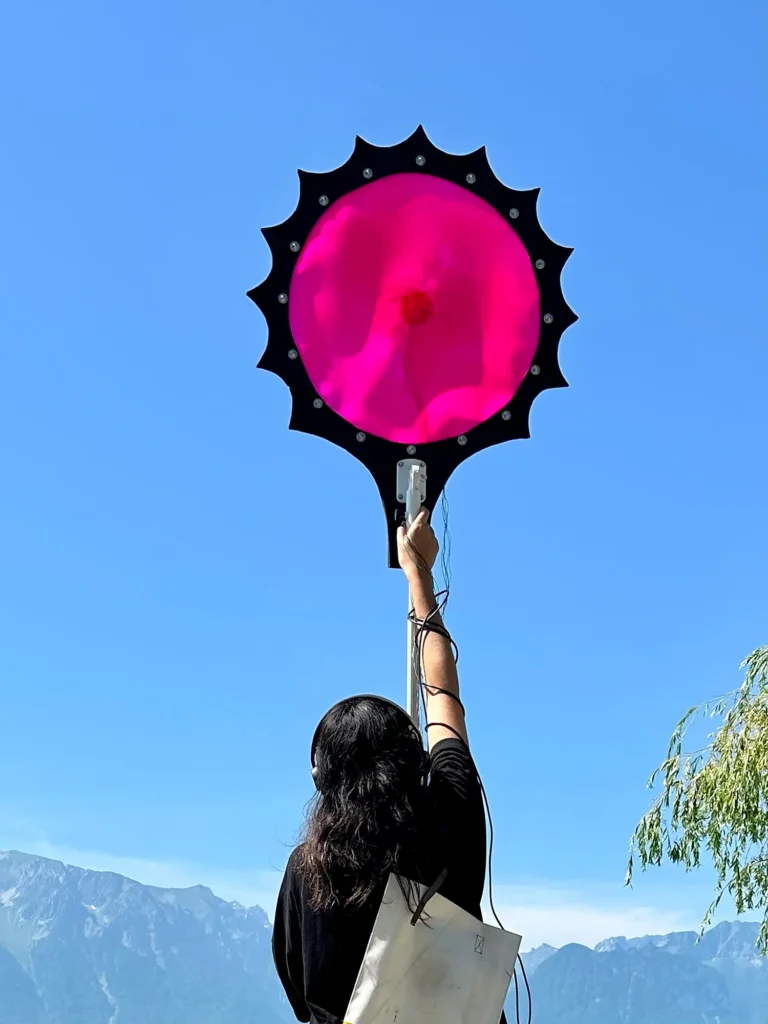
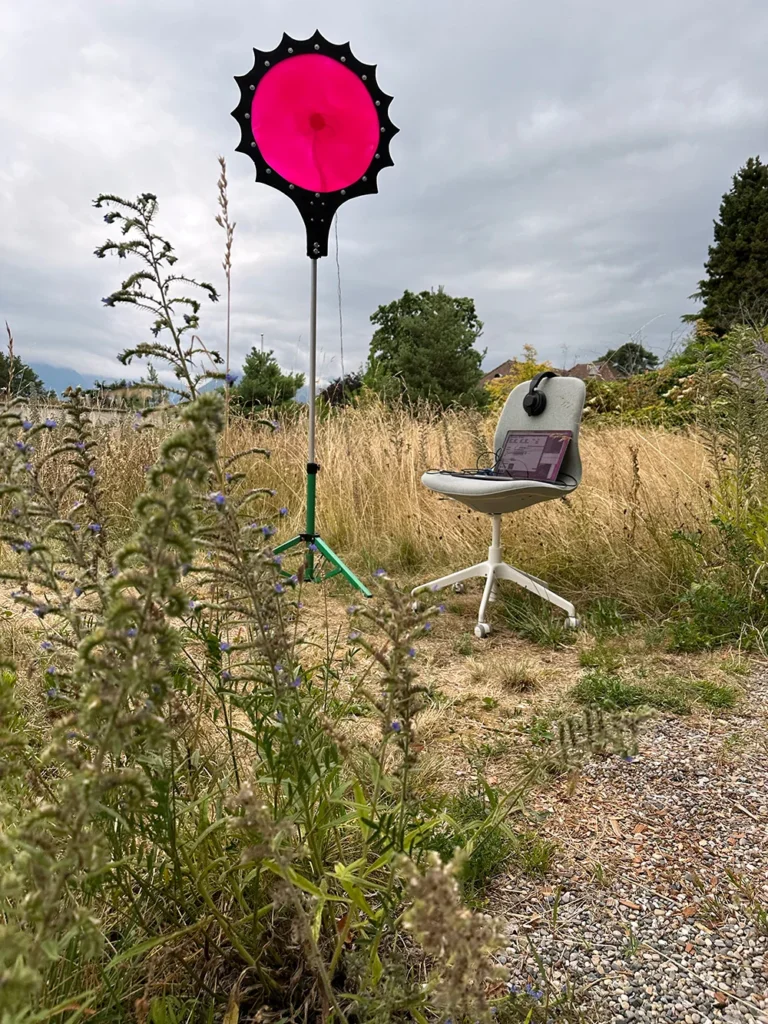
This contribution is presented as a mixtape that is open and unfinished. The songs (and songs to be) are recorded through vibrational membrane microphones that are mobile, collective, and outdoor recording devices-studios. The recording sessions or encounters are guided by the protocols of La Membrana, as a framework and invitation to tune into our vibrational reality.
Listening and Creating Through La Membrana and the Surlogical
The Membranas Mixtape – Side A, “Song 1,” as well as this accompanying text, emanate from my research into La Membrana (“The Membrane,” 2022), a body of work-thought-practice based on resonant membranes as model structures and conceptual apparatuses for collective (counter)listening.1 This framework is activated by custom-made listening membranal apparatuses usually consisting of resonant and elastic membranes made with latex, silicone, leather, or metallic sheets, with embedded sensors (gyroscopes, accelerometers, and microphones) that make them sensitive vibrational devices. Through the processing of the signal the membranes receive and output a slightly delayed amplification of the sound, the membranes produce sounds that are perceived as responses. Therefore, they behave as an improvisatory, respondent machine-entity. They are activated by collective call-and-response encounters where the membranes set a noisy architecture that contains the encounter and invites the participants to weave their sounds along. Some of these membranes, for example, La Orejona (that will be further discussed in the text), carry a strong lo-fi and noisy sonic signature in the way they listen, so they mask clarity and provide a noisy-muddy inseparable sound. This process is proposed as a counterlistening device because it moves away from the logic of recording devices that target clear and separable signals that can be isolated and categorized.
The Membrane emerged within a new paradigm of aural relationality that follows what I call a “surlogical” approach.2 Surlogical refers to a Southern logic or logics of the South/sur, which, differently from Western paradigms of listening and knowing, I understand as embodying a mobile and nurturing territory of artistic exploration by embracing fluidity, reorientation, improvisation, and dialogical exchange. Surlogics are thus rooted in sonic socialization through improvisatory open systems and polyphonic encounters of call-and-response, where sounds, instruments, and codes are all understood as vital technologies that fundamentally differ from conventional modern technological paradigms. These vital technologies prioritize fostering relationality and collective paradigms of making together beyond. Technologies undergirded by surlogics such as La Membrana (or, as we will see further down, the specific instance of La Orejona) thus operate as dynamic agents within a social membrane rather than static tools of extraction and control. Moreover, by creating spaces for collaborative emergence and attuned interactions, they challenge hierarchical structures and offer instead transformative possibilities that resonate across sensory, emotional, and societal dimensions. These practices transcend aesthetic functions, permeating other aspects of life and society and creating relational systems that foster emergent collectivity and transformative resonance.
La Membrana is both a physical structure and a conceptual apparatus, both a method and its action, offering a dynamic counterpoint to traditionally rigid or isolating frameworks. Its transformative potential lies in its emphasis on elastic,resonant, and oscillatory connections that confuse static boundaries, fostering a vibrant model for exploring the interferences and interweavings of our vibrational reality. To behave membranically is to exist as a body attuned to oscillations — a state of constant relational flux that emphasizes performativity and transduction.
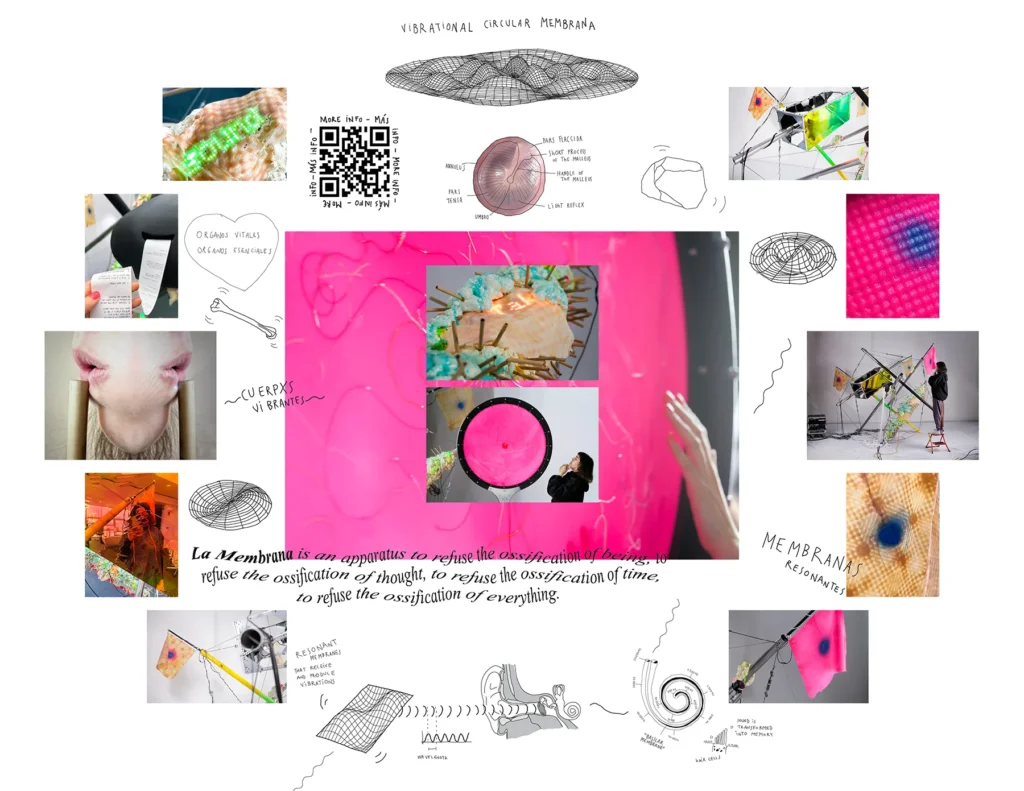
La Membrana acts as a communicative boundary, a pulsating and responsive entity that intertwines diverse materialities and subjectivities into an unstable and never-static territory that is in constant oscillation. In this space, the social membrane expands to everything else, stimulating a conversation that incorporates more-than-human materialities, agencies, and sensory registers. La Membrana fosters a vibrational imagination, enabling us to inhabit areality of oscillatory attunements and relational dynamism.
La Orejona
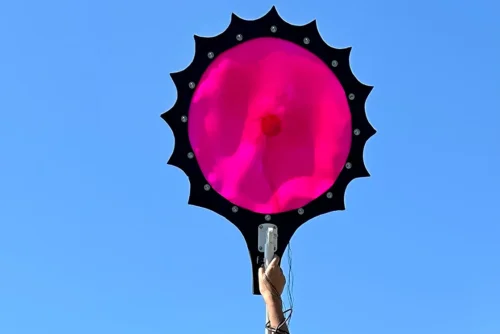
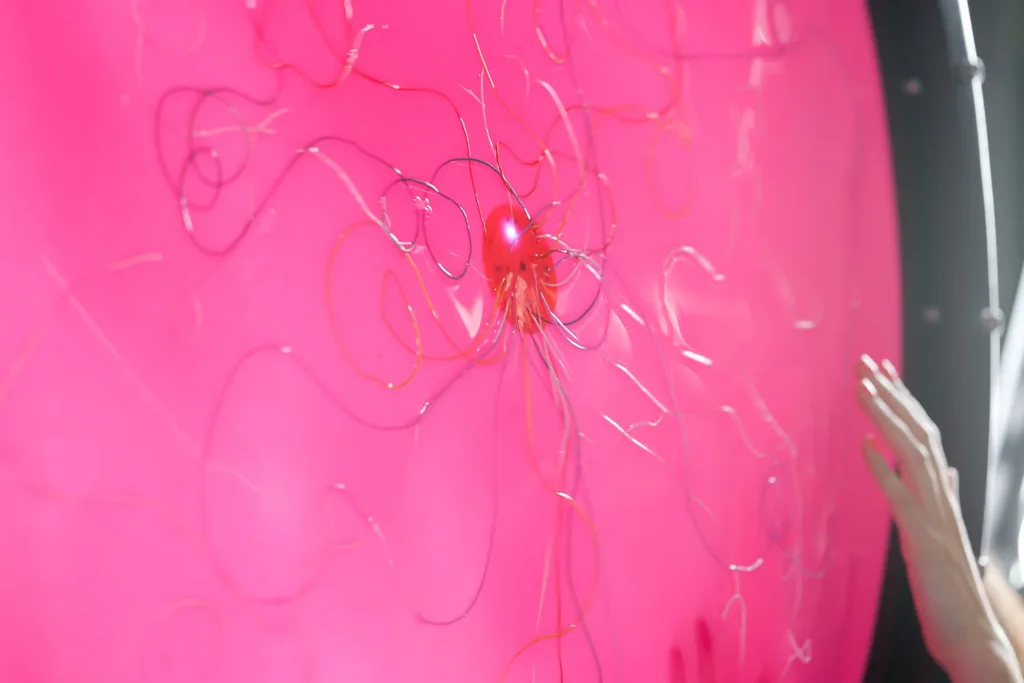
La Orejona (XS) (“The Big-eared one,” 2023) is also a listening apparatus against traditional technical logics, a vibrational membrane microphone that centers on the poetics of unintelligibility to produce fuzziness. It operates with the purpose of indiscriminately weaving individual signals into collective noise: an inseparable, muddy mass of sound. It is not a precise measurement device; on the contrary, it is an apparatus for confusing signals, for fuzzing, for agglutinating, for obscuring, for noising. By doing so, she problematizes the notion of signal and categorization to explore the possibilities of noise and the loss of individual clarity as a place for collective vibrational emergence.
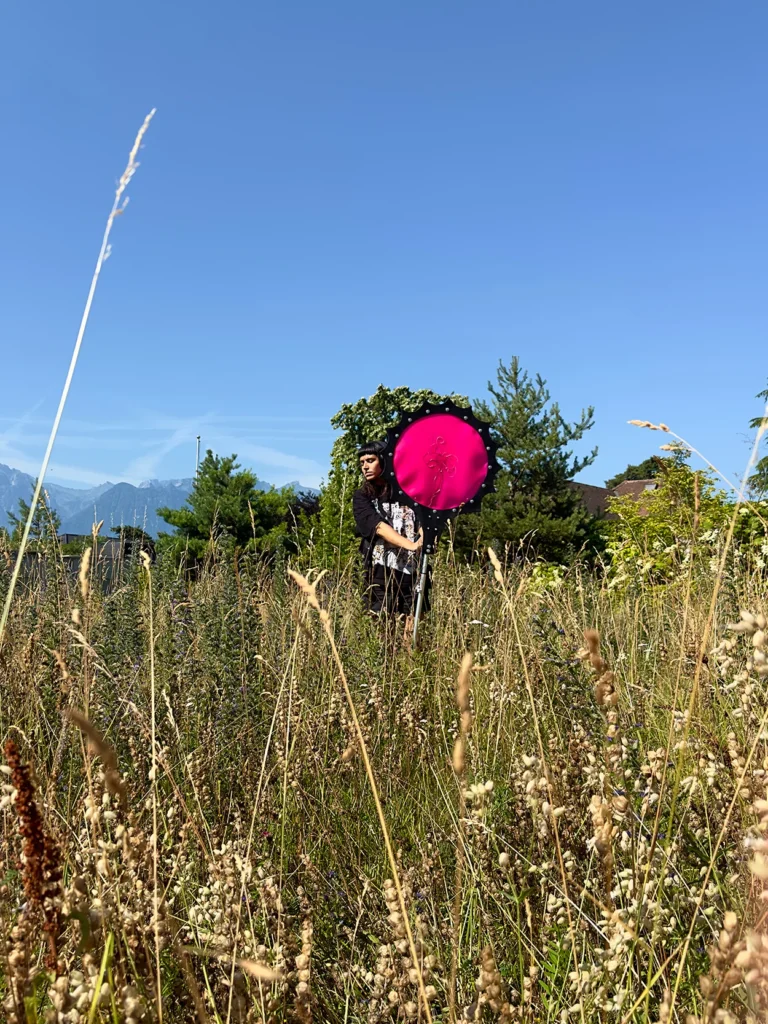
Bright pink and unapologetically present, La Orejona’s color and materiality emphasize its counter-hegemonic stance as a move to oppose the hidden and deceptive tendency of listening and surveillance technologies. Its bold hue asserts a physical and symbolic presence, breaking from contemporary Western technological paradigms that prioritize apparent invisibility and control. This choice underscores its role as an active participant in creating collective vibrational encounters, situating it as a highlighted relational agent within the social space it activates. Designed to weave independent signals into an inseparable, convoluted mass of sound, La Orejona fosters a reciprocal system of listening as a membranal act — indiscriminately receiving vibrations and weaving worlds together. This dialogical exchange positions listening as a shared act of transduction, where individuality dissolves, creating a dynamic field of entangled forces.
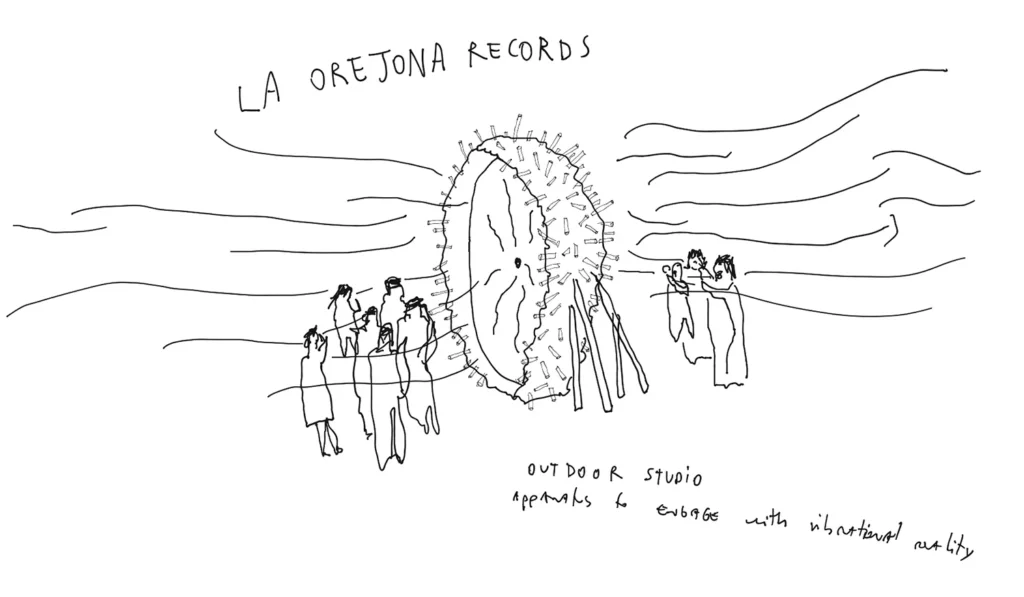
In practice, La Orejona has served as a facilitator of collective listening and sounding experiences, enabling participants to dissolve individual boundaries and enter a shared vibrational field. For instance, during collective improvisation sessions, La Orejona has been instrumental in blending diverse sonic inputs into a unified, indistinguishable noise, unveiling a language of collective interferences and resonances. By prioritizing relationality over clarity, La Orejona creates spaces where new languages can flourish, revealing the profound potential of membranal listening as an expansive act.
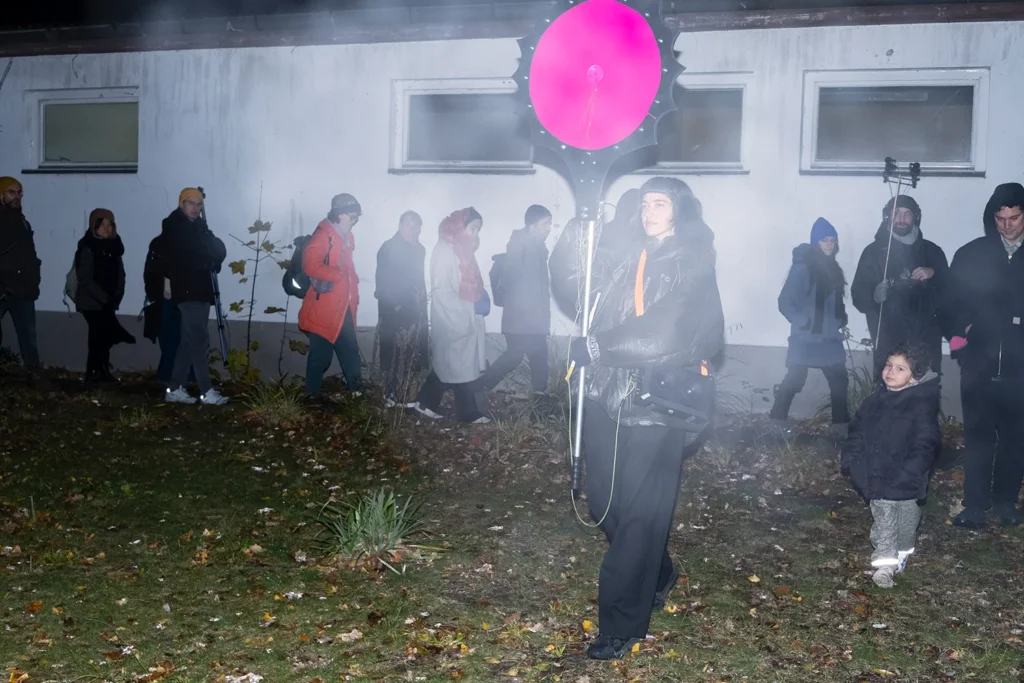
Membranal apparatuses such as La Orejona additionally challenge the dominant paradigms of technological design and usage, which have historically been grounded in rigid, linear, and normative understandings of listening and silencing. Contemporary listening apparatuses — often male-coded and rooted in Western technological traditions — have emphasized extraction, control, and precision, reinforcing systems of surveillance and categorization. In contrast, membranal tools like La Orejona propose a radically different (sur)logic: one centered on relationality, fluidity, unintelligibility, and collective resonance. These devices act as social entities, not merely instruments. They create spaces for shared encounters and actively participate in them, fostering a dialogical and reciprocal dynamic.
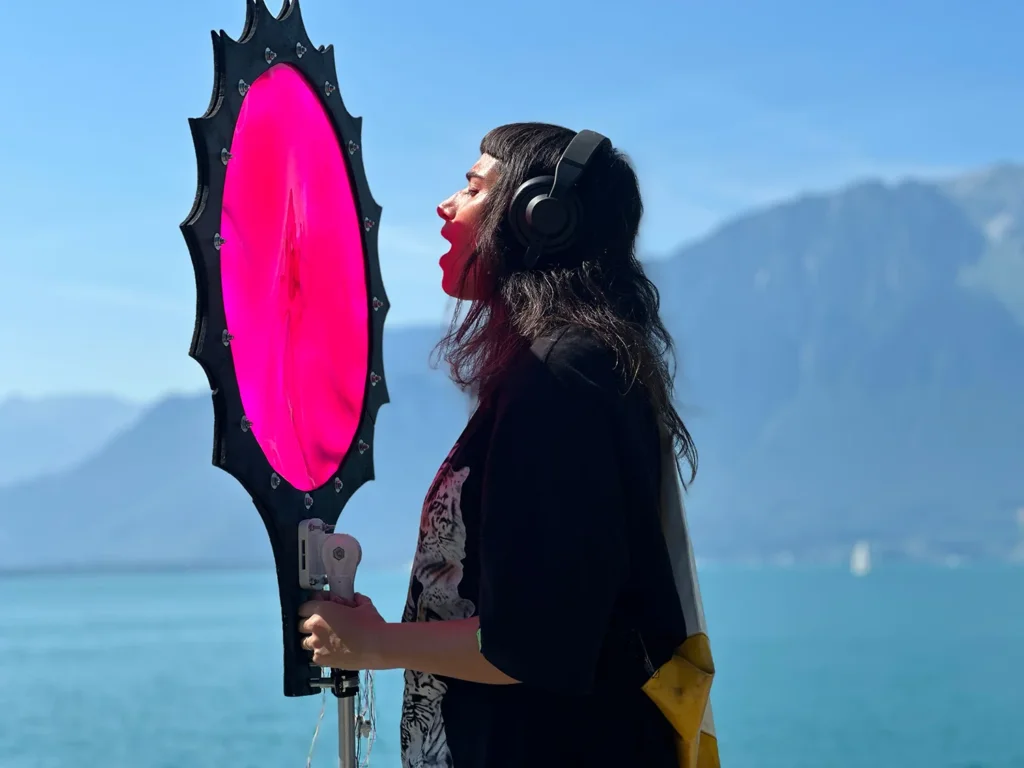
Membranas Mixtape
Therefore, inspired by the extent of this work, the audio piece included in this issue, “Song 1,” unfolds as a sonic extension of this membranal framework. Rather than functioning as a closed composition, it operates as an open and growing structure that emerges from collective improvisation sessions with La Orejona (XS). La Orejona served as a mobile membranal recording studio for the mixtape. “Song 1” embodies a fuzzy testimony of an encounter that took place indoors and outdoors on a rainy and windy night in November 2023 at Morphine Raum in Berlin as part of the 5th edition of the Radical Sounds Latin America Festival.3 The sound piece embodies the principles of La Membrana by weaving together heterogeneous signals into a dense, relational sonic fabric with La Orejona, where authorship dissolves into collective emergence. As a first iteration, it suggests continuity because the process is open and can expand into further songs, encounters, and resonant constellations. In this sense, the mixtape is not only a documentation but also an activation: a vibrational trace of a social membrane in motion, where listening, sounding, and relating become inseparable.
Rather than being fixed, stable entities, membranal apparatuses and compositions derive their strength and beauty from their capacity to catalyze transformative processes. They are defined not by what they are but by what they can do — enabling other forms of social interaction, collective emergence, and vibrational attunement. As relational agents, they prioritize interconnection over isolation, offering a mode of technological engagement that resonates with surlogical principles of improvisation and polyphonic exchange. Through their instability and responsiveness, these tools dissolve boundaries, fuzz rigid static lines, and weave together diverse voices, creating a shared sonic and social membrane.
Ultimately, membranal apparatuses like La Orejona empower us to listen otherwise. They invite us to inhabit a multidimensional space where listening becomes an act of “sending and receiving,” a continuous flow of vibrations that binds individuals and environments into a heterogeneous yet cohesive whole. As a result, they reorient our technological paradigms away from control and precision and toward resonance, reciprocity, and the incommensurable possibilities of a collective vibrational imagination.
Endnotes
- Nicole L’Huillier. “Membranas” (PhD diss., Massachusetts Institute of Technology, 2022).[↑]
- Nicole L’Huillier, “Surlógicas,” in Border-Listening/Escucha-Liminal – Volume 3, ed. Alejandra Cárdenas, (Contingent Sounds), 40-57.[↑]
- Infinitas gracias a todxs por resonar con nosotras y activar en conjunto una ruidosa comunidad en movimiento. Thank you to the Radical Sounds Latin America Festival for making this beautiful encounter possible and Rabih Beaini for hosting us at Morphine Raum and recording this session.[↑]