At its core, abolition feminism is the practice of making a world where all life is meaningful, where needs are met and the means to thrive are secure. Abolition is “about building life-affirming institutions,” as Ruth Wilson Gilmore is often quoted as saying.1 For example, the national grassroots organization Critical Resistance centers its vision of abolition on “the creation of genuinely healthy, stable communities that respond to harm without relying on imprisonment and punishment.”2 Or, as scholar-activists Alisa Bierria, Jakeya Caruthers, and Brooke Lober write, “abolition feminisms represent a long arc of ethical life-making and everyday practice that has always been at the root of abolitionist possibility.”3
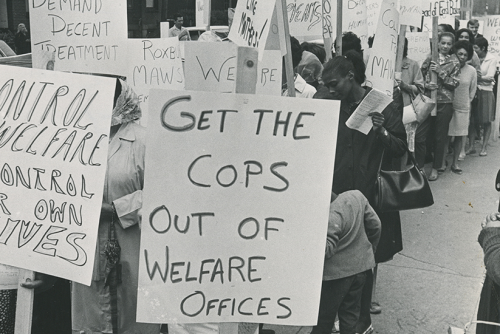
Abolitionist feminist scholarship and activism has expansively charted how meaningful collective life is imagined, produced, and sustained while mapping the terrains of life in which carceral dispossession is reproduced, including and especially terrains that are “hidden, disguised, or devalued,”4 and where subjection masquerades as recognition and care.5 As an analytic and a praxis, abolition feminism helps us develop a sharper analysis of both carceral power and anticarceral possibility, bringing us closer to what a life-affirming society might look and feel like. For instance, abolition feminists have long challenged the liberal feminist reform movement for “kinder, gentler, gender-responsive” prisons for women as a quintessential example of prison expansion adorned in the language of prison reform.6 Abolition feminists have also offered incisive critiques of the ways in which carceral logics proliferate within “institutions that are allegedly organized to provide assistance,” from shelters to welfare offices.7 Carceral institutions, no matter their form or the harm they purport to address, steal life instead of promoting its flourishing. The photograph on the cover of this special issue, of a 1966 protest organized by the Boston-based group Mothers for Adequate Welfare, represents one moment in the long arc of feminist struggle against the carceral capture of life sustainment.
In this special issue on abolition feminism we seek to highlight scholarship and organizing that explores the intersection of carcerality, reproduction, and anticarceral life-making. Ranging from long and short-form essays to interview and roundtable conversations, the contributions examine the workings of carceral power and modes of abolitionist struggle through the prism of social reproduction, traversing an array of historical and contemporary sites and practices. The term social reproduction is engaged expansively here to refer to the work of sustaining human life within and across generations, and to include its entanglements with biological reproduction. Feminist theorists of social reproduction have charted its distinct role in the production of capital and commodities.8 According to Tithi Bhattacharya, social reproduction theory is a framework “that is not content to accept what seems like a visible, finished entity — in this case, our worker at the gates of her workplace — but interrogates the complex network of social processes and human relations that produces the conditions of existence for that entity.”9 As the National Domestic Workers Alliance pithily summarizes, “domestic work makes all other work possible.”10 In situating social production in colonial and imperial contexts, Aren Aizura writes that “societies have instrumentalized reproduction in both social and biological forms to concretize racial, gender, and sexual orders.”11 Core to the conception of and thinking in this special issue is the imprint of theorists of racial capitalism, especially Black feminist theorists of captivity, the domestic, and reproduction.12
Building on these genealogies of thought and praxis, this issue asks what the analytic of social reproduction brings to feminist carceral studies and abolition. Across the contributions, readers will find incisive analyses of socially reproductive labor within and against the prison, the multiple dimensions of reproductive violence that constitute mass incarceration and genocide, the carceral state’s instrumentalization of institutions of social reproduction in marginalized communities, and insurgent practices of care work, kin-making, and collective defense. The issue opens with a roundtable conversation between Sarah Haley, Orisanmi Burton, Tiffany Lethabo King, Judah Schept, and Rosie Stockton in which they collectively theorize carceral social reproduction as the extraction and manipulation of life sustainment into carceral state resource. The dominant form of prison labor today is not the work of producing commodities for sale, but rather the work of maintaining and securing bodies in captivity, whether by guards who leave the institution at night or by the people who are forced to stay.13 Yet the utterly essential character of socially reproductive labor is often elided in conversations about carceral economies. Together the scholar-activists in this conversation contend with the carceral state’s “punitive management of injured life perpetually on the verge of death,” as Haley writes in her roundtable introduction. While Burton conceives of social reproduction in the prison context “as a technique of low intensity warfare,” Schept turns to the social reproduction of the guards engaged in this warfare and to the prison’s surrounding communities “that the carceral state mobilizes into constitutive components for its own reproduction.” Stockton shifts our attention to the putative private sphere, exploring “how the state has criminalized, controlled, and exploited the gendered labor/practices that reproduce ‘surplus populations’ in the form of extreme sentencing.” King brings our focus to the historical context of the plantation and the ways in which “Black people’s life-affirming and life-ending activities” were at once “sustaining, disrupting, and destroying the processes of social reproduction” on which the carceral order depended. Taken together, participants reflect on a range of rebellious activities within and against carceral institutions and consider how they manifest abolitionist possibility.
The question of social reproduction inside and against the prison is also explored by Sara Matthiesen, Stevie Wilson, and Kwaneta Harris. These authors diagram mass incarceration as a project of reproductive control, in both biological and social terms. They chart the prison’s generalized assault on reproductive possibility through family and kinship separation, specific technologies of reproductive violence and neglect, and the policing of gender and sexuality. Yet, they also detail various informal and formal strategies engaged behind and across prison walls to fight these assaults on bodily autonomy, biological and chosen family-making, and the estrangement that prisons produce between parents and children.
Sara Matthiesen’s essay brings us to the first decade of the late-twentieth century US prison buildup and explores incarcerated women’s labor to make and sustain families across the prison wall in the face of state neglect. Focusing on California’s state and federal prisons, Matthiesen illuminates numerous examples of what she refers to as “experiments in making life on the inside,” reading them as “moments of abolition.” For instance, a mass uprising at the California Institution for Women in 1975 was catalyzed by prison authorities’ decision to close the annual holiday party to loved ones on the outside. In tracing political activity that ranged from the “Christmas riot” to lawfare to the building of a children’s center, Matthiesen explores how the energy, effort, emotions, and skill of those held inside prison are at once extracted for the sustainment of the carceral state and are expropriated by imprisoned people toward their own well-being, relation, and extrication.
In a wide-ranging interview with Emily Thuma, imprisoned organizer and writer Stevie Wilson delves into questions of reproductive labor and care in the movement for prison industrial complex abolition. Wilson traces the throughlines from his experiences in HIV/AIDS activism and Philadelphia’s ballroom community to his abolitionist organizing behind and across prison walls — from infrastructures of mutual aid to political education to noncarceral responses to harm — charting the development of his Black anarchist orientation toward the state. Toggling between the violence of racialized heteropatriarchal policing and organized abandonment in the city and the techniques of control and repression in the prison, Wilson illuminates how “kinship making is the antidote” to carceral state violence and collective care is the fabric of abolitionist struggle.
In her essay, imprisoned journalist and reproductive justice advocate Kwaneta Harris wrenchingly reveals a “calculated system” of reproductive power and control operating in Texas’s women’s prisons today, one buttressed by the state’s reproductive healthcare deserts, anti-LGBTQ policies, and family policing system. In a political economy of sexual coercion and violence, prison guards weaponize imprisoned people’s access to their children, parole hearing dates, faith-based programs, and even menstrual supplies. As Harris shows, continuities of control are readily found in other state prison systems as well as in systems of parole and probation where “the methods might differ, but the goal remains the same.” Yet continuities of resistance also abound, as Harris and her neighbors practice refusal and collectively organize for bodily autonomy in myriad inventive ways.
From carceral reproductive terror in US prisons to the “open-air prison” of Gaza, the essays by Harris and Bayan Abusneineh variously expose the multiplicity and centrality of reproductive violence in the consolidation and social reproduction of carceral states. Abusneineh’s essay brings together analyses of the carcerality of the longstanding Israeli occupation of Palestine and the reproductive genocide still under way in Gaza at the time of this writing. Building on the Palestinian Feminist Collective’s “Statement on Reproductive Genocide in Gaza,” Abusneineh examines the carceral dimensions of three kinds of genocidal violence against the biological and social reproduction of Palestinian life: obstetric violence; infrastructural violence; and the deliberate killing of children. Reproductive genocide and carcerality are “mutually reinforcing mechanisms of elimination, where the regulation of birth, life, and kinship is inseparable from the prison-like conditions imposed on an entire population,” she writes. Ultimately, Abusneineh argues that Gaza “must be understood as a critical site for grasping the inseparability of struggles for reproductive justice and carceral abolition.”
Both Abusneineh and Alisa Bierria contend with the question of life-making in places where life is relentlessly under assault. Bierria’s context is the “criminalizing pipeline” that captures survivors of domestic and/or sexual violence who defend themselves from life-threatening abuse. Her essay proposes a survivor-centered liberatory paradigm of self-defense emerging from this experience of subjection to both interpersonal and state violence. To develop this paradigm, Bierria draws on the community-based participatory research conducted for a 2022 report she co-authored for the national feminist abolitionist organization Survived & Punished entitled, Defending Self-Defense: A Call to Action. Here, she synthesizes survivor participants’ individual and collective insights with academic research to demonstrate the “inconceivability of self-defense” before the law for Black, Native, immigrant, and trans survivors, and to distill a praxis of survivor self-defense that interrogates and resists the law’s violence. Through the prism of those outlawed for surviving gendered violence, Bierria argues for an expansive understanding of self-defense as an “ongoing practice of survival . . . stretched across time,” and as a practice of collective freedom-making.
As noted at the outset of this introduction, abolition feminism has been a crucial analytic for excavating the insidious ways in which carcerality is reproduced through purportedly progressive reforms. Kayla Martensen’s essay critically analyzes the proliferation of alternatives to incarceration programs for youth in recent decades. Drawing on a mixed-methods study of Cook County, Illinois, she provides a case study analysis of how institutions of social reproduction in racially and economically marginalized communities have become increasingly vulnerable to carceral cooptation. Under the auspices of benevolent reformism, youth decarceration has been spliced with what Martensen calls a “carceral service industry,” wherein nonprofit service providers assume the responsibilities of surveilling and controlling court-involved young people. Martensen ultimately urges those invested in systemic change to stay analytically vigilant toward the hydra of carcerality and its ability to reproduce itself through reform.
Like many contributors to this special issue, Martensen reminds us to keep our collective eye on an abolitionist horizon. Readers of these brilliant contributions will find that they also engage the crucial question of the social reproduction of life-affirming movements. Taken together, they name the work of “caring collectively” behind and across prison walls as vital political labor.14 They amplify the significance of insurgent knowledge production across generations. They point us toward numerous groups and organizations, across time and geography, that remind us that relationship-building and collective defense are at the heart of sustained struggles for radical freedom.
Given the prohibition of internet access in US prisons, we have ensured that this particular issue of The Scholar and Feminist Online has also been designed for print in an effort to facilitate intellectual exchange across prison walls. Each contribution to the issue is available for downloading as a printable, foldable booklet, and bound copies of the full issue are available for free to incarcerated people through Haymarket Books’s Books Not Bars program.
We would like to express our deepest gratitude to all of the contributors of this special issue for entrusting us with their writings. All our thanks as well to the reviewers, and to the artists who granted us permission to publish their work. Without the tenacious efforts of Sandra Moyano Ariza and Beck Jordan-Young at S&F Online, this issue would not have been possible; many thanks as well to creative director Hope Dector. We greatly appreciate Mitch Wiesen for designing the issue for print. Tremendous thanks to Dana Blanchard at Haymarket Books for generously collaborating with us to print and distribute the issue across the prison wall. A special thanks as well to Alisa Bierria and Grace Kyungwon Hong for their invaluable support and feedback, and to Premilla Nadasen for her vision and for creating the opportunity for these ideas to come together.
Endnotes
- Ruth Wilson Gilmore, Keynote Conversation, Making and Unmaking Mass Incarceration conference, University of Mississippi, Oxford, MS, December 5, 2019.[↑]
- Critical Resistance, “Mission & Vision,” 2025, https://criticalresistance.org/mission-vision/.[↑]
- Alisa Bierria, Jakeya Caruthers, and Brooke Lober, “Introduction: Abolition Feminisms in Transformative Times,” in Abolition Feminisms, Volume 1: Organizing, Survival, and Transformative Practice, ed. Alisa Bierria, Jakeya Caruthers, and Brooke Lober (Haymarket Books, 2022), 3.[↑]
- Alisa Bierria, Jakeya Caruthers, and Brooke Lober, “Introduction: Making a Clearing,” in Abolition Feminisms, Volume 2: Organizing, Survival, and Transformative Practice, ed. Alisa Bierria, Jakeya Caruthers, and Brooke Lober (Haymarket Books, 2022), 1.[↑]
- Saidiya Hartman, Scenes of Subjection: Terror, Slavery, and Self-Making in Nineteenth-Century America (Oxford University Press, 1997).[↑]
- Rose Braz, “Kinder, Gentler, Gender Responsive Cages: Prison Expansion Is Not Prison Reform,” Women, Girls, and Criminal Justice 7, no. 6 (2006): 87–88.[↑]
- Beth E. Richie, “Carcerality,” in Keywords for Gender and Sexuality Studies, ed. The Keywords Feminist Editorial Collective (NYU Press, 2021), 41.[↑]
- Premilla Nadasen argues that classical social reproduction theory sees social reproduction as a “precondition for capitalist profit” rather than “the creation of profit itself,” reflecting a “presumed distinction between social reproduction and production.” Analysts of racial capitalism, however, explain the inseparability of production and reproduction in the history of slavery and the direct commodification of reproductive work in the increasing predominance of medical, affective, immaterial, and service-based economies. Premilla Nadasen, Care: The Highest Stage of Capitalism (Haymarket Books, 2023), 8-9.[↑]
- Tithi Bhattacharya, “Introduction: Mapping Social Reproduction Theory,” in Social Reproduction Theory: Remapping Class, Recentering Oppression, ed. Tithi Bhattacharya (Pluto Press, 2017), 2.[↑]
- National Domestic Workers Alliance, “About Domestic Work,” www.domesticworkers.org/about-domestic-work/.[↑]
- Aren Aizura, “Reproduction,” in Keywords for Gender and Sexuality Studies, ed. The Keywords Feminist Editorial Collective (NYU Press, 2021), 188.[↑]
- See, for example, Jennifer Morgan, Laboring Women: Reproduction and Gender in New World Slavery (University of Pennsylvania Press, 2004); Saidiya Hartman, “Belly of the World: A Note on Black Women’s Labors,” Souls 18.1 (2016); Sara Clarke Kaplan, The Black Reproductive: Unfree Labor and Insurgent Motherhood (University of Minnesota Press, 2021); Dorothy Roberts, Killing the Black Body: Race, Reproduction, and the Meaning of Liberty (Pantheon Books, 1997); Jennifer Morgan and Alys Weinbaum, ed. “Reproductive Racial Capitalism,” History of the Present 14, no. 1 (2024); and Premilla Nadasen, Care.[↑]
- Ruth Wilson Gilmore and James Kilgore, “Some Reflections on Prison Labor,” The Brooklyn Rail, June 2019, https://brooklynrail.org/2019/06/field-notes/Some-Reflections-on-Prison-Labor/.[↑]
- While a commonly used phrase, in the context of this discussion we acknowledge the tenacious work of the California Coalition for Women Prisoners, for whom it is an official motto and north star. Other abolition feminist organizations doing invaluable intellectual and organizing work at the nexus of abolition, care, and reproduction include Survived and Punished, the Bloom Collective, Interrupting Criminalization, Southerners on New Ground, Black Mama’s Bailout, The National Council for Incarcerated and Formerly Incarcerated Women and Girls, and Women with a Vision.[↑]