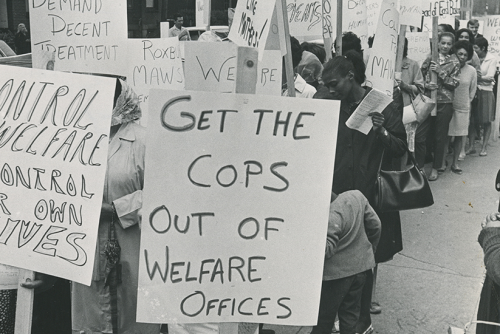
One evening in December of 1975, correctional officials informed women imprisoned at the California Institution for Women (CIW) that they were barring outside visitors from attending the upcoming Christmas party. They cited security concerns as the justification. In response a group of women filled a trash can with holiday decorations, lit them on fire, and hurled the flaming can of merriment-turned-protest through the superintendent’s office window. This act was the start of a five hundred-person rebellion that shut down the prison until the early hours of the morning. The uprising was quelled only by state violence, personified through numerous state and county officers who joined CIW staff in unleashing tear gas and other chemical agents on the women, flying a helicopter over the grounds that blinded them with its searchlight, and firing multiple warning shots that ultimately forced women back into their cells. The decision to bar visitors was merely the tipping point for women confined by an institution designed to dehumanize them. On this night they acted on a fundamental insight gained from their experience of incarceration: in conditions that were never meant to support life-making, it is necessary to fight for your life.1
In this article I explore the uprising at CIW alongside other experiments in making life on the inside through the feminist frameworks of social reproduction and prison abolition. I draw especially on debates begun by Marxist and socialist feminists in the 1970s over how to best characterize social reproduction and consider these alongside abolition’s dual mandate to decarcerate and build new worlds. Specifically, I am interested in exploring the varied effects of efforts that strive to make relations of care — familial and otherwise — possible across prison walls in the era of mass incarceration. How does our assessment of relations of care, famously claimed as work by Marxist feminists, change when they are performed inside the prison? Under the current regime of racial capitalism defined in part by mass incarceration, does social reproduction behind bars reproduce or extend beyond capital’s logics, or both? Alternatively, does it create something else altogether?
If the function of the prison is historically specific, then how we interpret the activities of those behind its walls must take into account the changing purposes of incarceration at distinct moments in history. In my prior work on histories of struggle over incarcerated women’s family making in California’s state and federal prisons, I engaged these questions largely by emphasizing the exploitative effects of mass incarceration.2 Reproduction Reconceived framed the efforts of incarcerated women and their advocates on the outside to maintain familial ties as a new form of reproductive labor specific to late twentieth-century racial capitalism made manifest in incarceration as “incapacitation.”3 I interpreted incarcerated women’s actions as resistive, but by conceptualizing them first and foremost as reproductive labor, I downplayed a key insight of Marxist thought: that capital will never totally dominate because “there can be no labor without life.”4 This decision stemmed from my interest in how to trace “reproductive labor” to places beyond the home — the quintessential site of both normative familial reproduction and 1970s autonomous Marxist feminists’ critique.5 This move was necessary for centering the familial relations of racially marginalized women historically excluded from the normative family, a deliberate exclusion that justified exploiting their reproductive labor to maintain families other than their own.6 While I prioritized following reproductive labor to various sites where family was being made in spite of violence and neglect, I could have done more to theorize the concept in relation to women’s different conditions. In the case of incarcerated women’s family making, this would have meant making the political economy of the prison and its role in managing the contradictions of late twentieth-century racial capitalism more of a central player in my analysis.
Following Sharon Luk’s invitation to abolitionist scholars and activists to bring social reproduction to the center of studies on incarceration, here I foreground the relational quality of imprisonment and incarcerated women’s efforts to maintain family.7 I begin by examining different frameworks that have endeavored to expose the harms of incarceration, focusing especially on how feminist scholars have theorized the impacts of mass incarceration on reproduction. In this analysis I make the case for more carefully distinguishing between the reproduction of life and the reproduction of labor-power that are at once implied by the term social reproduction, so that organizing strategies which mobilize care do not inadvertently serve capital’s expansion. In the next section I detail how women incarcerated in California’s state and federal prisons and their outside advocates challenged the violences of carceral neglect. I read these efforts as instances of what Alisa Bierria, Jakeya Caruthers, and Brooke Lober describe as the “ethical life-making” of abolition feminism.8 I conclude by looking at contemporary struggles over violence and abolition taking place at these two prisons.
Throughout I keep in view the inherent friction between the reproduction of life and the reproduction of labor in order to ask when and under what conditions such efforts might also entail exploitation. What follows makes the case for seeing family making on the inside as moments of abolition. Simultaneously, however, I gesture to organizing conditions that could produce both exploitative and abolitionist effects. I try to read these historical and contemporary struggles through a dynamic lens in which there is no pure outside of racial capitalism, even as there is everywhere evidence of what Susan Ferguson describes as “lives . . . organized against capital” constantly reaching beyond it.9
Exposing the Reproductive Harms of Incarceration
Few frameworks have done more to illuminate the reproductive harms of incarceration than the Black feminist concept of reproductive justice (RJ). Scholars examining incarcerated women and reproduction from various disciplines have mobilized the framework for what RJ founder and scholar-activist Loretta J. Ross has described as its “amplifying” powers, demonstrating how “prisons are sites of reproductive injustice” in relation to each of RJ’s three principles: the right not to have children, the right to have children, and the right to raise children in safety and with dignity.10 Organizing led by incarcerated and formerly incarcerated women and their communities has also played a central role in bringing RJ to bear on women’s experiences of reproductive injustice on the inside. Campaigns against the practice of shackling during labor and delivery and forced sterilization by prison physicians are especially visible examples of reproductive justice activism targeting the harms of incarceration.11
Collectively this scholarship and activism have made clear that there is no role for prisons in a world where reproductive justice is available to all.12 At the same time this body of work has had less to say about the function of prisons to historically specific regimes of racial capitalism. This analysis has more frequently come from scholars who foreground the relationship between the state and capital’s shifting labor needs in their assessment of modes of punishment.13 Ruth Wilson Gilmore’s groundbreaking study of the prison buildup in California, Golden Gulag, brings Black Marxism and critical geography to bear on the “punitive turn” that inaugurated what is now widely known as mass incarceration in the United States. Gilmore’s argument that prison construction made use of various surpluses threatening both capital and the state’s legitimacy in the wake of late twentieth-century deindustrialization and economic decline illuminates how punishment provided a dual solution for managing the population of under- and unemployed poor men of color in California. Through the hypercriminalization of participation in illicit economies and intense surveillance of youth of color, men were made into “criminals” according to preexisting, entrenched racial hierarchies which also ensnared poor whites. More “criminals” justified more prisons. California’s relative surplus population was made useful — not through captive, productive labor as the widely popular “New Jim Crow” thesis would have it, but by keeping idleness and its attendant deprivations contained and hidden away.14
Feminist scholars have drawn on Gilmore’s analysis to bring feminized social reproduction to the forefront of analyses that understand prisons in relation to the imperatives of contemporary racial capitalism. In their study on the carceral logics of disability confinement in California’s past and present, Jess Whatcott illustrates how “detention is eugenics.”15 Vrindavani Avila’s and Jennifer Elyse James’s analysis of forced sterilizations in California state prisons similarly frame incarceration “as a form of structural eugenics.”16 They detail how fictions of racialized “fitness,” necessitated by racial capitalism and reproduced through the white heteropatriarchal family, also require “deviant bodies” who are denied their right to procreation and family on the basis of “public safety.”17 Forms of punishment such as long sentences that subsume the entirety of one’s fertile years, forced sterilization, and the disruption of kin and community ties illustrate how prisons determine which groups of people will be able to reproduce themselves and be legible as family.
These analyses illuminate Luk’s argument that the dispossession accomplished by incarceration is best understood as a struggle over “the modes and means of social reproduction, struggles mediating the historical contours of life and death.”18 Here Luk builds on Gilmore’s observation that “prisons wear out places by wearing out people, regardless of whether they have done time.”19 Luk elaborates the stakes of Gilmore’s point by drawing on Marxian feminist thought that sees social reproduction as the central terrain of struggle against racial capitalism. Social reproduction is fertile ground for resistance because the activities required to (re)produce labor-power necessarily also (re)produce life. This remains true regardless of the metrics, categories, and violences imposed by historically specific regimes of racial capitalism. For example, Black Marxist feminists examining enslaved women’s dual labors under slavery have long made this point about enslaved people’s networks of kin and community. Reprising Angela Davis’ groundbreaking insights about enslaved women’s role within the family and its impact on Black feminist scholarship, Sarah Haley has recently argued, “socially reproductive labor creates something other and in excess of a captive labor force, namely Black life.”20 Across historically distinct regimes of dispossession, the life needs and desires of human beings, as Ferguson has argued, “can and will assert themselves against capital time and again.”21
In the case of mass incarceration, where criminalization and imprisonment work together to make surplus populations disposable and then contain them, a focus on social reproduction raises important questions about life making on the inside. If punishment in the age of mass incarceration is defined precisely by not putting incarcerated people to work to produce things or future workers, how should we understand efforts that refuse the carceral imperative to render life idle?22 Are such refusals best understood as social reproduction if the prison has no use for or interest in the labor-power reproduced alongside life? And what should we make of another Marxist feminist insight — namely, that because most activities associated with social reproduction take place in spaces and relations less directly disciplined by capital, life-making can take precedent over reproducing labor-power? As Davis famously argued, enslaved women’s work in their own households was “the only labor of the slave community which could not be directly and immediately claimed by the oppressor.”23 How does the idea that “the unpaid work of social reproduction is sufficiently ‘outside’ capital to be highly flexible” translate to the inside of a prison where surveillance, violence, and neglect attempt to keep people from life?24
These questions point to the issue of how to distinguish between social reproduction in the service of capital and social reproduction in the service of life. For feminist abolitionists engaged in what Bierria, Caruthers, and Lober describe as the “long arc of ethical life-making and everyday practice” of willing “an impossible future while resisting the deadly chaos of the present,” this distinction is of critical importance.25 It is worth trying to untangle “ethical life-making” from reproductive labor — both of which are frequently implied by the term social reproduction — in our organizing strategies. Such an effort aligns with the vigilance exercised by abolitionists against “reformist reforms,” or reforms that retrench and expand carceral power and extend the reach of racial capitalism into our lives.26 This is not a straightforward task because, as Harry Cleaver has argued, there is an “antagonistic two-sidedness of everyday activities: to some degree they contribute to the reproduction of labor-power and to some degree they may break free of such subordination to capital.”27 Lean too far towards social reproduction as exploitation and racial capitalism becomes all-encompassing. This is a recurring critique of 1970s autonomous Marxist feminist thought that theorized women’s subordination as a product of capitalist exploitation of women’s reproductive labors, an idea most widely popularized through the Wages for Housework campaign.28 When domination is everywhere, moments of self-determination are obscured, while appeals to adequately value care by understanding it as work risk reinscribing the logics of capital and the racialized gendered division of labor.29 Lean too far in the other direction — social reproduction as life-making beyond capital — and all caring activities become revolutionary, making it difficult to explore how care’s entanglement with structural inequalities necessarily shapes organizing that makes caring a central strategy.30
The antagonism Cleaver describes becomes less murky in the context of mass incarceration. In the current prison regime designed to bring life to a halt, any life-affirming practices are a refusal to remain idle or succumb to death and therefore flout the prison’s function under racial capitalism. Recent histories of incarcerated women’s organizing and support networks in the United States and Puerto Rico make abundantly clear just how life-affirming such activities are. These studies describe incarcerated people’s acts ranging from AIDS peer education to sharing food to maintaining visiting programs for outside advocates as “care work.” This aligns with socialist and Marxist feminist theorizing and serves to combat the devaluation of care as a political strategy. At the same time, the dual effect of social reproduction on the outside — reproducing ourselves as workers that expand capital and reproducing ourselves as lives always in excess of this mandate — does not easily translate to life on the inside.31 When incarcerated women care for one another and organize together on the inside, they are refusing to adhere to the prison’s aim of incapacitation. This is also a refusal of imprisonment as a solution to the crises of late twentieth and twenty-first century racial capitalism, and thus a rejection of the logic that life be subordinated to capital.
As Heather Berg has argued about the “militant care” performed by sex workers with and for one another, such practice “prepares us for struggle more than it reproduces us to maintain the status quo.”32 For members of the California Coalition for Women Prisoners (CCWP), an organization guided by the motto “caring collectively,” the support, care, and organizing forged inside and across prison walls are most accurately described as feminist abolition. This assertion reframes “care as crucial to abolition” in contrast to anti-prison organizing that elevates acts of resistance like riots and hunger strikes over collective care.33 These observations are especially illuminating in the context of activities aimed at strengthening incarcerated women’s claims to their children. Reproductive labor is often described colloquially as the reproduction of the next generation of workers. However, when incarcerated women demand to be regarded as parents and force the prison to accommodate their parental desires in the prison-as-warehouse era, they are insisting on a world that is incompatible with carceral, capitalist logics.
At the same time, incarcerated women’s familial ties necessarily extend beyond prison walls by virtue of their children’s tenuous freedom.34 When efforts to support women’s family making take place beyond the prison’s warehousing grasp to incarcerated women’s children, for example, exploitation and abolition arguably bleed into one another. Here, the dynamic in which labor-power and life are produced simultaneously is once again at play, and individuals must carve out as much life as possible from the activities of social reproduction. This is made all the more difficult by the multi-pronged threat of criminalization that poor families of color are most subject to, a role carried out in part by the “capitalist state” so as to “keep the formal inequality of capitalism acceptable to the polity,” to return to Gilmore.35 In bringing together the histories and stories in this paper, I want to explore the paradox of care as both abolitionist and exploitative in greater detail. I keep in mind the above insight that social reproduction on the outside more frequently serves capital’s need for labor-power than life-making on the inside — even as inside-outside organizing ensures these two realms remain interconnected. Collectively, the examples considered here suggest that in addition to liberatory but precarious moments of family making and care inside the prison, the “ethical life-making” practiced by feminist abolitionists must engender, to invoke Ferguson again, “lives . . . organized against capital” in all places and under all conditions where life resides.36
Life Stolen by — and from — Carceral Neglect
I was hesitant to emphasize a single finding from my previous work on feminist struggle in California’s state and federal prisons as especially alarming, given that it details in numerous ways the violence of incarceration during the 1970s and early 1980s. However, I have returned more than once to this: “It is unclear just how many children were stolen from their families as a result of the institutional neglect baked into incarceration and child welfare services.”37 I wrote this sentence to reflect my reading of two studies investigating the impact of incarceration on women and their children conducted by researchers at CIW in 1960 and 1961, respectively.38 The research documented how women were barred from communications between CIW and child welfare services regarding the whereabouts of their children as well as their legal standing as parents. Correctional staffers’ refusal to provide women any information about their children or facilitate communication with state agencies frequently culminated in child welfare services placing children in foster care and/or up for adoption — typically without women’s knowledge, involvement, or consent. One researcher approvingly described correctional staffers’ refusal to answer women’s repeated questions about their children as an intentional practice designed to facilitate the emotional separation necessary to aid the legal revocation of parental rights — a move frequently motivated by the express desire to get children into adoptive families and off of public aid.39 The neglect and coercion researchers documented did not mean the investigators took incarcerated women at their word, even as they recorded their numerous protestations: demands to know what “their rights were,” a refusal to discuss their children with social workers because “I don’t trust them,” and assertions that “it is unfair for the courts to take our babies away from us while we’re in here and can’t defend ourselves.”40 These clear expressions of women’s concern about their children and their legal standing as parents were interpreted by one researcher as “conscious or unconscious distortions by inmate-mothers as to the adequacy of the care they gave their children before they were incarcerated” and as motivated by “what would gain institutional approval and the earliest parole date.”41 Both researchers used their findings to recommend that correctional staff do more to aid women in accepting the loss of their children so as to prevent them from “sabotaging sound arrangements made for the children.”42
My use of the word “unclear” in the sentence describing this violence above was partially due to archival gaps in the Department of Corrections Records, housed in the California State Archives where I conducted research. Both the studies and other records documenting the conditions at CIW provided only a snapshot of what happened to women’s children. At least some of these gaps were created by women themselves. Researchers noted that some of the 814 women they surveyed in the early 1960s refused to participate due to fears that the information would make their children vulnerable to state intervention.43 But my use of the word “stolen” was an attempt to counterbalance that uncertainty.44 The archives did not contain an exact number, but I did not want this to cloud readers’ ability to share in my certainty that both state officials and the researchers who so eagerly wanted to study so-called “inmate-mothers” were to blame for women’s loss of their children and children’s loss of their parents. While in the 1960s white women comprised the majority of incarcerated women at CIW, the enduring, shapeshifting link between criminalization and Blackness ensured that Black women were disproportionately represented in the state prison.45 Researchers’ inability or refusal to believe that women’s parental concerns were genuine drew on and reasserted this link in the form of parental “distortions” supposedly made evident by women’s legal crimes of soliciting sex and social crimes of single motherhood and divorce.46 Black women’s overrepresentation in this prison as compared with the general population in California at the time no doubt means that then, like now, poor Black mothers who could not turn to relatives for help with child-rearing were especially likely to have their families “torn apart” when state institutions exercised their administrative power.47
But how can children be “stolen” by something as passive as “neglect?” By theorizing “carceral neglect,” I was attempting to foreground the moments where the violence of prison is enacted through officials’ willful inaction, a refusal to attend to life. The medical neglect endemic to carceral institutions is another salient example, and certainly prison guards ignored pregnant women’s repeated and urgent requests for medical attention just as they did their repeated and urgent requests for information about their children. In both instances, neglect was just as punishing a force as overt acts of violence. Correctional staff’s refusal to care for women’s medical concerns — or to generally attend to the health needs of pregnant incarcerated people — could mean an infant stolen by death. Welfare officials’ refusal to care for women’s parental autonomy and legal standing could mean an infant stolen by the state. Returning to Luk’s invitation to approach incarceration as “a struggle over the modes and means of social reproduction,” we can understand such violence at CIW as the logical outcome of the prison-warehouse designed to bring both life and labor to a halt.48
Researchers at CIW interpreted women’s concern for their children as efforts at sabotage, but the distorted lenses through which they viewed incarcerated people meant they missed the saboteurs’ actual target: the conditions that defined confinement. In the years that followed these reports, those incarcerated at CIW insisted on and carried out a variety of life-making activities despite correctional staff’s systemic protocol of neglect. In superintendent Brooke Carey’s report of the 1975 Christmas riot to her boss, then-Director of the California Department of Corrections J.J. Enomoto, she described the uprising as a “spontaneous release of hostility” rather than a “pre-planned” protest.49 Such anodyne language might be convincing were it not for the reports from other correctional staff. Reading across these documents makes clear that the 1975 uprising was years of cumulative insults in the making. When a sergeant tried to persuade women to return to their cottages by assuring them they had been heard, one woman reportedly responded, “You motherfuckers always say, ‘yeah, we’ll take care of it,’ but you fuckers never doing anything, so we are not locking up.”50 Carceral neglect was a central component of incarceration as incapacitation, but in disruptive demands for their children and rejections of constraint, women at CIW refused to relinquish their right to family, kin, community, and life.
While incarcerated women at CIW and their advocates on the outside took on the Department of Corrections through legislation and lawsuits aimed at improving conditions for pregnant women and mothers, women imprisoned at a federal prison nearly four hundred miles away in northern California endeavored to make FCI Dublin hospitable to life in another way: through a children’s center.51 The group Prison Mothers and Their Children (MATCH) was started by incarcerated women and outside advocates in 1978. It was based on a belief that the separation inherent to imprisonment harmed women and their children equally; the Pleasanton Children’s Center was a space where they could “restore family ties.” Here incarcerated women could spend the entire weekend with their children in recognition of the fact that “meaningful contact between parents and their children during imprisonment,” in addition to other resources that addressed their needs, was necessary to mitigate harm.52
For ten years, Prison MATCH tried to overcome the carceral neglect that devastated incarcerated people’s familial relations by supporting life in myriad ways. The majority of incarcerated staff adapted “normative” child development models to account for the impact an imprisoned parent had on children’s development and helped children make sense of the multiple caretakers in their lives. Members conducted political education around the incarceration of primary caretakers of small children while constantly coordinating with sympathetic foster parents so that children could get to the prison every weekend. In order to legitimize and destigmatize women’s experiences of parenting from behind bars, they developed a certificate program in Child Development in hopes that members could bring their expertise to early child development programs such as Head Start upon release. They fundraised to keep the program afloat and barred correctional staff from any formal participation so as to prioritize incarcerated women’s authority. They insisted that the program needed a dedicated social worker if women were to have any say over their child’s welfare during incarceration and upon release. And they attempted to address the issues consistently raised by women incarcerated at FCI Dublin, such as medical neglect, particularly with regards to prenatal care. During the ten years this version of Prison MATCH was operational, inside and outside staff — along with the program’s advisory board of incarcerated mothers — helped start similar programs at seven other correctional institutions.
Members of Prison MATCH leveraged cracks in the edifice of imprisonment in order to mobilize the prison in service of life. While then-warden Charles Turnbo initially rejected the original proposal of a seven-day a week children’s center, he was willing to compromise with advocates on the weekend model and eventually became an enthusiastic supporter. An outside member used her professional connections at the National Council on Crime and Delinquency (NCCD) to secure funding for the first four years of the program which shielded organizers from the demands of fundraising while they found their footing. This financial support was also undoubtedly greased by the fact that rehabilitation still held some political currency on the eve of California’s prison construction boom. And the fact that FCI Dublin put no funds or personnel towards the running of the program but could still claim it as a success made for mostly amicable relations whilst protecting members’ authority over the program.53
Cleaver’s observation about the “antagonistic two-sidedness” of social reproduction is useful for thinking through many of Prison MATCH’s initiatives, especially given the organization’s necessary connections to the outside. When foster parents and relatives brought children to visit their parents in the Center on weekends, they were at once performing the reproductive labor of child-rearing, reuniting families, and refusing to reproduce normative models of motherhood that justified severing incarcerated women’s parental rights. When inside-outside staff and community members ran the program without any support from the prison, they reclaimed life and agency from confinement while their labors repaired harms they had not perpetrated and for which prison officials, social service workers, and politicians should have been accountable. And when Prison MATCH organizers initiated a certificate program in child development based on their experiential expertise, they were preparing themselves to perform paid reproductive labor upon release while undoing dominant logics which framed incarceration as disqualifying for future employment and parenthood. That these effects were being produced simultaneously is both challenging and hopeful. They illustrate the ease with which caring as a political strategy can become exploitative in a punishing society where care is made a scarce resource. At the same time, they demonstrate how abolitionist life-making on the inside requires and produces the same on the outside, refusing containment despite the prison’s best efforts.
Assessment reports written for the NCCD characterized Prison MATCH’s “first years, 1978-1982” as “full of growth, change, and excitement.”54 But as politicians on both sides of the aisle bolstered their “tough on crime” credentials by turning people into “criminals,” and as the state resolved numerous crises by funding prison construction, these forces also narrowed the cracks that gave Prison MATCH its tenuous if promising foothold. When federal and state politicians passed harsher sentencing laws that created a crisis of overcrowding in the nation’s prisons, 250 of the women incarcerated at FCI Dublin were transferred to facilities far from their families and with no similar parent-child programs. When outside members went to Washington, DC to protest these and other changes wrought by mass incarceration, Prison MATCH’s value to the Bureau of Prisons (BOP) ceased outweighing its costs. The version of the program envisioned and lived out by Prison MATCH’s founders ended in 1988 when the BOP awarded a contract to a different agency promising to offer services at a lower rate. Members considered this decision patent retaliation for their repeated agitation on behalf of women who had been transferred out of the state.55 Prison MATCH and its power to restore family ties were a vital source of life within a “death-dealing” institution, as is made clear by the consequences of its abrupt removal from women’s lives.56 One woman who had been transferred far from California to a state prison and still had much of her fifteen-year sentence to serve pleaded for help from Prison MATCH asking, “How can I make it not knowing what is happening to my family?”57
The Necessity of Abolition
Like the fate of women studied by researchers in the early 1960s, it is not clear from the archives I consulted what happened to this woman and her family upon being transferred from FCI Dublin.58 What clarity I hope this history does offer, however, is that any moments where carceral neglect loses out to life are as hard-fought and tenuous as they are life-saving and liberatory. The urgent need for the rapid proliferation of such moments is demonstrated by the conditions that made it possible for women’s children to be stolen in the late twentieth century, conditions that continue to render incarcerated people vulnerable to incredible violence in the twenty-first. CIW made headlines in 2013 when the Center for Investigative Reporting provided evidence of systematic forced sterilization in California’s women’s prisons between 2006-2010.59 Research conducted by those who worked to document this abuse and the activism against it in the documentary film Belly of the Beast found that nearly 1,400 people were sterilized between 1997 and 2013.60 In 2021 a historic campaign led by California Coalition for Women Prisoners’ Reparations 4 Reproductive Justice seeking to provide monetary compensation to those sterilized won $7.5 million from the state of California, the first legislative victory of its kind.61 Reporting on the program’s rollout reflected what activists involved with the campaign always knew would be a challenge — that despite the bill mandating survivor involvement, their marginalization during the creation of the program ultimately weakened its impact.62 In contrast, CCWP’s memorial quilt project, “Together We Rise, Together We Heal,” centered those most impacted and allowed for repair through community.63 While the monetary compensation undoubtedly made a difference in the lives of those who successfully navigated the program, the harms that occurred throughout the program’s creation and implementation also attests to the existential difficulties of repairing what a life might have been with a check.
Both CIW and FCI Dublin have also been the subjects of lawsuits brought by incarcerated women who experienced sexual assault by correctional staff.64 Sexual abuse was so rampant at FCI Dublin that the BOP announced it was closing the federal prison in spring 2024, leaving the women incarcerated there to agonize over what being transferred would mean for their connections to family for at least the second time in the institution’s history.65 The warden, Ray J. Garcia, and the prison chaplain, James Theodore Highhouse, were two of eight FCI Dublin employees charged with sexually abusing incarcerated women. Notably, Garcia was responsible for leading compliance trainings to make sure staff followed the requirements of the Prison Rape Elimination Act.66 It is always a charade when those in power are charged with limiting their own reach, but the results are especially disturbing when turning the gears of an institution designed to dehumanize is your job. The abuse of power baked into the carceral system has similarly enabled abuse to go unaddressed for years in California’s states prisons where the responsibility for investigating reports of sexual violence brought forward by incarcerated people lies with California Department of Corrections and Rehabilitation (CDCR) staff. Investigative reporting and state audits revealed that CDCR staff dismissed the majority of complaints.67 These outcomes are precisely why Prison MATCH organizers refused to enlist guards into the operations of the program, even when they expressed sympathetic interest. Members were clear that “their role as guards” categorically prohibited correctional staff from advocating for families, just as contemporary advocates insist that at a bare minimum, there should be an independent system for investigating reports of abuse.68
Most importantly, however, is that those involved in exposing the abuse at California’s state prisons and FCI Dublin believe the surest way to end the violence endemic to these institutions is by freeing once and for all those currently held in its grasp.69 No doubt this is because they share a profound understanding of the challenges inherent in seizing life from an institution intent on dehumanization to the point of death. In Reproduction Reconceived, I characterized women’s efforts as “reproductive labor that made family possible . . . in the space of carceral neglect.”70 I emphasized the exploitative side of these practices, both in terms of the labor performed and the costs to women and their children when community efforts were insufficient to mitigate the violent outcomes of carceral neglect. Here and now, in the bleakness of a political moment where those in power have a political vision that amounts to “preparing for the end of the world” — it feels crucial to highlight the life-making activities that elude the deadly grip of racial capitalism.71 In the 1970s and 1980s, people incarcerated in California’s women’s prisons and their communities temporarily created conditions capable of nurturing life from within an institution meant to bring it to a halt. They wielded the prison to other, more generative ends and put the institution at odds with its own mandates. Abolition feminism as “ethical life-making” consists of every moment where individuals live in “a more healthy manner and more joyfully” than the reproduction of capital could ever allow or even imagine.72 At the same time, the fact that such moments must be repeatedly seized and are often met with repression aimed at restoring the prison’s intended function demonstrates why women at CIW refused to “lock up” in 1975, and why abolition feminists today insist we must “free them all.”
Acknowledgements: Many thanks to the editors Sarah Haley, Emily L. Thuma, Sandra Moyano Ariza, and Sarah Ross; the anonymous reviewer; and Heather Berg — for taking such care with this piece in its various stages and improving it with your collective brilliance.
Click here to read or download a designed-for-print version of this article.

Click here to download a print-and-fold booklet version of this article.
Endnotes
- For a fuller account of the uprising at CIW, see Sara Matthiesen, Reproduction Reconceived: Family Making and the Limits of Choice after Roe v. Wade (UC Press, 2021), 58–61.[↑]
- Sara Matthiesen, Reproduction Reconceived.[↑]
- Ruth Wilson Gilmore, Golden Gulag: Prisons, Surplus, Crisis, and Opposition in Globalizing California (University of California Press, 2007), 21; Matthiesen, Reproduction Reconceived, Ch. 2.[↑]
- Susan Ferguson, Women and Work: Feminism, Labour, and Social Reproduction (Pluto Press, 2020), 126.[↑]
- Key texts by autonomous Marxist feminists active in the Italian New Left during the 1970s include Silvia Federici, Wages against Housework (Power of Women Collective, 1975); Mariarosa Dalla Costa and Selma James, The Power of Women and the Subversion of the Community (Falling Wall Press Ltd, 1975); Leopoldina Fortunati, The Arcana of Reproduction: Housewives, Prostitutes, Workers, and Capital (Verso Books, 2025).[↑]
- Dororthy E. Roberts, Killing the Black Body: Race, Reproduction, and the Meaning of Liberty (Vintage Books, 1997); Evelyn Nakano Glenn, “From Servitude to Service Work: Historical Continuities in the Racial Division of Paid Reproductive Labor,” Signs: Journal of Women in Culture and Society 18, no. 1 (1992); and Evelyn Nakano Glenn, Forced to Care: Coercion and Caregiving in America (Cambridge: Harvard University Press, 2010); Premilla Nadasen, Care: The Highest Stage of Capitalism (Verso, 2024); Sarah Haley, “‘Like I Was a Man’: Chain Gangs, Gender, and the Domestic Carceral Sphere in Jim Crow Georgia,” Signs: Journal of Women in Culture and Society 39, no. 1(2013); Rhacel Salazar Parreñas, Servants of Globalization: Migration and Domestic Work (Stanford University Press, 2015).[↑]
- Sharon Luk, “Ourselves at Stake: Social Reproduction in the Age of Prisons,” CR: The New Centennial Review 18, no. 3 (2018).[↑]
- Alisa Bierria, Jakeya Caruthers, and Brooke Lober, “Abolition Feminisms in Transformative Times,” in Abolition Feminisms Volume 1, ed. Alisa Bierria, Jakeya Caruthers, and Brooke Lober (Haymarket Books, 2022), 11.[↑]
- Ferguson, Women and Work, 119.[↑]
- Ross describes reproductive justice as “an amplifying, organizing concept to shed light on the intersectional forms of oppression that threaten Black women’s bodily integrity.” Loretta Ross, “Reproductive Justice as Intersectional Feminist Activism,” Souls 19, no. 3 (2017): 293; Rachel Roth, “‘She Doesn’t Deserve to Be Treated Like This’: Prisons as Sites of Reproductive Injustice,” in Radical Reproductive Justice: Foundations, Theory, Practice, Critique, edited by Loretta J. Ross et al. (The Feminist Press, 2017). For a key text that helped inaugurate this approach see Rickie Solinger et al., eds., Interrupted Life: Experiences of Incarcerated Women in the United States (University of California Press, 2010). For recent publications that explicitly engage all three principles see Alice Cavanaugh et al., “Lived Experiences of Pregnancy and Prison Through a Reproductive Justice Lens: A Qualitative Meta-synthesis,” Social Science & Medicine 307 (2022); Vrindavani Avila and Jennifer Eylse James, “Controlling Reproduction and Disrupting Family Formation: California Women’s Prisons and the Violence Legacy of Eugenics,” Societies 14, no. 5 (2024); Crystal M. Hayes, Carolyn Sufrin, and Jamila B. Perritt, “Reproductive Justice Disrupted: Mass Incarceration as a Driver of Reproductive Oppression,” American Journal of Public Health 110, no. S1 (2020).[↑]
- For a discussion of these campaigns and their growing visibility, see Priscilla Ocen and Julia Chinyere Oparah, “Embodied Abolition: Prisons, Pregnancy and the Struggle for Birth Justice,” in Birthing Justice: Black Women, Pregnancy, and Childbirth, edited by Alicia D. Bonaparte and Julia Chinyere Oparah (Routledge, 2023), 250-254. For examples of how feminist abolitionist organizations are mobilizing the framework of RJ in service of feminist abolition see California Coalition for Women Prisoners, “Reproductive Justice x Abolition,” https://womenprisoners.org/rj-abolition/ and Justice Now, “Prisons as a Tool of Reproductive Oppression,” in Menace to the Future: A Disability and Queer History of Carceral Eugenics, ed. Jess Whatcott (Duke University Press, 2024), 9.[↑]
- Scholars and activists mobilize this relationship in different ways but nevertheless argue that reproductive justice and abolition strengthen one another. See Ocen and Oparah, “Embodied Abolition”; Jess Whatcott, “No Selves to Consent: Women’s Prisons, Sterilizations, and the Biopolitics of Informed Consent,” Signs: Journal of Women in Culture and Society 44, no.1 (2018); Cavanaugh et al., “Lived Experiences of Pregnancy and Prison Through a Reproductive Justice Lens”; Vrindavani Avila and Jennifer Elyse James, “Controlling Reproduction and Disrupting Family Formation.” For a key text that brings reproductive justice to bear on women’s experiences of incarceration, see Solinger et al., Interrupted Life.For an example that mobilizes reproductive justice as both analytical tool and proposed remedy, see Hayes, Sufrin, and Perritt, “Reproductive Justice Disrupted.”[↑]
- See Georg Rusche and Gerda Dinwiddie, “Labor Market and Penal Sanction: Thoughts on the Sociology of Criminal Justice,” Crime and Social Justice 10 (1978); Sarah Haley, No Mercy Here: Gender, Punishment, and the Making of Jim Crow Modernity (UNC Press, 2016); Christian Parenti, Lockdown America (Verso Books, 1990).[↑]
- Gilmore, Golden Gulag, Ch. 1. For the “New Jim Crow” thesis, see Michelle Alexander, The New Jim Crow: Mass Incarceration in the Age of Colorblindness (The New Press, 2010).[↑]
- Whatcott theorizes “carceral eugenics” to analyze “how state confinement functions to control the reproduction and life chances of groups of people who have been deemed biologically undesirable.” Whatcott, Menace to the Future, 3.[↑]
- Avila and James, “Controlling Reproduction and Disrupting Family Formation,” 3.[↑]
- Avila and James, “Controlling Reproduction and Disrupting Family Formation,” 3.[↑]
- Luk, “Ourselves at Stake,” 234.[↑]
- Gilmore, Golden Gulag, 17.[↑]
- Haley continues, “Davis is the foundational theorist of the domestic as a site for the production of Black life beyond racial capitalism; accordingly, her essay demands that the terrain of Black liberation be reoriented to the realm of care and intimacy, both historically and in the present.” Sarah Haley, Shoniqua Roach, Emily Owens, and Keeanga-Yamahtta Taylor, “Confinement, Interiority, Black Feminist Study,” The Black Scholar 51, no. 1 (2021): 5.[↑]
- Ferguson, Women and Work, 128, 126.[↑]
- See also James Kilgore in addition to Gilmore and Luk on this point. James Kilgore, “Confronting Prison Slave Labor Camps and Other Myths,” Social Justice Blog, August 28, 2013, https://socialjusticejournal.org/confronting-prison-slave-labor-camps-and-other-myths/.[↑]
- Haley highlights Dorothy Roberts’s elaboration of this claim in her field-defining work on reproductive justice, Killing the Black Body. Quoted in Haley et al., “Confinement, Interiority, Black Feminist Study,” 4–5.[↑]
- Ferguson, Women and Work, 127.[↑]
- Bierria, Caruthers, and Lober, Abolition Feminisms Volume 1, 11, 12.[↑]
- For an extended analysis of how left social movements coalesced around “non-reformist reforms” under neoliberalism, see Amna Akbar, “Non-Reformist Reforms and Struggles over Life, Death, and Democracy,” Yale Law Journal 132, no. 8 (2023).[↑]
- Harry Cleaver, “Self-Valorization in Mariarosa Dalla Costa’s ‘Women and the Subversion of the Community’ (1971),” https://la.utexas.edu/users/hcleaver/357k/HMCDallaCostaSelfvalorizationTable.pdf.[↑]
- Federici, Wages against Housework; Dalla Costa and James, The Power of Women and the Subversion of the Community; Fortunati, The Arcana of Reproduction.[↑]
- Cleaver, “Self-Valorization”; Ferguson, Women and Work, Ch. 8; Angela Davis, Women, Race and Class (Vintage Books, 1983), Ch. 13; Nadasen, Care, Ch. 1.[↑]
- As Hi‘ilei Julia Kawehipuaakahaopulani Hobart and Tamara Kneese point out in their analysis of “radical care,” “the process of extending self-care outward and building a collective capacity for substantive political change requires hard work. So often this work is performed below the line, ignored by the media or narratives about political leaders and social change agents . . . we also notice who is uncared for, who receives care and who does not, and who is expected to perform care work, with or without pay.” Hi‘ilei Julia Kawehipuaakahaopulani Hobart and Tamara Kneese, “Radical Care: Survival Strategies for Uncertain Times,” Social Text, 38, no. 1 (2020): 8.[↑]
- Mónica A. Jiménez, “Searching for Monse,” Radical History Review, no. 148 (2024); Emily Hobson, “The AIDS Quilt in Prison: Care Work in and against the Carceral State,” Radical History Review, no. 148 (2024); Rachel Leah Klein, “Surviving domestic and state violence: Women’s Prison Organizing and the Gendered Politics of Solidarity,” Gender & History 36, no. 3 (2024); Emily L. Thuma and Joseph Hankins, “Caring Collectively: Twenty-Five Years of Abolition Feminism in California,” in Abolition Feminisms, Volume 1, edited by Alisa Bierria et al. (Haymarket Books, 2022). With the exception of Jiménez who only uses “care,” all invoke some combination of care and care work/labor.[↑]
- Heather Berg, “‘Today Solidarity Means, Fight Back:’ On Militant Care,” Essays in Philosophy 24, no.1–2 (2023): 27.[↑]
- Victoria Law, Afterword to “Caring Collectively,” 57.[↑]
- Research has shown that children of incarcerated parents are more likely to be criminalized themselves. Once children are in foster care — an outcome five times more likely when women are incarcerated as opposed to men — they are far more vulnerable to the juvenile justice system. This is especially true for Black children. For these and other reasons, scholar and activist Dorothy Roberts calls child welfare services a “family policing system.” See Eli Hager and Anna Flagg, How Incarcerated Parents Are Losing their Children Forever (The Marshall Project, 2018); Dorothy E. Roberts, Shattered Bonds: The Color of Child Welfare (Basic Books, 2002); and Dorothy E. Roberts, Torn Apart: How the Child Welfare System Destroys Black Families — And How Abolition Can Build a Safer World (Basic Books, 2022).[↑]
- Gilmore, Golden Gulag, 71. In addition to scholarship cited in the prior footnote, on the criminalization of the poor see Kaaryn Gustafson, Cheating Welfare: Public Assistance and the Criminalization of Poverty (New York University Press, 2011).[↑]
- Bierria, Caruthers, and Lober, Abolition Feminisms Volume 1, 11; Ferguson, Women and Work, 119.[↑]
- Matthiesen, Reproduction Reconceived, 68.[↑]
- Dorothy Zietz, “Child Welfare Counseling Project, California Institution for Women, Corona, California,” 1960, Folder “Projects and Programs — Children of Women Prisoners F3717:573,” Projects and Programs Central Files, 1945-1962, Department of Corrections Records, California State Archives; Serapio R. Zalba, Women Prisoners and Their Families: A Monograph on a Study of the Relationships of a Correctional Institution and Social Agencies Working with Incarcerated Women and Their Children (Delmar, 1965).[↑]
- Matthiesen, Reproduction Reconceived, 68.[↑]
- Matthiesen, Reproduction Reconceived, 69.[↑]
- Matthiesen, Reproduction Reconceived, 70.[↑]
- Matthiesen, Reproduction Reconceived, 71.[↑]
- Matthiesen, Reproduction Reconceived, 234, n. 36.[↑]
- It was also an acknowledgement of feminist scholarship that has reframed adoption as coercive rather than benevolent. For a sweeping history of the theft of children in the US see Laura Briggs, Taking Children: A History of American Terror (UC Press, 2021).[↑]
- See especially Khalil Muhammed, The Condemnation of Blackness: Race, Crime, and the Making of Modern Urban America (Harvard University Press, 2011) and Haley, No Mercy Here.[↑]
- Matthiesen, Reproduction Reconceived, 71-72.[↑]
- Quote is a reference to the title of Roberts’ most recent book on the family policing system, Torn Apart. Incarceration in jail and the economic barrier to posting bail is a huge factor in permanently separating poor Black queer women from their children. See also Aleks Kajstura and Wendy Sawyer, “Women’s Incarceration: The Whole Pie 2024,” Prison Policy Initiative, March 5, 2024, https://www.prisonpolicy.org/reports/pie2024women.html.[↑]
- Luk, “Ourselves at Stake,” 234.[↑]
- Matthiesen, Reproduction Reconceived, 59.[↑]
- Matthiesen, Reproduction Reconceived, 59. For a fuller discussion of the rebellion that draws on multiple reports see 58-61.[↑]
- For a more thorough discussion of the advocacy that followed the Christmas riot at CIW, see Matthiesen, Reproduction Reconceived, 75-81.[↑]
- Matthiesen, Reproduction Reconceived, 82.[↑]
- For a fuller discussion of Prison MATCH’s development and trajectory, see Matthiesen, Reproduction Reconceived, 81-88.[↑]
- Matthiesen, Reproduction Reconceived, 86.[↑]
- Matthiesen, Reproduction Reconceived, 86-87.[↑]
- Gilmore, Ruth Wilson, and Léopold Lambert, “Making Abolition Geography in California’s Central Valley with Ruth Wilson Gilmore,” The Funambulist, January-February, 2019.[↑]
- Matthiesen, Reproduction Reconceived, 87. [↑]
- Dorothy Zietz, “Child Welfare Counseling Project, California Institution for Women, Corona, California”; Serapio R. Zalba, Women Prisoners and Their Families.[↑]
- Corey G. Johnson, “Female Inmates Sterilized in California Prisons without Approval,” Reveal, July 7, 2013, https://revealnews.org/article/female-inmates-sterilized-in-california-prisons-without-approval/.[↑]
- Shilpa Jindia, “Belly of the Beast: California’s Dark History of Forced Sterilizations,” The Guardian, July 30, 2020, https://www.theguardian.com/us-news/2020/jun/30/california-prisons-forced-sterilizations-belly-beast.[↑]
- Ocen and Oparah, “Embodied Abolition,” 251-252.[↑]
- Shefali Luthra, “California Promised Reparations to Survivors of Forced Sterilization. Few People Have Gotten Them,” The 19th News, September 5, 2023, https://19thnews.org/2023/09/california-forced-sterilization-incarceration-reparations/.[↑]
- California Coalition for Women Prisoners, “Reproductive Justice x Abolition,” https://womenprisoners.org/rj-abolition/.[↑]
- Sam Levin, “A Prison Guard Confessed to Sexual Misconduct. He Got a Year of Paid Time Off and No Charges,” The Guardian, October 30, 2023, https://www.theguardian.com/us-news/2023/oct/30/california-womens-prisons-correctional-officers-sexual-assault-investigation; Michael Balsamo and Michael R. Sisak, “AP Investigation: Women’s Prison Fostered Culture of Abuse,” Associated Press, February 6, 2022, https://apnews.com/article/coronavirus-pandemic-health-california-united-states-prisons-00a711766f5f3d2bd3fe6402af1e0ff8.[↑]
- Michael R. Sisak, Michael Balsamo and Christopher Weber, “Bureau of Prisons to Close California Women’s Prison where Inmates Have Been Subjected to Sex Abuse,” Associated Press, April 15, 2024, https://apnews.com/article/federal-prison-dublin-california-sexual-abuse-bureau-of-prisons-17731ecb5d0a14adf6011e853bf7e05d.[↑]
- Balsamo and Sisak “AP Investigation”; Michael R. Sisak and Michael Balsamo, “Ex-prison Warden Convicted of Sexually Abusing Inmates,” Associated Press, December 8, 2022, https://apnews.com/article/prisons-california-sexual-abuse-us-federal-bureau-of-investigation-93a168903fbeaed61f72fb9088e02dd4; Michael R. Sisak and Michael Balsamo, “Chaplain who Sexually Abused Inmates Gets 7 Years in Prison,” Associated Press, August 31, 2022. https://apnews.com/article/us-prisons-chaplain-abused-inmates-dfd76afcae114b3ef8430bb4eff05ce8.[↑]
- Sam Levin, “A Prison Guard Confessed.”[↑]
- Matthiesen, Reproduction Reconceived, 85; Sexual Abuse Response and Prevention Working Group, “CA Women’s Prisons: Sexual Abuse Response and Prevention Working Group, Community Report to the Legislature,” March 2024, https://assets.nationbuilder.com/swactionfund/pages/342/attachments/original/1709747546/CA_Women%E2%80%99s_Prisons_%E2%80%94_Sexual_Abuse_Response_and_Prevention_Working_Group.pdf?1709747546.[↑]
- For example, the first recommendation of the sexual abuse response and prevention working group, comprised of numerous feminist abolition groups based in California, was expedited release for all survivors of sexual abuse at the hands of corrections staff. Sexual Abuse Response and Prevention Working Group, “CA Women’s Prisons,” 6. Responding to the BOP’s decision to shut down FCI Dublin, an incarcerated women who is also a whistleblower told reporters, “What the women have gone through at this facility, the abuse they suffered, that was punishment. They’re all low security. Send them home.” Sisak, Michael Balsamo and Weber, “Bureau of Prisons to close California women’s prison where inmates have been subjected to sex abuse.”[↑]
- Matthiesen, Reproduction Reconceived, 83, 90.[↑]
- Naomi Klein and Astra Taylor, “The Rise of End Times Fascism,” The Guardian April 13, 2025, https://www.theguardian.com/us-news/ng-interactive/2025/apr/13/end-times-fascism-far-right-trump-musk.[↑]
- Cleaver, “Self-Valorization.”[↑]