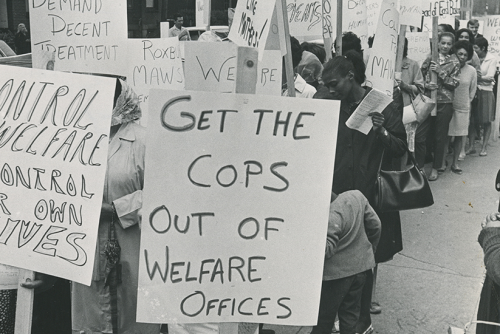
In July 2024, special issue editors Sarah Haley and Emily Thuma asked Orisanmi Burton, Tiffany Lethabo King, Judah Schept, and Rosie Stockton — visionary scholars of captivity, carcerality, rebellion, and gender theory — to engage the following questions:
- How does the analytic of social reproduction contribute to your prison-industrial complex abolitionist work (whether in scholarly, organizing, and/or creative realms)?
- What genealogies of thought and praxis inform your understanding of the relationship between the carceral state and social reproduction? Relatedly: how does thinking social reproduction, carceral power, and abolition together provide more gender nuance in analyses of abolition and/or elucidate any racial conundrums in analyses of social reproduction?
These questions were meant to provoke a reckoning with the multiple implications of tethering the crises of the carceral to that of social reproduction. Carceral social reproduction names a dire conundrum: life is a necessary constitutive element of the carceral project, even as it is brutalized and enervated life; even as it is immured and reviled. The false promise of prison as livelihood and life-protecting exists, of course, alongside carceral social negation — social and physical death-making — which is a perpetual feature of imprisonment and carceral control.
Carceral social reproduction is neither an established field of study nor elaborated theory; in fact, the term has rarely been used by scholars. And while we see the productive potential of thinking about the way that life is made and unmade via carceral regimes, practices, agents, and institutions toward the project of abolition, we seek to grapple with a set of questions about social reproduction rather than to commodify a set of ideas or produce a unified definition of the term. As a starting ground, this roundtable explores a set of inquiries, histories, experiences, and structural shifts. For example, how do we think about the significance of the life work that takes place inside institutions of captivity? How might we struggle against a regime that insists that prisons promote human sustainability? How do we produce a fully-loaded cost accounting of how meaningful, dignified, experimental, and creative life is precluded by policing and carceral regimes, to say nothing of the prison state’s unraveling of the capacity to meet basic human needs?
There continues to be an urgent need to face the state’s selective deployment of carceral expansion as life sustainment and its enduring proliferation of the notion that Black and Brown bodies reproduce criminality. Scholars have exposed how carceral and legal regimes structurally thwart the life chances of those populations rendered socially excess, economically surplus, or in other ways disposable. They have traced imprisoned peoples’ insurgent practices of living, struggles toward life-making, forging of — and foraging for — intimate relation, ingenious practical inventions, and revolutionary organizing, all vital topics that might be further explored through an analysis of carceral social reproduction.
As feminist scholar Premilla Nadasen explains, the scholarship of social reproduction theory “argues that capital or the state [has] supported this [care and household] labor because women’s labor of cooking, cleaning, and caring created the capacity for labor-power needed by capital to generate profit through commodity production.”1 Carceral social reproduction thus follows Nadasen’s work and that of Black and Marxist feminist writers and activists to expand thinking about social reproduction beyond the activity that produces a (typically) male worker producing exchange value. Instead, carceral social reproduction reckons with carceral capitalism in relation to and in excess of commodity production, and delineates the state’s punitive management of injured life perpetually on the verge of death. That is, the reproduction of life for the carceral state’s own proliferation exists alongside carceral enervation and annihilation.
Police often extract people from the home, a key realm of social reproduction, to legitimate and sustain the cellblock; in so doing, they and other carceral agents render imprisoned people and their broad relatives vulnerable to premature death. The home is also the site of violently coerced care work. The carceral regime facilitates, intensifies, and replicates such gendered and sexual abuse. Nadasen urges an analysis of social reproduction grounded in the economic value of care itself under racial capitalism. Theory and activism around carceral social reproduction must, along the same lines, grapple with life and its value, production, constraint, restraint, and obliteration. All this in the historical context of the afterlives of slavery, toward the fortification of national borders and nationalist constituencies, in service of unregulated capital accumulation, and through an infrastructure of forced gender normativity.
As I have written elsewhere, the “daily activity of force required to compel the labor of basic human needs provision is also part of the work of carceral social reproduction.”2 In carceral institutions, incarcerated people who attend to the basic needs of the captive population (food preparation, laundry, janitorial tasks), and those who manage, compel, and extract that labor through their position of “guarding,” are all performing socially reproductive labor amidst abounding violence.3 Such socially reproductive “violence work” extends the logics and economic imperatives of slavery, in which the captive Black body was put to use against itself, for the purpose of materially reproducing the slaveholding economy.4 We gingerly propose that the current regime, too, relies upon a system of “carceral increase.”5
Judah Schept, a contributor to this roundtable, has discussed social reproduction as a “process of community renovation through prison and jail growth.”6 Policies that purport to create community growth and economic redevelopment through the expansion of prisons gesture to the salience of what Dylan Rodriguez calls the prison regime, a “putative ‘centering’ and consolidation of power that, in practice, necessarily exceeds and violates its official directives and juridical norms.”7 In emphasizing dominion over domicile it becomes clear that the prison is a place, but it is emplaced through its command over living and dying itself.
In the responses that follow, the roundtable participants offer still more ways of thinking about the category of carceral social reproduction. They are meant to be read alongside the video clips of a conversation that took place after all of the contributors had read each other’s essays. Taken together, they urge us to consider carceral social reproduction as a mode of warfare. They elaborate the negotiation and negation of captive reproduction under the long historical domain of the settlement-plantation; they elucidate the production of criminalized existence as carceral material; they excavate the life infrastructures of carceral maintenance and unpack the political project of carceral social revitalization.
— Sarah Haley
I.
SARAH HALEY: How does the analytic of social reproduction contribute to your prison-industrial complex abolitionist work (whether in scholarly, organizing, and/or creative realms)?
ORISANMI BURTON: Social reproduction asks us to consider how social subjects, social relations, institutions, and systems of power are made, remade, and unmade at different scales and across generations. I think about social reproduction in the context of the prison as a technique of low intensity warfare. Focusing on the late 1960s and the early 1970s — the pivot point of the US prison system’s globally and historically unprecedented expansion — I focus on how prisons are deployed to contain and neutralize populations rendered surplus by capital as well as potential and extant political militants.
This institutionalized domestic war unfolds on different terrains, perhaps most effectively on the terrain of narrative, memory, and ideology. It is a future-oriented war, which is to say that this counterinsurgency is not only interested in eliminating radicalism in the here and now but also its prospect. Three examples from the state archive should sufficiently prove this assertion. Point five of the FBI’s anti-Black Counterintelligence Program — which employed political imprisonment, assassination, defamation and other nefarious tactics to destroy progressive and radical left movements — prioritized preventing radical ideas from reaching youth.8 Similarly, in a memo from 1968, the Special Agent in Charge of the FBI field office in San Francisco wrote to Director J. Edgar Hoover that “the negro youth and moderate must be made to understand that if they succumb to revolutionary teaching, they will be dead revolutionaries.”9 Furthermore, a 2021 manual outlines what the US military calls the “generational approach” to counterinsurgency, in which young people must be treated as the primary targets for psychological operations designed to shore up their identification with the state.10
These examples demonstrate that state actors are thinking about social reproduction, and specifically about how to interrupt the intergenerational transmission of Black radical knowledge, knowledge that threatens the stability of the carceral system and the broader social order. With this framework in mind, my research examines the modalities through which imprisoned Black men rebel within and against this counterinsurgency. This rebellion often expresses itself in classically militant forms of both armed and unarmed rebellion, but it also expresses itself in ways that are often disqualified from the realm of the political, through intimacy and what I have termed “Black masculine care work.”11 I have looked at how imprisoned Black men establish durable networks of inter and intra-generational kinship through which they collectively nurture their humanity, creativity, and development amid the suffocating atmosphere of captivity. They feed each other, teach each other, sing to each other, tell each other stories, and protect each other from harm. These intimate networks of care and accountability become critical sites of anti-carceral struggle. They can function as autonomous infrastructures of Black radical consciousness. They can also be captured and coopted by state programs that reform them into technologies for maintaining institutional stability.
TIFFANY LETHABO KING: Throughout my work, I have paid attention to the ways that Black people’s life-affirming and life-ending activities can sustain or ruin the carceral order of the “settlement-plantation.”12 The settlement-plantation is a material, ideological, discursive, aesthetic, epistemic, and metaphysical space of conquest. I have spent considerable time attending to the ways that the violently regulated space of the Black maternal holds the potential to reproduce or destroy the settlement-plantation and its afterlives. As the 50-year anniversary of the Moynihan Report approached, I returned to the work of the radical Black organizer, Pacifica radio host, and artist Kay Lindsey. Her 1970 essay “The Black Woman as a Woman,” which appears in the anthology The Black Woman edited by Toni Cade Bambara, puts forth an unusual Black feminist demand: “the abolition of the family.”13 Lindsey’s essay, rooted in Black feminist and Marxist feminist analyses, theorized the family as an arm of the capitalist state. As a space that reproduced the violence of the state, the family functioned as a key site of social reproduction and thus a target for destruction. In the words of Lindsey, “The family has been used by the white agency to perpetuate the state, and Blacks have been used as extensions of the white family, as the prisoners of war enslaved to do the dirty work of the family, i.e. the state. If the family as an institution were destroyed, the state would be destroyed.”14
Lately, I find myself returning to archives that surface Black enslaved and Black captive communities on plantations who were sustaining, disrupting, and destroying the processes of social reproduction that sustained relations of conquest and domination. My more recent scholarly endeavors have turned my attention to archival accounts of the panic that dirt eating (or Cachexia Africana) caused in the eighteenth and nineteenth centuries for slave owners in the Caribbean and US South.15 The translation of Cachexia Africana is “literally the African wasting disease.”16 In the eighteenth and nineteenth centuries, Black practices like dirt-eating perplexed and stoked the anxieties of the planter class, as well as the physicians that plantation owners employed to help maintain their slave populations. In 1799, physicians like Colin Chisholm diagnosed Cachexia Africana (and to a lesser extent Mal d’Estomac) as a disease that affected Africans in the Americas exclusively.17 Due to its potentially devastating impact on plantation (re)productivity, the disease and its carriers became critical sites of observation and medical intervention on plantations. Physicians like Chisholm, who treated the enslaved, and John Imray, who treated “apprenticed laborers,” held captive on plantation estates in Dominica between 1835 and 1841 evince slave owners and plantation managers’ desperate attempts to treat their captive Black laborers who failed to be productive and reproductive.18 In addition to Cachexia Africana rendering the enslaved incapable of labor for varied periods of time, for enslaved women, reproductive functions were also interrupted. According to Imray’s case notes, women experienced “obstruction or suppression of the menstrual discharge.”19 In my article, “Geophagia: The Pull of the Earth,” I posit dirt eating as a Black “maternal function” that fails to reproduce the existing order.20 Dirt eaters’ maternal function or (anti)work breaks with slavery’s plantation orders as well as “abolition’s” or Jubilee’s (a non-event) new order in the West Indies after 1833.21 Further, the Black maternal practice of dirt eating enacts material and symbolic collapse of the plantation estate through its failed reproductivity and a refusal to provide “normative” care for the self and others. These maternal refusals work against the grim imperative of social reproduction on the plantation.
ROSIE STOCKTON: The analytic of social reproduction is necessary for thinking about one of the most draconian and contradictory forms of carcerality that manages the reproduction of surplus population under racial capitalism: the Life Without Parole (LWOP) sentence. Ruth Wilson Gilmore has shown how, since the 1970s, the California prison boom absorbed and warehoused populations ejected from the labor market after economic crises of surplus necessitated the shifting of capital and state capacity.22 While the majority of the masculinized workforce has been criminalized through widely discussed tough-on-crime laws, I analyze how the state has criminalized, controlled, and exploited the gendered labor/practices that reproduce “surplus populations” in the form of extreme sentencing. Debates between Marxist feminist analyses and Black left feminisms around the nature of social reproduction under racial capitalism have long sought to theorize the relationship between paid and unpaid work in the production of relative surplus value: the under and unwaged activities of reproducing life — and labor-power — that have historically fallen on feminized and racialized subjects in the private realm. As 1970s tough-on-crime laws ideologically and materially turned the unemployed worker into “the criminal,” the state also managed the reproduction of “criminality,” or criminalized forms of survival, in the “private” sphere through broadened frameworks of culpability that encompassed racialized, feminized, and queer subjects.
LWOP sentences that target subjects bound to the realm of social reproduction are a key aspect through which the carceral state “fixes” crises of capital and preserve state legitimacy. One the level of sentencing, my work looks to the racialized and gendered logics behind extreme sentences embodied in laws like the Felony Murder Rule, under which over 50 percent of the 5,000 LWOPs incarcerated in California prisons are sentenced, which expands intent and culpability for murder to activities such as aiding and abetting and self-defense. In my research, I provoke a comparison between the invisible labor of social reproduction and the invisible “labor” of aiding and abetting or self-defense to suggest that we cannot understand the scope of the carceral racial state if we exclude criminalized activities deeply entrenched and embedded in the private sphere.
Moreover, my work uses social reproduction to understand the division of labor inside California women’s prisons, which is characterized by both paid and unpaid social reproductive labor largely dependent on women serving LWOP sentences who are often barred from the “productive” labor spheres due to their security classification. Whether or not we consider the women’s prison a warehouse for surplus reproductive labor-power or the surplus of racialized existence itself, the socially reproductive labor of people serving LWOP is essential for reproducing the social and material spheres of the prison. I turn to Marxist Feminist and Black Feminist debates around the social reproduction of the household to understand what I term the “social reproduction of the warehouse.”23
Understanding the political-economic and political-existential mechanisms through which women, queer, trans, and nonbinary people come to serve LWOP sentences is foundational to demystifying how the racial carceral state enacts accumulation by dispossession. It does so via the management, criminalization, and exploitation of the life-making practices of populations rendered at once excess to capital and foundational to the racial state’s expression of its legitimacy. In my scholarly and abolitionist work, I elucidate how extreme sentencing practices that discipline and criminalize Black women and women of color developed alongside the 1970s property tax revolts and gutting of the welfare system in California. Proposition 13, or the “tax payer revolt,” which enabled wealthy landowners to pay less property taxes and left poor communities to face higher regressive taxes and fewer social services, signaled a delegitimization of the Keynesian welfare-warfare state to fund programs that enabled newly disenfranchised surplus populations to reproduce themselves. At the same time, California voters passed tough-on-crime laws targeted at managing the very same population, including the expanded use of the LWOP sentence. Given this contradiction that initiated a new character of the carceral state in California, my work posits that grassroots feminist abolitionist resistance to extreme sentences (such as the DROP LWOP campaign) is a critical intervention into a highly invisibilized realm of carceral power. I rely on genealogies of abolitionist feminisms that question the normative forms of social reproduction, such as the public/private split, gendered reproductive labor, and the racialized gender binary itself.24
JUDAH SCHEPT: My political and scholarly work has focused on trying to better understand carceral expansion in order to sharpen abolitionist interventions. In places like Eastern Kentucky, where much of my work has occurred, social reproduction has been a helpful analytic that has considerable explanatory power. Central Appalachia has sixteen prisons; eight of those are in Eastern Kentucky and most have been built since the late 1980s. Carceral expansion has occurred in the region across every scale of the state, from overcrowded jails to expanded and reopened state prisons to new federal prisons. As we speak, the Bureau of Prisons (BOP) is pursuing the construction of FCI Letcher, which if built would be the fifth federal prison in Eastern Kentucky. The expansive carceral geography has risen largely as a response to two crises: first, the rise of mass imprisonment, which is actually accelerating in Kentucky, fueled by ongoing rounds of harsh sentencing and increased criminalization and imprisonment in rural communities; and second, the collapse of the coal industry, and with it the loss of once-reliable if always exploitative opportunities for work, revenue, and social reproduction. The prisons and jails are quite directly an attempt to manage or resolve these dual crises.
As coal declined in the region, the industry offloaded the burden for social reproduction onto communities and households, even as companies had actively damaged strategies for social reproduction by contaminating water tables, polluting air, destroying streams, enclosing and devastating areas for hunting, foraging, and harvesting, and shifting production and cutting jobs through mechanization. Coal employment is now at its lowest since the 1890s; there are about double the amount of prison and jail jobs in the state of Kentucky as there are mining jobs, even as it must also be noted that jobs in the carceral economy don’t necessarily go to local residents.25 Indeed, recent studies have demonstrated that counties with federal prisons built over the last decades remain some of the poorest in one of the poorest congressional districts in the US.26 That contradiction raises the question: if the jobs don’t actually materialize, what is the work the prisons perform in the region?
With the decline of the coal industry came a loss of stable revenue attached to production levels. Prisons and jails have been used to address this decline, from jails becoming increasingly reliant on per diem payments for incarcerating state prisoners and federal detainees in order to “keep their lights on,” to the significant impact of the prisons on social infrastructure.27 Communities plan for new cages and, in turn, existing cages structure how communities plan. All over the historical record for numerous prisons that have been built in recent decades is evidence of communities grafting their hopes for survival — for their own reproduction — onto the prospect of a prison coming. Communities plan for prisons in order to help support community centers and keep health care facilities open; to justify the building or paving of roads, the extension of municipal water lines, and the renovation of waste water treatment plants; and to maintain or boost school enrollments and produce the next generation of a regional workforce — prison guards.
To put that another way, if we are serious about abolition, we have to understand the flourishing carceral geography of places like Eastern Kentucky beyond criminalization, mass incarceration, and even the changing nature of rural employment. Social reproduction theory pushes to see spaces for abolitionist intervention in the surrounding and even mundane familial, municipal and regional geographies that the carceral state mobilizes into constitutive components of its own reproduction. If we ask how it is, for example, that the prison worker arrives at the gates of the prison and jail — a central question of social reproduction theory — we encounter numerous opportunities for struggle. Most concretely, they arrive on roads, some of which are only able to be paved, widened or updated precisely because of the promise or presence of the prison and the ability to secure infrastructure funding that it can offer. Probing further, their arrival at the prison gates is contingent on being credentialed, educated, healthy, and ideologically positioned for such work, qualities that raise the centrality of social reproduction — in the home, in the school, in the doctor’s office — and which also lead us to amend our question: “what produces the conditions of possibility for the worker to arrive at the prison in Central Appalachia but also, in turn, what does the prison produce in the worker?” I will address this further in my response to our second question.
SARAH HALEY: What genealogies of thought and praxis inform your understanding of the relationship between the carceral state and social reproduction? Relatedly: how does thinking social reproduction, carceral power, and abolition together provide more gender nuance in analyses of abolition and/ or elucidate any racial conundrums in analyses of social reproduction?
TIFFANY LETHABO KING: I am particularly grateful for this question about genealogies. The question provides me with an opportunity to revisit my first earnest scholarly attempt to engage with social reproduction, abolition, and the (Black) family. What is interesting, or perhaps useful, about a recounting of the history of the origins of my essay “Black ‘Feminisms’ and Pessimism: Abolishing Moynihan’s Negro Family” is that it reveals a genealogy that is in fact meandrous, halting, inventive, and full of interruptions, shifts, and readjustments that might not be readily apparent to readers.28 For one, I did not originally intend to engage an Afropessimist reading of the family. My original aims were quite modest and disciplinarily oriented toward a form of sociological inquiry. I set out to map various Black feminist assessments of the sociological unit of the family fifty years after the publication of the Moynihan Report. I hoped to track different Black feminist attempts to reimagine the Black family, often recast as liberatory in its matriarchal and queer formations, and understand why I rarely encountered an echo of Kay Lindsey’s call for the abolition of the family. Approaching 2015, Black feminists still seemed to consider the Black family and its non-nuclear iterations worth reclaiming.
I submitted drafts of the essay to the journals Souls and Critical Sociology in 2013 and 2014. Both journals rejected the article. Eventually, I was invited by Tiffany Willoughby Herard and M. Shadee Malaklou to submit the article to their special issue on “Afropessimism and Black feminism” that was published in Theory & Event in 2018. The invitation gave me an opportunity to think more critically and deeply about Black feminist postures of ambivalence, skepticism, agnosticism and even rejections of the Black family as a form of violent incorporation or a form of recognition that Saidiya Hartman would clock as attempting to “tether, bind, and oppress.”29 Writing the essay for this special issue forced me to think about the ways that bringing together Lindsey, Hartman, Angela Y. Davis, Hortense Spillers, the writer Sapphire, and Frank Wilderson into conversation might produce discordant convergences that nonetheless reveal the ways that ideological and theoretical traditions that are imagined to be incommensurate help bring conversations that nibble at the edges — abolishing the Black family — of abolitionist discourse into view.30 While I will not argue for any kind of resolution or agreement between Afropessimist, Black feminist, Black abolitionist feminist, and Marxist feminist accounts of the grounds upon which the family should be abolished, the juncture I explored suggests that a different, more interdisciplinary, and even more rigorous reading practice is required. Interestingly, my article taking up Afropessimism put me into conversation and relationship with Marxist, transfeminist thinkers theorizing and working out family abolition on the ground like Sophie Lewis and M.E. O’Brien.31 The unlikely affinities that conversations like family abolition facilitate need to be taken more seriously.
As I revisit Lindsey’s essay and archive, I find myself wondering about the community and comrades that made her call for the abolition of the family possible. In the late 1960s and into the early 1970s, Lindsey was a Pacifica Radio contributor who hosted several shows where she moderated conversations on abortion, sexuality, radical feminism, and childlessness. She also hosted guests like Flo Kennedy, Kate Millet, Roxanne Dunbar Ortiz, and Martha Gershun. I wonder how these interactions shaped her conviction that the family was a carceral formation. In “The Black Woman as a Woman,” Lindsey writes, “The family and the land on which it lived and cultivated its crops became the man’s property, man moved on to the seizure of the land of others and his prisoners of war became his slaves. Upon this base, the state evolved, and empires were created.”32 When I reflect upon Lindsey’s understanding of the family and its reproduction as a proliferation of warfare, I also think about ways that scholars like Joy James and Orisanmi Burton theorize carceral power as a form of war.33
As I turn my attention to my newer work on social reproduction — through geophagia — I continue to think with the crucial 2016 special issue in Souls, “Black Women’s Labor: Economics, Culture, and Politics,” edited by Prudence Cumberbatch, Dayo Gore, and Haley.34 For instance, I keep returning to the guest editor’s note as well as Hartman’s “Belly of the World: A Note on Black Women’s Labor’s” to honor the gendered texts and acts of insurgency, like geophagia and maternal refusal, that revolutionary histories often disappear.35 In this same work, I also consider the ways Rizvana Bradley’s theorization of the “maternal function” alongside James’s “captive maternal” offer a glimpse into ways of inhabiting an underside of an anti-Black racial regime (or world) in ways that throw it into crisis and eventually ruin.36
ORISANMI BURTON: There is a lot of academic literature on social reproduction theory that has influenced me. Marx’s Capital and Davis’s “Reflections on the Black Women’s Role in the Community of Slaves” immediately come to mind. So we can say that my understanding is informed by a Marxist perspective and a Black radical perspective. But in a much deeper way my understanding has been informed by people who would be considered non-theorists in the sense that they do not publish peer-reviewed scholarship on the subject. My ideas developed through my parents and my extended family, many of whom were deeply involved in the movements of the 1960s and 1970s.
My book, Tip of the Spear, begins with a speech delivered in Green Haven Prison by Queen Mother Audley Moore.37 The speech is in many ways about the need to regenerate Black revolutionary thought and praxis amid a counterinsurgency that aims to tame Black rebellion. In other words, through her speech, Moore was performing the labor of anti-carceral social reproduction. And of course, she earned her honorific — Queen Mother — because of her painstaking work to mentor, and mother, and reproduce new generations of Black militants including Muhammad Ahmad (nee Max Stanford), Malcolm X, Mutulu Shakur, and other figures who would play a key role in the prison movement. Queen Mother Moore was also a political mentor to my parents. She gave my mother her African name — Nefertiti. I have memories and photographs of sitting with her as a child and listening to her speak. Another key figure that appears early in my book is a man named Eddie Ellis, who helped establish the Harlem Black Panther Party — which is related to, yet distinct from, the formation that Huey and Bobby started a few months later — and who was in Attica during the rebellion. I didn’t learn this until after he passed away, but Eddie was tight with Moore and several other individuals who I grew up calling my aunts, uncles, godmothers, and godfathers. Me and Eddie were family.
In a 2021 American Anthropologist article I wrote a little bit about how I began to think deeply about social reproduction and its relationship to the prison.38 It really grew out of my correspondence with an imprisoned Black man named Absolute for whom questions of knowledge, intimacy, memory, and kinship were a matter of survival. Absolute is part of a trajectory, spanning three consecutive generations of the men in his family that have been incarcerated. At one point he and his father were locked up in the same prison at the same time; at another point he and his son were locked up in the same prison at the same time. We would write a lot to each other about manhood and fatherhood, and domestic war, and also about a lot of mundane stuff too. But in one letter Absolute told me that not only does he know my father, but that my father was the first real man he ever met in his life. I get choked up every time I think about that. He also met Eddie while he was in prison, and he cites these two men — my father and Eddie — as key figures who set him on his current path of political and intellectual development. While he does not have direct access to his biological son, Absolute struggles to carry on the tradition of mentoring younger brothers he encounters while inside.
So you see, this is a complicated question for me. There is a lot more and I’m not quite sure I know how to write about it effectively, or if I even want to. It’s messy, and beautiful, and painful, and it speaks to the importance of relationship building for the long-term sustainability of our lives and our collective struggles.
ROSIE STOCKTON: My inquiry into social reproduction and LWOP sentences is motivated by the crisis in feminist carceral studies around how to mediate debates over the relationship between state management of capitalist surplus and anti-Black racial violence in shaping the contemporary prison state. Is the prison state an inevitable expression of anti-Black political ontologies, rooted in liberal conceptions of freedom and liberty and born from the afterlives of slavery, as scholars like Hartman have argued? Or, as Gilmore argues, is the prison a particular, historical form for managing crises of capitalist surplus, possible to alter via coalitional class struggle? I draw on Black left feminist genealogies that theorize the realm of social reproduction in order to understand contemporary carceral power and inform abolitionist strategies of refusal.
Many tendencies of Marxist feminism have worked to show how colonialism and capitalism continue to rely on racialized gendered labor in the realm of social reproduction to maintain hegemony. Since the 1970s, Marxist feminists like Sylvia Federici, Selma James, and Leopoldina Fortunati have contested how the classic Marxian theorization of the divide between production and reproductive labor failed to account for the sexual division of labor centered around the development of the household and conceptions of the nuclear family. Marxist feminists developed political demands with the goal of making unpaid domestic labor legible and illuminating how the sexual division of labor exists as an ongoing form of primitive accumulation, arguing that the domestic, private sphere was crucial for upholding the invisibilized contradictions of capital.
At the same time, Black left feminists, from Davis to Jennifer Morgan to Dorothy Roberts, have contested fundamental assumptions around whiteness and womanhood baked in Marxist feminist thought to reveal the limitations of the primary political demands expressed in the Wages for Housework Campaign, the reproductive justice and violence against women movements, and white feminism at large. Black feminist historians and critical theorists like Spillers, James, Hartman, Tiffany Lethabo King, and Sarah Haley put forth an analysis of the function of the racialized gender binary, criminalization of non-normative kinship structures, and characterized forms of dispossession and criminalization specific to Black women and women of color, opening into an abolitionist approach to gendered reproductive labor and gendered violence as documented in the work of historians like Andrea Ritchie and grassroots collectives like Survived & Punished. Challenging the unpaid reproductive and paid productive divide that undergirded Marxist feminism’s analyses, Black feminist thought centers the impact of the afterlives of slavery on shaping categories of “private” and “public,” womanhood, and reproductive labor under racial capitalism. This intervention is key to contemporary abolitionist feminist thought that works to dismantle the gendered and racialized foundations of the carceral state.
Following these debates, I utilize Black feminist and abolitionist feminist analysis to understand how social reproductive labor is exploited by racial capitalism while also disorienting the very category of labor. In centering people serving extreme sentences, often relegated to “political death,” I apprehend different forms of social reproduction performed by criminalized and incarcerated women, queer, trans, and nonbinary people that are essential to the machinery of carcerality yet also undermine and exceed total capture. That is, everyday modes of social reproduction are not just about creating and sustaining life to the ends of waged work and carceral reproduction, but also about dismantling the political and economic structures that reproduce carcerality. These genealogies inform how I approach shifting, contradictory public policies that criminalize what is properly understood as surplus population while lifting up the criminalized social practices, kinship structures, and gendered labor that reproduces surplus population as anticarceral life.
JUDAH SCHEPT: In my first response I noted that in their departure from Central Appalachia, coal companies offloaded the burden of social reproduction downscale to counties, communities, and households. I used “burden” intentionally, drawing from two influential theorists of capitalism, the state, and social reproduction: Ruth Wilson Gilmore and Jessie Wilkerson. Gilmore’s foundational argument about organized abandonment defines the process as “the removal of jobs, factories, benefits, schools, you name it,” which in her formulation “sums up to a general burden that households and communities bear,” reminding us of who pays for capital’s quest for profit and the state’s related reorganization.39 Wilkerson also discusses the “burden of social reproduction,” expertly pointing us at once to the gendered histories of care work in the coalfields and the ways in which such work, such as the creation of rural health clinics in Eastern Kentucky, connected in certain conjunctures to antipoverty organizing and militant labor insurrection. This essential thread of Appalachian movement history should center the question of social reproduction in any analysis of the prison-industrial complex (PIC) in the region.
As I began to discuss above, prisons and jails are sites of urgent political contestation around social reproduction. Supporters of prison-building anticipate that the prisons will not only provide immediate relief in the form of jobs, but also will invest in the stability of the community, from producing the next generation of workers to bringing more students to schools, patients to health care facilities, support to social services, and updates and expansions to infrastructure. In a particularly distressing example, school districts, vocational schools, and colleges have all explicitly developed criminal justice programs and curricula in order to prepare young people for jobs in the carceral economy.
It is important to emphasize that there are major social differences between an economy organized around mining or a factory and one organized around imprisonment. I want to offer here two analyses that are somewhat in tension. First, renovating community and regional identities and economies around a prison portends a thoroughly racialized and gendered social order, where largely white and male Appalachian residents experiencing precarity are deputized into “violence work” to administer the captivity of other people experiencing precarity, disproportionately from communities of color.40 We might think of this as internal and external pacification, with the prison providing new cages for the multi-racial working class and a purported economic and psychic salve for rural communities in acute crisis, including a resolution to the “surplus masculinities” produced by the decline of coal jobs.41 An example from Eastern Kentucky is instructive. In Martin County, the USP Big Sandy federal prison opened in 2003. The 2000 census shows a 99 percent white population in the county; by 2010, the census showed a 92 percent white population and a growth from 4 to 892 Black residents in a county of just 12,000 people. The 22,000 percent growth rate of the local Black population is attributable almost entirely to their incarceration in USP Big Sandy. In the work of criminalization and employment that brings two different, and differently racialized, groups of people together in the prison but on opposite sides of the cage, separated by their relationships to state violence, the prison enacts a key function of racial capitalism, what Jodi Melamed calls “densely connected social separateness.”42
Applying the politics of scale offers a somewhat different reading. Recent trends in criminalization and imprisonment at the state and local level in Kentucky suggest a more complex racialized and gendered social formation in and outside of cages. Kentucky has the second highest rate of incarceration for women in the US; at the same time, incarceration rates in cities have been declining and rural incarceration rates for both prisons and jails have been growing.43 While rural is by no means code for white, it is also true that in some places in Kentucky overcrowded jails are filled with huge numbers of mostly white people. Once the foot soldiers of empire in the region, white Appalachians have been subjected to the violence of capital and the state since the arrival of wage labor, from the mine wars to bloody Harlan to black lung disease. In Eastern Kentucky, there is now a growing concentration of people subjected to criminalization and incarceration as well as the facilities that employ and cage them, and which simultaneously promise a future for some by foreclosing it for others.
The carceral realignment in the region across scales is not inevitable. There is a rich, multi-sited and multi-racial history of solidarity work against the PIC, much of which centers questions of social reproduction. A community radio show based in Letcher County broadcasts messages of love and support alongside song requests between people on the outside — family, friends, and former prisoners — to their loved ones inside the eight prisons within the show’s listening range. People affiliated with the show have assisted with the development of a rideshare program, connecting people in places like Washington, DC who travel together to visit their loved ones in prisons hundreds of miles away in the mountains. They have also been central protagonists in multiple campaigns against attempts to build a prison in Letcher County. On the heels of devastating floods in 2022, after which the BOP proposed the most recent iteration of a prison in Letcher County, local organizers formed a coalition with environmental activists, movement lawyers, and people formerly incarcerated in the region in order to defeat the prison. Their demands for housing, environmental remediation, mental health, grassroots democratic planning, and development not premised on the racialized immiseration of others reveals social reproduction as an urgent terrain of abolitionist struggle.
II.
In September 2024, the roundtable contributors had an informal virtual working discussion after reading initial drafts of each other’s short essays that appear above.
Click below to listen in on short exchanges from the working meeting.
Listen in on comments from Tiffany Lethabo King, referencing Black feminist writer Kay Lindsey:
Listen in on an exchange between Orisanmi Burton and Rosie Stockton:
Listen in on comments from Judah Schept:
Listen in on an exchange between Orisanmi Burton and Rosie Stockton:
Click here to read or download a designed-for-print version of this article.

Click here to download a print-and-fold booklet version of this article.
Endnotes
- Premilla Nadasen, Care: The Highest Stage of Capitalism (Haymarket Books, 2023), 49.[↑]
- Sarah Haley, “Flesh Work and the Reproduction of Black Culpability” in Antiblackness, ed. Moon-Kie Jung and João H. Costa Vargas (Duke University Press, 2021), 136.[↑]
- On wide-scale prison idleness, the predominance of service labor in the prison labor economy, and the minimal role of private prisons and for-profit labor in the twentieth and twenty-first century prison economy see key texts including Ruth Wilson Gilmore’s preeminent book Golden Gulag: Prisons, Surplus, Crisis, and Opposition in Globalizing California (University of California Press, 2007); Ruth Wilson Gilmore and Craig Gilmore “Restating the Obvious,” in Indefensible Space: The Architecture of the National Insecurity State, ed. Michael Sorkin (Routledge, 2008); and James Kilgore Understanding Mass Incarceration: A People’s Guide to the Key Civil Rights Struggle of Our Time (The New Press, 2015). For other important work on the carceral economy see Jackie Wang, Carceral Capitalism (MIT Press, 2018) and Lydia Pelot-Hobbs, Prison Capital: Mass Incarceration and Struggles for Abolition Democracy in Louisiana (University of North Carolina Press, 2023). While it is critical to distinguish the contemporary carceral economy from that of slavery, namely the minor role of private profit and industry in the carceral economy and the generally fixed terms of captivity among other differences, the significance of social reproduction, racialized reproduction (see note 6), and the broad capitalist imperative in anti-Black captivity reflect key continuities with the slaveholding political, social, and economic regime.[↑]
- Micol Seigel, Violence Work: State Power and the Limits of Police (Duke University Press, 2018).[↑]
- Angela Y. Davis’s remarkable essay “Reflections on the Black Woman’s Role in the Community of Slaves” remains a vital text in Black feminism and a critical analysis of the relationship between carceral systems and social reproduction. Davis, The Black Scholar 4, vol. 3 (1971). Her broader oeuvre of work on abolition, gender, prisons, and domestic work is indispensable to the concerns of this roundtable. Towering scholarship has excavated the relationship between Black reproduction, capitalism, and captivity, especially Dorothy Roberts, Killing The Black Body: Race, Reproduction, and the Meaning of Liberty (Pantheon Books, 1997); Jennifer Morgan, Laboring Women: Reproduction and Gender in New World Slavery (University of Pennsylvania Press, 2004); Saidiya Hartman, “Belly of the World: A Note on Black Women’s Labors,” Souls 18.1 (2016); and Sara Clarke Kaplan The Black Reproductive: Unfree Labor and Insurgent Motherhood (University of Minnesota Press, 2021).[↑]
- Judah Schept, Coal, Cages, Crisis: The Rise of the Prison Economy in Central Appalachia (New York University Press, 2022), 5.[↑]
- Dylan Rodriguez, Forced Passages: Imprisoned Radical Intellectuals and the US Prison Regime (University of Minnesota Press, 2006), 46.[↑]
- Orisanmi Burton, “Captivity, Kinship, and Black Masculine Care Work under Domestic Warfare,” American Anthropologist 123, no. 3 (2021): 623.[↑]
- Orisanmi Burton, Tip of the Spear: Black Radicalism, Prison Repression, and the Long Attica Revolt (University of California Press, 2023), 206.[↑]
- Dylan Rodriguez, “Insurgency & Counterinsurgency 101: A Conversation,” moderated by Jared Ware, virtual lecture, January 26, 2024, by Millennials Are Killing Capitalism, Youtube, https://www.youtube.com/watch?v=SPu-nAwky6U.[↑]
- Burton, “Captivity, Kinship, and Black Masculine Care Work.”[↑]
- See Tiffany King’s dissertation, In the Clearing: Black Female Bodies, Space and Settler Colonial Landscapes, PhD dissertation, University of Maryland, College Park, 2013, https://api.drum.lib.umd.edu/server/api/core/bitstreams/76eff28b-5a87-4a73-8581-9b21672063b1/content.[↑]
- Kathi Weeks argues that the demand to abolish the family was also a rare and uncommon demand for radical feminists of the 1970s and failed to gain traction over the decades. See Kathi Weeks, “Abolition of the Family: the Most Infamous Feminist Proposal,” Feminist Theory 24, no. 3 (2023).[↑]
- Kay Lindsey, “The Black Woman as A Woman,” in The Black Woman: An Anthology, ed. Toni Cade Bambara, (Vintage Books, 1970), 105-6.[↑]
- Tiffany Lethabo King “Geophagia: The Pull of the Earth.” Parapraxis 4 (2024).[↑]
- Colin Chisholm quoted in Barret Bell, “Good Eatin’ Dirt” Historical Constructions of Dirt Eating in the United States (University of Louisville, 2010), 12-13.[↑]
- Colin Chisholm’s “An Account of the Cachexia Africana,” The London Medical Journal 2 (1799).[↑]
- See article by Joh Imray, “Observations on the Mal d’Estomac or Cachexia Africana, as it Takes Place among the Negroes of Dominica,” Edinburgh Medical and Surgical Journal 59, no. 155 (1843). Imray treated “apprenticed” Black laborers held on plantation estates in Dominica (West Indies) after the 1833 Slavery Abolition Act was passed.[↑]
- Imray, “Observation on the Mal d’Estomac,” 307.[↑]
- King, “Geophagia: The Pull of the Earth.” [↑]
- Hartman, Scenes of Subjection: Terror, Slavery, and Self-making in Nineteenth-century America (Oxford University Press, 1997). Hartman refers to formal Emancipation in 1865 as a non-event and a continuation and intensification of racial violence and discipline against a recaptured, fungible, labor force. [↑]
- Gilmore, Golden Gulag.[↑]
- See Sylvia Federici, Wages Against Housework (Power of Women Collective, 1975); Mariarosa Dalla Costa and Selma James, The Power of Women and the Subversion of the Community (Falling Wall Press, 1972); Angela Y. Davis, “The Approaching Obsolescence of Housework: A Working-Class Perspective,” in The Angela Y. Davis Reader, ed. Joy James (Blackwell Publishers, 1998).[↑]
- I specifically draw on Black Feminist theorists and historians of slavery that excavate legal designations of gendered labor that ejected the black enslaved from normative conscriptions of womanhood. See Davis “Reflections on the Black Woman’s”; Hortense Spillers, “Mama’s Baby, Papa’s Maybe: An American Grammar Book,” Diacritics (1987); Hartman, “The Belly of the World”; Morgan, Laboring Women. I look to contemporary abolitionist feminisms that draw on this genealogy. See Angela Y. Davis, Gina Dent, Erica R. Meiners, and Beth Richie, Abolition. Feminism. Now., (Haymarket, 2021); and Alisa Bierria, Jakeya Caruthers, and Brooke Lober, eds. Abolition Feminisms Vol. 1. Organizing, Survival, and Transformative Practice (Haymarket, 2022).[↑]
- Kentucky Quarterly Coal Report 2025, Kentucky Energy and Environment Cabinet, 2025, https://eec.ky.gov/Energy/News-Publications/Pages/quarterly-coal-dashboard.aspx; Occupational Employment and Wages, Correctional Officers and Jailers, Bureau of Labor Statistics, 2023 https://www.bls.gov/oes/2023/may/oes333012.htm. For a broader discussion of these trends, see Schept, Coal, Cages, Crisis.[↑]
- Ashley Spalding, Jason Bailey, and Dustin Pugel. “Facts Don’t Support Economic Argument for Proposed Federal Prison in Letcher County.” Kentucky Center for Economic Policy, May 13th, 2023: https://kypolicy.org/letcher-county-prison-will-not-help-economy/.[↑]
- In Jack Norton and Judah Schept. “Keeping the Lights On: Incarcerating the Bluegrass State.” Vera Institute of Justice, March 4th, 2019: https://www.vera.org/in-our-backyards-stories/keeping-the-lights-on. See also Schept, Coal, Cages, Crisis.[↑]
- Tiffany Lethabo King, “Black ‘Feminisms’ and Pessimism: Abolishing Moynihan’s Negro Family,” Theory & Event 21, no. 1 (2018).[↑]
- Hartman, Scenes of Subjection, 5.[↑]
- I bring several ideological, theoretical, and disciplinary perspectives into conversation to broach the unpopular discussion of the abolition of the (Black) family in Black feminist traditions. Davis, “Reflections on the Black Woman’s Role”; Kay Lindsey, “The Black Woman as a Woman”; Hartman, Lose Your Mother: A Journey along the Atlantic Slave Route (Macmillan, 2008); Spillers, “Mama’s Baby, Papa’s Maybe”; Sapphire, Push (Vintage Books, 1998); Frank Wilderson, Red, White and Black: Cinema and Structures of US Antagonisms (Durham: Duke University Press, 2010).[↑]
- Sophie Lewis’ and Michelle O’Brien’s Marxist feminist analyses are capacious enough to seriously contend with autonomist Marxist, psychoanalytic, radical feminist, and afropessimist contributions to discussions of social reproduction and the abolition of the family. See Sophie Lewis, Abolish the Family: A Manifesto for Care and Liberation (Verso Books, 2022); and M. E. O’Brien, Family Abolition: Capitalism and the Communizing of Care (Pluto Press, 2023).[↑]
- Lindsey, “The Black Woman as A Woman,” 104.[↑]
- See Joy James, ed. Warfare in the American Homeland: Policing and Prison in a Penal Democracy (Duke University Press, 2007); and Burton, Tip of the Spear.[↑]
- Prudence Cumberbatch, Dayo F. Gore, and Sarah Haley, “Guest Editors’ Note,” Souls 18, no. 1 (2016).[↑]
- Hartman’s “The Belly of the World,” 171.[↑]
- Rizvana Bradley, “Vestiges of Motherhood: The Maternal Function in Recent Black Cinema,” Film Quarterly 71, no. 2 (2017); and Bradley’s Anteaesthetics: Black Aesthesis and the Critique of Form (Stanford University Press, 2023). See also Joy James, “The Womb of Western Theory: Trauma, Time Theft, and the Captive Maternal,” Carceral Notebooks 12, no.1 (2016).[↑]
- Burton, Tip of the Spear, 1–3.[↑]
- Burton, “Captivity, Kinship, and Black Masculine Care Work.”[↑]
- Gilmore, Golden Gulag; Jessica Wilkerson, To Live Here You Have to Fight: How Women Led Appalachian Movements for Social Justice (University of Illinois Press, 2019).[↑]
- I borrow this term from Seigel, Violence Work.[↑]
- On the instrumentalization of surplus masculinities into the exercise of state violence, see Burton, 2024; Deborah Cowen and Amy Siciliano. “Surplus Masculinities and Security,” Antipode 43(5): 1516 – 1541; and Andrea Morrell. Prison Town: Making the Carceral State in Elmira, NY. University of Nebraska, 2025.[↑]
- Jodi Melamed. “Racial Capitalism,” Critical Ethnic Studies 1, no. 1 (2015): 81.[↑]
- Bea Halbach-Singh et al. “The Criminalization of Poverty in Kentucky: How Economic Crises and Flawed Reforms Fueled an Incarceration Boom,” The Vera Institute of Justice, August 2023.[↑]