If the violence is unabated, we risk losing our lives.
If we defend ourselves, we risk losing our freedom.
— Marissa Alexander1
Prisons do not end domestic and sexual violence; prisons intensify and institutionalize domestic and sexual violence.2 The vast majority (some studies show up to 99 percent) of people in women’s prisons experience domestic and/or sexual violence before they are incarcerated, and 84 percent of girls in juvenile detention experience family violence.3 These numbers reflect what some researchers have called an abuse-to-prison pipeline.4 Each point of this criminalizing pipeline — including policing, child welfare systems, medical systems, pretrial lock-up in jails, prosecution in court, imprisonment, ICE detention and deportation, and punitive reentry systems — uses its unique institutional power to humiliate, dehumanize, and trap survivors.5 The pipeline feeds survivors into the prison system within many different contexts: survivors are criminalized for defending themselves, for “failing to protect” their children from their abuser, for taking their children away from an abusive relationship, for being an immigrant, for being a youth who runs away from an abusive home, for being coerced by an abusive person into criminalized activity, for being in the sex trade, and for self-medicating with criminalized drugs. Some survivors, such as Black survivors or disabled survivors, are constructed by the criminal punishment system as intrinsically criminal. The United States warehouses tens of thousands of survivors within punitive lockups that mirror, reproduce, and compound survivors’ experiences of abuse.6
Founded in 2016 by a coalition of organizers from several campaigns organizing to free criminalized survivors — Chicago Alliance to Free Marissa Alexander, Free Marissa Now, and Stand With Nan-Hui — and the California Coalition for Women Prisoners, a statewide organization that also led several survivor defense campaigns, Survived & Punished (S&P) is a national feminist abolitionist organization advocating for the freedom of all survivors and the decriminalization of survival. In 2021, S&P organized a research initiative to produce the 2022 community-based research report, Defending Self-Defense (DSD).7 Produced in collaboration with Project Nia and the UCLA Center for the Study of Women, DSD examines the criminal punishment of survivors who act in self-defense, with a focus on survivors who self-identify or are gendered by others as cis women, trans men, trans women, lesbian/bi/queer women, heterosexual women, and non-binary people.8
This essay expounds on DSD, for which I was one of four lead researchers along with Marissa Alexander, Colby Lenz, and Sydney Moon, as well as co-editor of the report with Colby Lenz. The report itself reflects a body of testimony, insights, and recommendations of a ten-person Survivor Advisory Board, a collective of survivors who were criminalized for acting in self-defense in the context of gender-based violence. This board included Marissa Alexander, Aylaliyah Birru, Tewkunzi Green, Robbie Hall, Renata Hill, Wendy Howard, Roshawn Knight, Bresha Meadows, Ky Peterson, and Anastazia Schmid, with additional insights from Patreese Johnson and Alisha Walker. We also incorporated insights from other survivors who had been targeted by police and prosecutors, as well as organizers and advocates within the broader S&P network (including other survivors and family members) who have collaborated with criminalized survivors to secure their freedom. Together we collected a body of crucial insights, analyses, ideas, and recommendations from survivors who were punished for defending their lives.
A collaborative report by design, DSD is structured for readers’ proactive use by providing tools to learn about the criminalization of survival, conceptualize its abolition, and take action for its dismantling. The heart of the report features key themes identified by participants that map how and why survivor self-defense is systematically criminalized and outline patterns that shape the experience of self-defense and its criminalization.9 Additionally, the report provides a wide scope of recommended legal, advocacy, and organizing action items; shares a description of its participatory research methodology; and includes several practical resources, such as an organizational assessment worksheet, an explanation of self-defense law that centers the concerns of survivors facing prosecution, and resources for further learning.
The DSD introduction, which provides a brief political and scholarly overview of the criminalization of survivor self-defense, is a generative springboard for this essay.10 Specifically, I place survivors’ testimonies and analyses in critical engagement with academic research and a legacy of anti-carceral feminist organizing to illuminate a key insight made evident by the report: “self-defense” is not only a single act of refusal to a violent event but can also be conceptualized as a way of being. For example, self-defense can be understood as a practice and paradigm that enables conceptual shifts such as multifaceted meanings of the “self,” nonlinear formations of time, or radical conceptions of agency. Further, while in the DSD introduction a series of important points from the text are graphically highlighted to help contextualize the findings from the report, in this discussion I revise and reframe these ideas to propose nine working principles that I contend are building blocks for a feminist abolitionist paradigm for “self-defense.” This paradigm reveals how survivor self-defense can pose a foundational challenge to carceral patriarchy by both refusing violence and refusing the normalization of that violence.
In short, I aim to explore in more detail the implicit theoretical interventions within the report. Situating this research in company with the other critical essays in this special issue of The Scholar and Feminist Online also helps to frame the analytical intervention of this work within a broader context of feminist critiques of carceral violence and feminist formations of abolitionist politics.
This essay begins with a brief political history of survivor self-defense to situate self-defense within a feminist political context. Then I examine two critical approaches to the politics of self-defense. First, I introduce a framework — the ‘no way out’ bind — that outlines how the interlocking triad of gender-based violence, criminalization, and social abandonment produces a deadly political economy that erodes survivors’ capacity to secure safety. Second, I explore the legacy of ‘self-defense’ as a legal concept and a social-political framework to consider how self-defense has been constructed as antagonistic to the lives of Black survivors and other survivors positioned as intrinsically criminal. The final section of this report reviews what I have identified as nine principles of survivor self-defense developed from findings from DSD. While the first three principles describe the meaning of survivor self-defense as an emergency measure when one is confronted with life-threatening violence with ‘no way out’, the final six principles map a living idea of ‘self-defense’ as not just an immediate safety strategy but as a broader form of political resistance and a way of being in the world.
A Brief Political History of Survivor Self-Defense
To contextualize the discussion about how criminalized survivors shape the concept of “self-defense,” let us briefly consider how survivors and organizers11 have contested, politicized, and refigured the concept in recent years. The anti-violence field in the US was catalyzed by feminist mobilization in the early 1970s within vibrant political conditions shaped by multifaceted social movements in the US and beyond, such as the women’s liberation movement, Black Panther Party mobilizations, and mass anti-colonial struggles in the US and around the world.12 The first rape crisis centers and battered women’s shelters (as they were called then) began emerging in 1972 within a political atmosphere that demanded an end to rape and domestic violence, fiercely critiqued state violence and repression, and advocated for the right to self-defense for Black people, women, and other oppressed peoples.13
Within this political context, survivors and organizers led pivotal participatory defense campaigns in the 1970s calling for the freedom of Joan Little, Dessie Woods, Yvonne Wanrow, and Inez García — Black, Native, and Latina women who were targeted for prosecution to punish them for their acts of self-defense in the context of gender-based violence.14 As demonstrated by the thousands of people who participated in these four campaigns, participatory defense campaigns mobilize coalitions and individuals at the grassroots to collectively advocate for the freedom of someone who is targeted by systems of criminalization. Campaigns are participatory in that they engage a broad base of people through storytelling, media-making, fundraising, direct action organizing, and coalition-building.
Organizers use the power of an individual story to illustrate systemic injustices embedded in systems of criminalization and to create a bigger platform for a critical and comprehensive analysis of violence. As such, these four campaigns catalyzed intersecting critiques of racial violence, gender violence, and carceral violence. As historian Emily Thuma contends, the campaigns teach us that organizing to end sexual and domestic violence was “indivisibly linked” with struggles against the abuses of the carceral state.15 Further, the organizing precedents created by these coalitional campaigns helped secure these survivors’ legal victories, which, in turn, set key legal precedents for self-defense. The Joan Little decision set a precedent for women survivors to use lethal force in self-defense against sexual violence, and both the Wanrow and García decisions broke new ground for the courts to take the context of domestic violence into account in cases where women survivors kill their abusers.16
Despite these gains, the US anti-violence field became more aligned with, rather than in critical opposition to, systems of criminalization in the decades that followed. As Beth Richie writes, over the course of the 1980s and 1990s the anti-violence field “won the mainstream and lost the movement,” and participatory defense organizing for survivors became relatively scarce.17 Still, many anti-violence advocates continued to argue that advancing freedom and safety for survivors requires political organizing and a critical stance towards systems of punishment. As Mimi Kim writes, insurgent advocates and survivors ramped up ongoing efforts to bridge public critiques of state violence and intimate violence in the late 1990s and early 2000s.18 These efforts were amplified by the impact of Incite!, a national feminist of color organization established in 2000, which included anti-violence victim advocates who mapped out a feminist abolitionist politics from the context of that experience.19 Within this political climate, participatory defense campaigns surfaced in 2011–2012 when pivotal campaigns to free several Black survivors — Cece McDonald, the New Jersey 4 (Venice Brown, Terraine Dandrige, Renata Hill, and Patreese Johnson), and Marissa Alexander — emerged, notably around the same time as the beginning of the Black Lives Matter movement. These defense campaigns had a catalyzing impact on many advocates, but that impact usually unfolded outside of, in the margins of, and/or in contention with the non-profit anti-violence field.20 For example, in 2014, Hyejin Shim, a former advocate at a domestic violence shelter, received a call for help from Nan-Hui Jo, a Korean survivor who was targeted by a web of criminalizing forces.21 Shim reflected, “I didn’t view this as a case where I’d be someone’s domestic violence advocate. At that point it was clear that what was needed most was not case management. . . . In this case you had ‘domestic violence experts’ like the district attorney saying that this was not a domestic violence case. So then what? We needed to organize.”22
The number of autonomous survivor defense campaigns expanded over the next ten years and, along with Survived & Punished, became part of the larger abolitionist/feminist anti-violence political landscape.23 More recent participatory defense campaigns focusing on survivors’ right to self-defense include campaigns calling for the freedom of trans survivors, such as Ky Peterson and Eisha Love; immigrant survivors, such as Aylaliyah Birru; survivors in the sex industry, such as Alisha Walker and Chrystul Kizer; survivors who are mothers, such as Tracy McCarter, Maddesyn George, Nikki Addimondo, Wendy Howard, Roshawn Knight, and Cherelle Baldwin; and survivors who are children, such as Bresha Meadows; among others.
Further, participatory and mass clemency campaigns calling for commutations and pardons of survivors after they have been convicted also have a critical social movement legacy. This includes groundbreaking leadership by organizations such as Convicted Women Against Abuse (which was founded in 1989 by incarcerated survivors), Free Battered Women in California, the Michigan Women’s Justice & Clemency Project, and the National Clearinghouse for the Defense of Battered Women, among others.24 Other families and organizations currently lead clemency campaigns for criminalized survivors, including Free Hearts in Nashville, Survived & Punished New York, Survived & Punished California, Love & Protect in Chicago, Moms United Against Violence and Incarceration also in Chicago, California Coalition for Women Prisoners, the devi co-op in Atlanta, and the Illinois Prison Project’s Women & Survivors Project.
Like participatory defense, participatory clemency often challenges the underlying logics of prison itself.25 DSD contributor Tewkunzi Green reflects,
Clemency was a chance to tell my truth — a truth I’ve been made to feel the courts do not want to hear, especially having gone through a sentencing hearing that led to a sentence of 34 years. With clemency, I was asking, ‘Can somebody hear my voice?’ And then, with the success of our efforts, I felt it made me visible. Clemency made me visible after the courts and prison had made me feel invisible.26
As Green teaches us, collective efforts to free survivors can help enable a public platform for survivors to express themselves on their own terms. Rather than their stories being mediated through carceral distortions, media stigma, academic consumption, or even defense campaign organizers’ rhetoric — which is often angled towards strategic talking points — campaigns raise awareness of survivors’ cases, leading to opportunities for survivors to share their testimonies through autobiographies, letters, essays, and interviews.27 These testimonies provide indispensable insights into the expansiveness of the meaning of self-defense.
Through advocating for the freedom of criminalized survivors, survivors and organizers have developed a living politics of self-defense that destabilize carceral “common sense” by enabling a public discourse that denaturalizes gender violence (intimate, state, and carceral) and maps an expansive understanding of what freedom demands of us.
No Way Out
With respect to the stakes of self-defense, Marissa Alexander gets to the heart of the matter: “If the violence is unabated, we risk losing our lives. If we defend ourselves, we risk losing our freedom.”28 Alexander, a Black mother of three based in Florida, survived a brutal attack by her estranged husband because she fired a warning shot that compelled him to stop his assault and leave the home. Although the gunshot caused no injuries and her abuser detailed his history of violence on the record in a deposition, Alexander was denied protection under Florida’s Stand Your Ground law, prosecuted, and sentenced to a mandatory minimum of twenty years in prison.29
In this section, I examine the political-economic conditions in which survivor self-defense unfolds as an emergency measure in life-threatening circumstances. Alexander’s striking summary of the ‘loss of life or loss of freedom’ trap reveals what we might understand as a deadly ‘no way out’ bind that enables survivors’ deaths rather than their lives. I propose the ‘no way out’ bind as a framework through which to understand the ongoing material conditions of survivor self-defense. Stabilized by three interlocking elements, the ‘no way out’ bind (represented in Figure 1) systematically restricts options for escape and closes off pathways for support and survivability. The elements include 1) the combined pervasiveness and lethality of gender-based violence; 2) the dearth of material resources required to help survivors to transform or escape conditions of violence; and 3) systems of criminalization dead set on punishing survivors who take action to save their own lives given the lack of options.30 Importantly, the convergence of the bind’s three elements creates a condition of closure, their interdependent relationship blocking off options to pursue for survival. Below I describe how the bind operates in survivors’ lives by considering each element and the ways in which it converges with the others.
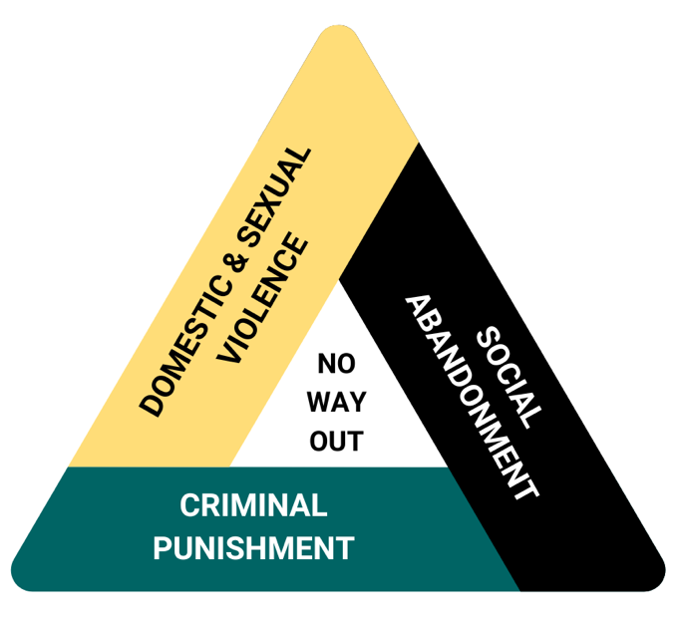
Domestic and sexual violence, the first element of this bind, has the distinguishing quality of being both stunningly common and potentially catastrophic for survivors and their families — both in terms of the immediate crisis of violence and the pernicious conditions of violence that accumulate over time. Every day in the United States, four women will be murdered by an intimate partner and over half of all homicides of women are domestic violence related.31 Gender violence is particularly deadly for trans women, Black women, Native women, and other survivors of color.32 Further, when survivors attempt to escape their abusive relationships, their abusers’ violence tends to escalate, becoming more rather than less lethal.33 Domestic and sexual violence produce heightened forms of deadly precarity for survivors, many of whom are forced to manage the punishing effects across time, their lives remaining haunted for years.
The second element of the bind, social abandonment, flags the decimation of the social safety net, punitive and exclusionary policies within existing social services, social isolation, and blame, all of which obstruct survivors who search for a route to safety. Courts justify punishing survivors who act in self-defense by holding survivors responsible for the violence they experience if they do not — or cannot — escape.34 But escape where? The chronic lack of safe, affordable, and accessible housing ensures there are few to zero escape locations. Several years of recent surveys by the National Network to End Domestic Violence found that “in a single day in 2024, domestic violence victims made 14,095 unmet requests for services” — including emergency shelter, housing, transportation, childcare, and legal representation — which could not be provided because programs lacked the resources to meet their needs.35 Further, some domestic violence shelters will not accept certain survivors of domestic violence, such as survivors with criminal convictions, trans and non-binary survivors, disabled survivors, survivors with children, or survivors who do not speak English.36 Shelters can also pose high risks if the program enacts punitive policies and practices — such as mandatory reporting policies that increase survivors’ vulnerability to being targeted by police or Child Protective Services, ultimately becoming integral to survivors’ criminalization.37
DSD contributor Anastazia Schmid who was criminalized for defending her life asserts that the criminal punishment system exploits the lack of safe housing options to “keep survivors incarcerated the whole time,” including while awaiting trial and as a reason for denying parole.38 Indeed, in a ‘no way out’ bind, emergency housing becomes a site of criminalization, while jails and prisons, sites of brutal punishment, are invoked as housing “solutions.” DSD contributors also emphasize that both incarceration and domestic and sexual violence can cause and create compounded economic insecurity. Gender-based violence and criminalization are powerful pressure points within racial capitalism, entrapping survivors within webs of violence that intersect and interlock with each other by design.
To detail further, the 1970s dismantling of the welfare state unfolded in concert with the era’s radical expansion of prisons, policing, and prosecution.39 This interdependent relationship took definitive form during Nixon’s and Reagan’s “wars” on crime and drugs, respectively, as Black women were scapegoated as so-called “welfare queens” to justify the severe cutbacks of food and housing support. It was intensified under Clinton’s 1994 Crime Bill and 1996 Welfare Reform Act, legislation that ossified this transition into what has become a “prison nation,” as Beth Richie writes.40 This development has recently escalated to disastrous levels with the Trump administration’s radical dismantling of the already inadequate social safety infrastructure and corresponding advancement of authoritarianist policies.41 These policies include mass removals of immigrants as well as military occupations of cities that destabilize communities, deepening a condition of social crisis for many survivors. Just this year, widespread ICE raids, including in “sensitive zones” such as shelters, have made immigrant survivors terrified to seek support.42 Federal funding already earmarked for housing and other services for survivors of domestic violence has also been threatened for cancellation, with the federal government citing grantees’ support of diversity, equity, and inclusion or services for trans survivors as a justification.43
Given the symbiotic relationship between the erosion of social resources needed to contend with gender-based violence and the intensification of prisons and policing, it is no surprise that survivors have become increasingly targeted with severe criminal punishment, the third element of the ‘no way out’ bind. In 2005, the New York Department of Correctional Services found that two-thirds of women incarcerated for killing someone close to them had been abused by that person.44 Survivors prosecuted for domestic homicide who do not conform to the “perfect victim” myth, such as being considered “good wives and mothers,” are more likely to receive a guilty verdict.45 In a 2007 resolution, the Criminal Justice Committee of the American Bar Association asserted that the judicial system frequently metes out long prison sentences and denies parole and clemency to survivors of domestic violence, assuring their long-term incarceration and, often, life-long punishment.46 For example, in a 2023 report, the UC Sentencing Project found that parole boards have refused to grant parole to incarcerated survivors because, if they disclose that they are survivors, the board uses the disclosure as evidence that they fail to take responsibility for their crime.47
The ’no way out’ bind is fundamentally anti-survivor and anti-survival. DSD contributors and other survivors have called for the transformation of each element of this bind and the dismantling of any legal structure capable of sustaining and endorsing this brutal trap. DSD contributor Renata Hill concludes, “I pray one day a new system will be created by people like us, those of us who have survived and lived through our experiences. This system was not made for us at all.”48 Hill was a member of the New Jersey 4, a group of Black lesbian friends who were targeted by prosecutors after they fought off an attacker who physically assaulted them and threatened to rape them.49 Given the ‘no way out’ bind, we can consider Hill’s assertation that “the system was not made for us at all” in the context of trying to defend one’s life while being systematically locked into a political-economic trap where the possibility of life is refused in all directions.
Further, Hill’s observation suggests that the system of “self-defense” itself, as a legal “right” or a cultural concept, was also not made for survivors at all. I turn to the legal formation and the social-political history of the concept of self-defense, exploring how survivors become blocked from accessing self-defense as a legal entitlement or a legitimate narrative about their experience within a social climate that reifies blame and punishment.
When Self-Defense Is Outside of the Law, Survival Is Outlawed
If self-defense is, in some ways, technically protected by the law, why are survivors being criminally punished for self-defense as if they are breaking the law? While the ‘no way out’ bind describes a political economy that locks survivors into a ‘loss of life or loss of freedom’ trap,50 survivors and researchers have described in detail how self-defense laws in the US were never designed to protect survivors’ lives. As historians contend, legal protection for self-defense was originally designed for property-owning white men.51 Courts commonly reject gender-based violence as legitimate justifications for self-defense, either by the law’s design or through its application.
Clarifying the scope of self-defense law in her legal appendix to the DSD report, legal scholar Sydney Moon states, “When defending against a homicide charge, self-defense law requires that the defendant . . . reasonably believed lethal force was both (1) necessary and (2) proportionate to repel an imminent attack which would have resulted in death or serious bodily injury.”52 Courts determine if these two standards — necessary and proportionate — have been met based on the “objective reasonableness” standard, or whether a “reasonable person” would agree that lethal force was necessary. In other words, survivors’ own evaluation of the need to use force is considered subjective, but, under law, the imagined reasonable person is considered objective.
Despite the fantasy of objectivity, what juries and judges understand as “reasonable” remains deeply anchored to the social and political context of the case and self-defense as a broader concept.53 Because of the social and political evolution of self-defense laws in the US, the dominant paradigm of “self-defense” fails to resonate with the reality of survivor self-defense. For example, legal narratives frequently center scenarios involving sudden attacks by strangers — often racialized as non-white men — as the default justification for the legal protection of self-defense.54 Yet, most women are killed by people that they know, and of those homicides, most are committed by people with whom victims had an intimate relationship. The Violence Policy Center found that, in 2019, ten times as many women were murdered by a man they knew (1,476 victims) than were killed by a man they did not know.55 Of the men that the victims knew, 62 percent were husbands or intimate acquaintances.56 Moreover, a Washington Post study found that 69 percent of trans women who were murdered between 2010 and 2015 were killed by acquaintances, half of whom were intimately involved with them.57 Yet decades of racist crime panic discourse have primed juries and judges with a “stranger as danger” narrative of self-defense that does not align with the majority of survivors’ experiences.
As DSD contributors show, the concept of “imminence” looms as a legal standard which requires a threat to be both imminent and immediately confrontational for self-defense to be legally defensible.58 Feminist advocates have argued that this standard fails to meet the living reality of gender violence in which the experience of an imminent threat can exist as a constant condition rather than a discrete event.59 For example, Michelle Horton, sister of criminalized survivor Nikki Addimondo and a leader in the campaign to free her, recounted that Addimondo’s legal team did not adequately explain “why a man would think he has such complete control over his victim that he doesn’t need to be on his feet at the time.”60 Therefore, imminence has long challenged feminist legal advocates to determine how to translate survivors’ lived experiences of gender-based violence within this legal framework of time.
In the late 1970s, Lenore Walker introduced the concept of “Battered Women’s Syndrome” to contend that domestic violence places survivors in states of “learned helplessness,” so that instead of escaping, survivors use lethal force when their abuser is not expecting it rather than wait for the violence to become immediately at hand.61 However, invoking Battered Women’s Syndrome often fails as a legal strategy for multiple reasons, such as the concept hinging on a stereotyped image of “victim” which tends to be racialized as white and,62 as Horton asserts, juries feeling alienated by a concept they perceive as pathologizing of women.63
In addition to implicit exclusion of survivors from the self-defense legal threshold, lawmakers explicitly deny survivors access to some self-defense protections. Stand Your Ground (SYG) laws, for example, aim to widen the scope of protection for self-defense, eliminating the longstanding “duty to retreat” requirement when one is faced with a violent threat and instead affirming people’s choice to “stand their ground” and use force if they perceive another person as a threat. However, some states intentionally exclude survivors of domestic violence from SYG protection. For example, a South Carolina prosecutor asserted that the state lawmakers’ intent for SYG “was to provide law-abiding citizens greater protections from external threats in the form of intruders and attackers. We believe that applying the statute so that [it reaches] into our homes and personal relationships is inconsistent with (its) wording and intent.”64 Denise Crisafi writes that, of the twenty-three states with SYG laws, only four of them “provide greater acknowledgement and enforcement of protections for victims of domestic violence and family violence,” yet eight of them “require victims of domestic violence to retreat before responding with deadly force.”65
In Marissa Alexander’s case the prosecutor used logic that directly contradicted the principle of SYG, arguing that, if Alexander was truly afraid, she should have retreated when attacked, even if it meant “jumping out of a window.”66 As I have argued elsewhere, although the stated purpose of SYG is, if one feels fear, one has the right to remain where one is and defend oneself, the court in Alexander’s case argued the reverse: because Alexander remained in the home and defended herself, she could not have been afraid.67 This established a contradiction impossible for her to resolve: fear was required to justify standing one’s ground, but to convincingly perform “fear” for the court, Alexander would have had to retreat.
Less than a year after Alexander was convicted, George Zimmerman, also based in Florida, was acquitted of killing Black teenager Trayvon Martin, the jury citing SYG as the reason for their decision.68 His acquittal reflects statistical patterns in which homicides against Black people are more likely to be deemed justifiable in SYG cases.69 Critics of SYG juxtaposed Zimmerman’s case with Alexander’s, arguing that the two cases exemplified how, from prosecution to defense, the application of SYG treats Black life as if it is disposable.70 In an interview Alexander interrogated the law as a dead-end route, asking, “If you do everything to get on the right side of the law, and it is a law that does not apply to you, where do you go from there?”“If you do everything to get on the right side of the law, and it is a law that does not apply to you, where do you go from there?”71
Contributors to the DSD report identify many limits of legal frameworks for self-defense, critically examining the anti-survivor climate within a judicial system that survivors are forced to navigate. They critique legal terms and defense strategies that are relevant to survivors who are prosecuted for defending their lives, such as Battered Women’s Syndrome and Stand Your Ground, as ultimately ineffective in their efforts to wage a legal defense and represent their own experiences. They wonder what metric used by the judicial system — what level of violence, how close to death — could ever activate their legal right to self-defense? How does one navigate a judicial system instilled with the power to determine whether one is legally permitted to go on living? As Wendy Howard asserts,
I think people don’t understand the constant abuse you’re going through and [the times] you didn’t use self-defense for previous abuse, like being strangled and held down by a full-grown man until you pass out. At what point are you allowed to defend yourself?72
DSD contributors assert that chronic dangers integral to an unjust legal system — such as lack of consistent access to skilled, respectful, and affordable counsel; the extreme financial and emotional costs of a trial; the dangers of pre-trial lock-up; and prosecutorial incentives to pursue the most severe convictions for survivors who use force to defend their lives — must urgently be addressed. However, others reflect on the hollowness of trying to defend yourself in a court system that is already organized around your destruction. For survivors, self-defense is lawlessness.
The Inconceivability of Self-Defense
While the DSD report outlines reforms recommended by contributors that may strengthen the possibility of their legal defense, contributors also make it clear that the reasons why the legal system punishes survivors for defending themselves exceed the letter of the law and even the structural violence built into legal proceedings. For example, DSD contributor Ky Peterson, a Black trans survivor, recounts,
My lawyer wanted to give me a plea deal and I’m telling him this is not right. And he tells me, ‘You got to think about living in the south, they see you walking in their neighborhood at night, they’re gonna swear you’re a criminal.’ Why would you say that? He’s telling me pretty much that you can’t defend yourself just because of how you look.73
The legal advice that Peterson received — “you can’t defend yourself because of how you look” — resonates with Marissa Alexander’s view that the cultural politics of self-defense has deep historical roots. She asserts,
I find that conceptions of ‘self-defense’ are rooted in a romanticized Western type of bad guy, good guy, Hollywood kind of thing, a very white heterosexual patriarchal lens. We want to start looking at self-defense with a broader lens [to understand the experiences of] women and then take it a step further and look at Black women. But from that realm, self-defense can’t even be conceived by these entities because they’ve had such a narrow ideology about what self-defense actually should look like. And since it is so pro-hetero, so pro-patriarchal, and so pro-white, it is very difficult for them to shift that.74
The inconceivability of self-defense for Black survivors in particular has a legacy established in slavery, such as in the case of Celia, a young Black woman in Missouri who was sentenced to death by hanging in 1855 for killing the man who enslaved and raped her for years.75 In her bracing study of the criminalization of Black women survivors during the Jim Crow era, historian Sarah Haley details how their “self-defense against domestic violence meant internment in carceral dungeons that they could not shake.”76 Then and now, Black women’s attempts to survive violence by intimate partners makes them vulnerable to violence by police, prosecutors, judges, and prison guards, entrapping them, as Haley writes, “in a circle of unyielding assault.”77 Further, Kali N. Gross argues that this refusal of US law to protect Black women who act in self-defense reflects legacies of an “exclusionary politics of protection” which bars Black women from legal protection from violence while simultaneously enacting punishing brutality against them.78
Native survivors are also prosecuted for defending their lives from deadly attacks produced by domestic and sexual violence, colonial control, and the crisis of missing and murdered Indigenous women, girls, and Two-Spirit people (MMIWG2S).79 As Chrystos writes about the women who were “locked in my joints:” “We are prisoners of a long war.”80 The 2021 federal prosecution of Maddesyn George, a member of the Colville Confederated Tribes and a survivor who defended herself from a non-tribal member who sexually assaulted her, exemplifies this long war of ongoing gendered colonial violence. As the defense committee of the Campaign to Free Maddesyn George asserted, “Incarceration is a tool of Indigenous removal, and Maddesyn is now missing from her community.” Their campaign teaches us how the criminalization of survivors sustains the continuity of genocidal violence.81
Survivor self-defense represents a refusal to comply with gendered norms, which also places them outside of conceivable self-defense. For example, police and courts often assert that survivors who fight back against rape and domestic violence do not do so out of self-defense or fear, but only out of vengeance, aggression, or anger.82 Criminalizing institutions rationalize this assertion by erasing survivors’ complex narratives and replacing them with already existing and available racist and sexist tropes, such as the “angry Black woman.”83 Likewise, when the New Jersey 4 defended themselves from sexual and physical violence in New York, the press facilitated their punishment by labeling them a “lesbian wolf pack,” instigating anti-Black and anti-lesbian public contempt which further armed prosecutors with powerful tropes.84 As Beth Richie reflects, “It is almost as if Black women in the court system are seen to not have a full range of emotions . . . not fear, pain, or terror.”85 Indeed, in her testimony for policymakers, Marissa Alexander asserted that she did not see why she could not have been both angry and afraid when she defended her life.86 Further, prisons attempt to coerce survivors into regurgitating these violent narratives in the name of “rehabilitation.” DSD contributor Alisha Walker assesses, “Instead of making a way to help heal traumatized survivors of domestic violence, they shame you and force you to believe you are the monster that the court made you out to be.”87
Prosecutors also characterize survivors engaged in criminalized action, such as the sex trade or street economies, as already guilty and outside of the law and, therefore, undeserving of protection when they act in self-defense. In their groundbreaking report, the Young Women’s Empowerment Project provide a nuanced definition of sex trade that incorporates several key factors: the complexity and diversity of survivors’ experiences across contexts of sex work, the sex trade, and sex trafficking; the importance of survivors defining their experiences on their own terms; and the reality that survivors in the sex industry are disproportionately vulnerable to experiencing violence and to being blamed for that violence.88 For example, in analyzing the criminalization of Alisha Walker and Cyntoia Brown, young Black women criminalized for acting in self-defense in the context of the sex trade, Mariame Kaba and Brit Schulte write:
Alisha’s act of self-defense was met with the violence of a racist court system that branded her a manipulative criminal mastermind. Alisha and Cyntoia were both young Black women whose bodies were inscribed with inherent criminality and were, to some degree, presumed guilty until proven innocent . . . Cyntoia and Alisha’s radical acts of self-love and preservation were criminalized by those with authority; each had the carceral weight of racism and whorephobia stacked against them.89
Further, immigrant survivors who are vulnerable to a web of criminalization from ICE and federal and state prisons often lack access to reforms that aim to end the criminalization of survivors, especially reforms that distinguish the so-called “deserving” from the “undeserving.”90 For example, immigrant survivors with criminal convictions, including for self-defense, can be disqualified from the Violence Against Women Act’s (VAWA) protection from deportation because their convictions prevent them from meeting the law’s “good moral character” standard, which punishes survivors for “failing” to conform to “perfect victim”/ “perfect immigrant” expectations.91 Moreover, if immigrant survivors incarcerated in state prisons receive rare opportunities for release through a governor’s commutation or sentencing reform, they can still be subject to relentless carceral punishment through ICE detention and deportation.92 DSD contributor Aylaliyah Birru analyzed the impact this prison-to-prison pipeline has on survivors’ lives. She noted,
I have been a victim of crime or abuse, but also I have been doubly, triply criminalized by the state and federal government as well . . . In prison I was able to get a lot of milestones. I got a little over two years taken off my six-year sentence. But then I was transferred to ICE detention because I was not a US citizen. So, I was in ICE detention for another year and a half, which basically was all the time that was taken off through my milestones, unfortunately. But you know, that’s just part of this horrible system.93
Birru reveals what other survivors, scholars, and activists also lay bare: in innumerable ways, a broad range of social identities and experiences are weaponized by police, prosecutors, juries, and judges to distort or dismiss survivors’ experiences of violence in order to justify their unyielding punishment.94 Tracy McCarter, the survivor at the center of the #StandWithTracy campaign, reflects, “I wonder if anyone who looks like me ever actually experiences the presumption of ‘innocence.’ I was marked guilty from the start. These labels mean nothing inside of a system that is itself guilty of stealing so many lives.”95
Reflecting on Black women’s resistance in the US along multiple fronts, Audre Lorde memorably emphasizes a lesson she says we must not forget: “We were never meant to survive.”96 Accordingly, self-defense as a legal claim, a social entitlement, or a cultural concept was not designed for survivors because it was never meant for survivors. Yet, as we have seen, survivors claim and reclaim self-defense as part of their testimony while navigating a world of meaning mobilized against their survival. As demonstrated in the political history of self-defense explored earlier, survivors not only defend their lives but find ways to define self-defense on their own terms, from the reality of their own experiences. In the next section, I review how DSD contributors map a paradigm of self-defense that resists systems of punitivity and affirms practices of connection, care, and freedom.
Self-Defense As Abolitionist Paradigm
Through their testimonies, analyses, and reflections, contributors to the Defending Self-Defense report outlined an expansive and transformative meaning of self-defense.97 Their view of self-defense includes more than its legal definition, and more than the act of using force, including deadly force, to protect themselves and others from another person’s violence. Taken together, I contend that the convergence of their ideas crystallizes an abolitionist feminist paradigm of self-defense.
Here, I propose nine principles of survivor self-defense based on their insights and ideas. The first three principles reflect survivors’ understanding of defending one’s life while being systematically locked into a ‘no way out’ bind, where the possibility of life is refused in all directions. In this context, survivors shape the meaning of self-defense as not just a safety strategy, but a survival imperative. The final six principles reveal how survivor self-defense has the capacity to clarify the stakes of survival beyond a carceral-patriarchal system of meaning. Together, these nine principles map a feminist abolitionist paradigm of self-defense, revealing how survivor self-defense ruptures the normalization of punishment and disposability, and models a practice, an ethic, and a way of being that affirms life.
Principle 1: Self-defense is how survivors halt an attack, whether imminent or unabating.
As noted above, imminence has long challenged feminist legal advocates to determine how to translate survivors’ lived experiences of gender-based violence within this legal framework of time. Rather than adapting the legal concept of imminence, DSD contributors described gender violence as unfolding within multiple formations of time: discrete instances of violent acts that are part of an escalation or feel like they come out of nowhere; threats of violence that are periodic or sustained; and violence that becomes so integral to domestic life that the “beginnings” and “ends” of violence lose meaning — violence just is. As this more complex temporality of violence reveals, survivors are forced to consider the broad context of violence while deciding in a “split-second” whether or how to defend themselves. As DSD contributor Ky Peterson reflected, “It’s not that we don’t care about other people. But it’s that split-second where you have to decide, do you want to live?”98
Further, the time of violence as experienced by survivors can be a lifetime of events including their many attempts at securing safety for themselves and others. DSD contributor Anastazia Schmid reflects, “We put so much focus and emphasis on the moment of the crime itself while we completely disregard every single thing that happened before, and every single thing that’s going to happen after . . . it’s like you are frozen forever as if there is nothing more to you as a person or nothing more to your life, other than that one single moment and incident.”99
In fact, as DSD contributors show, police, courts, and prisons shape the temporal experience of sexual and domestic violence as they become integral to the before, during, and afterlife of that violence. Their experiences reveal that punitive systems not only fail to consider survivors’ experience of gender-based violence, they are themselves a continuation of that violence. For example, as Colby Lenz and I argue elsewhere, court processes and procedures systematically stabilize and extend the violence that survivors experience, exhibiting signs of what we diagnose as “battering court syndrome.”100 Prosecuting survivors for defending themselves exemplifies battering court syndrome, a phenomenon in which a system that purports to repair violence only makes violence ever more imminent.
Principle 2: Self-defense is how survivors get to safety within a ‘no way out’ bind.
Patreese Johnson, a contributor to the DSD report, was also a member of the New Jersey 4. Johnson notes that the prosecutor attempted to blame her and her friends for being attacked because they did not call law enforcement for help, but when police did arrive on the scene, Johnson and her friends were arrested. As Johnson details, the police had a record of enacting unrelenting racist harassment and violence against herself, her family, and her community before this experience. She states,
Because of our history with the police, we’re definitely not calling the cops. It’s never the first thing to be like, oh my God, we’re being attacked, let’s call the cops. Nobody in our community would do that. We’re going to defend ourselves. Like, we know how to defend ourselves to the best of our ability and we all go home together. At that moment I’m thinking about saving myself. It’s not an option not to make it home.101
Though survivors who act in self-defense are often blamed for not seeking police for help, police often exacerbate violence rather than ensure survivors’ safety.102 The ‘no way out’ bind clarifies that institutions that survivors are expected to access in cases of life-threatening emergencies are also sites of punishment or physical danger. Yet, as Johnson states, it’s not an option not to make it home, which situates self-defense as a life imperative.
Principle 3: Self-defense is how survivors stay alive amidst social abandonment.
Mariame Kaba and Andrea Ritchie summarize a core irony at the heart of replacing the social welfare state with the carceral state: “Cops fuel the problem and then offer themselves as the only viable solution.”103 As noted above, US political leaders pursued a decades-long systemic divestment from non-carceral resources for safety and survival, leaving survivors with police as their only resource. Yet, police often fail to support survivors for a myriad of reasons, including believing the issue is a private family matter, assessing the survivor as not credible, or simply viewing that person as disposable.104 Given limited public resources, the failures of police to respond to violence can lead to catastrophic consequences.
As the anti-violence field became increasingly collaborative with carceral systems, advocates called for mandatory arrest policies to address the problem of police abandonment. Becoming widespread in the 1980s and 1990s, mandatory arrest policies required police to arrest the person whom they determined was the appropriate person to arrest when responding to domestic violence calls.105 While supporters hoped mandatory arrest would compel police to more effectively support survivors, the arrest and death rates of many survivors, especially Black survivors, increased.106
Even in mandatory arrest states, police continue to dismiss survivors in life-threatening circumstances.107 For example, DSD contributor Bresha Meadows was fourteen years old at the time she was arrested in Ohio for defending her life and her family from her abusive father. She recounted her experience trying to get help before she was forced to take defensive action, stating,
I called the cops to let them know I had run away and I didn’t feel safe at home. I told them that I didn’t feel comfortable going back. They told me to come to the police station because I was still a runaway and whoever I was with would get a kidnapping charge. So I did go to the police station, and they sent me home with no questions whatsoever.108
Together, Patreese Johnson and Bresha Meadows teach us that police intervention and police abandonment are, in fact, different sides of the same coin: police intervention can escalate gender violence, while police abandonment can affirm gender violence. Given the dismantling of the social safety infrastructure, positioning police as an emergency response to gender-based violence, whether they respond or not, leaves survivors with the essential option of self-defense — they are their own life-saving resource.
Principle 4: Self-defense is a life-affirming practice.
While the law frames self-defense as a specific act that occurs after and in response to another act, survivors describe self-defense as a practice that is stretched across time. Self-defense occurs before, during, and after the single act for which survivors are targeted for prosecution and includes all the strategies survivors use to try to de-escalate or escape violence before they use force. After they have been criminalized, survivors continue to defend themselves using an array of strategies: self-advocacy while in brutal contexts of incarceration; affirming the truth of their experience of violence even when it means continued punishment; fighting for clemency to secure release from prison and/or protection from being targeted by ICE; conducting legal research and working with advocates to make strategic legal decisions, including whether to go to trial or negotiate a plea deal; taking action to support their physical and emotional well-being; telling their stories on their own terms; and cultivating life-sustaining family and community support. As an ongoing practice, self-defense flags a form of feminist world-making that incorporates practices, relationalities, and systems of meaning that affirm survivors and their lives.
Principle 5: Self-defense resists identity annihilation.
Domestic violence, sexual violence, and carceral violence attempt to obliterate survivors’ sense of self. These forces of violence create what Mariame Kaba describes as a social structure in which there are “no selves to defend.”109 Stormy Ogden’s description of her entry into prison resonates with this experience; she writes, “On the first day when we first get off the bus, we are no longer our own person; we belong to the state of California . . . We are stripped of our identity; names are replaced by numbers, and for us, the pride of being native is stripped down to being Other.”110 Tracy McCarter also recounts that, after her arrest, her booking and case numbers replaced her name, writing, “My very identity was an early casualty.”111 DSD contributors and other survivors also describe efforts to resist this violence of erasure. CeCe McDonald asserts, “[This system] wanted me to delegitimize myself as a trans woman — and I was not taking that. As a trans woman — as a proud Black trans woman — I was not going to allow the system to delegitimize and hyper-sexualize and take my identity away from me.”112 Thus, self-defense may be imagined as both a defense and a recovery of a survivor’s sense of self.
Principle 6: Self-defense is collective defense.
Almost all of the survivors who contributed to the DSD report had experiences collaborating with grassroots participatory defense campaigns to advocate for their own and/or others’ freedom through collective defense. As noted above, a defense campaign can mobilize large numbers of individuals and organizations to participate in the practice of defense, including signing petitions calling for survivors’ freedom, organizing rallies, engaging in mass letter-writing to those in power and to the survivor, bringing strategic media attention to the case, facilitating community forums and vigils, fundraising for legal defense funds, and leading court watches.113 These collective defense strategies create a powerful locus of mass support, connection, and political momentum for survivors who are isolated through incarceration, social stigma, and media distortions. Reflecting on the impact of her defense campaign, Wendy Howard recounts,
I had so much community support. They did protests, news media coverage, and my family was a real voice. After I made bail, one of the friends that I wrote to said that she heard the bailiff saying they had never seen something like that ever happen. So, I attribute that to community support and community pressure.114
Organizing to defend self-defense, then, clarifies that the “self” and the “collective” are not necessarily oppositional concepts of being. Rather, both can emerge within a reciprocal relationship that makes freedom possible.
Principle 7: Self-defense echoes and connects survivors across time and space.
Self-defense can be an act of faith that connects people to one another, which enables and expands freedom in unexpected ways. Participatory defense campaign efforts build on the body of self-defensive actions that the survivor has taken, which, in turn, creates a pathway for future survivors to fight for freedom. In discussion with Marissa Alexander, Tewkunzi Green shared how Alexander’s release was pivotal to her own process of advocating for her freedom:
I saw your case on CNN and when they said she’s getting out, and I’m like, wow, that was so amazing that she got out. And then I was like, if she could do it, I definitely can. So you inspired me. . . . I’ve always been the type of person who would be embarrassed about what I’m about to say, I just crawl in my shell like a turtle. And I felt like that for years until when you came home. When you came home, you spoke your voice on CNN news and that pushed me even harder. I was doing all of my paralegal research. I sat in a room at night, I was up until three, four o’clock in the morning some nights, trying to write out things. I sent that all out in January and in the beginning of March, Rachel [White-Domain] and them came, and I was like, wow that didn’t take long. So on that day, more people started getting involved. In the midst of that time, I was [also] seeing Ky’s story, and that inspired me. Then I heard about Bresha’s case and then it was like, okay, everybody had similar problems. So this is God telling me like, wake up. I’m giving you all the signs. So you need to get going and that’s when I started doing the advocate work from the inside of the prison.115
Green’s experience of hearing God through “hearing” about other survivors’ fight for freedom resonates with the echoes between survivor defense campaigns, such as the refrain from Inez García’s campaign: Inez will be free because Joan is free.116 These testimonies teach us that survivor self-defense can enable the freedom of other survivors or, in the words of poet Gwendolyn Brooks, “We are each other’s harvest; we are each other’s business; we are each other’s magnitude and bond.”117
Principle 8: Abolition means that survivors’ lives are essential.
The collective vision holds that no one would be targeted with violence and, consequently, no one would be forced to use violence to save their lives. Towards that end, survivor self-defense is an abolitionist ethic. It demands an end to domestic and sexual violence, anti-trans and anti-queer violence, and racial, economic, and carceral violence. Further, as DSD contributors insist, the end of this violence requires the transformation of a world that remains committed to these forms of violence. Survivor self-defense unfolds within the intersections of these forms of violence and exposes the interlocking structures of this violence. Therefore, survivors’ lives are not incidental to abolition nor a reason to reject abolition; they are central to abolition. As a practice of refusal, self-defense reveals a core truth that, while these layered and intersecting forms of violence are pervasive and powerful, they are not inevitable.118
Principle 9: Self-defense is a practice of freedom.
Assata Shakur teaches us that “it is our duty to fight for our freedom.”119 Contributors to the DSD report outline specific policy, legal, and political recommendations for transformative action that support the safety and freedom of survivors who act in self-defense, including those still behind bars. Survivor self-defense requires proactive and collaborative efforts to dismantle “perfect victim” paradigms and build stronger networks of care and connection on both sides of the bars and across them. In short, as Mary Shields asserts, “We absolutely stick together and fight it.”120 If survival itself is against the law — resistant to the law, oppositional to the law — then survivor self-defense, as a life-affirming ethic, can act as a corrosive to the carceral state. Survivor self-defense bolsters resistance to violence, insists on solidarity as a practice that is part of everyday life, demands a world in which freedom is abundant rather than exceptional, and, to quote DSD contributor Robbie Hall, allows survivors the space to breathe.121
This essay is indebted to DSD contributors and co-authors, including Marissa Alexander, Aylaliyah (Liyah) Birru, Moni Cosby, Tewkunzi Green, Robbie Hall, Renata Hill, Wendy Howard, Patreese Johnson, Roshawn Knight, Colby Lenz, Bresha Meadows, Sydney Moon, Ky Peterson, Anastazia Schmid, Hyejin Shim, and Alisha Walker, as well as Jakeya Caruthers, Emily Thuma, and members of the broader survivor defense community. I also appreciate the very helpful feedback of the journal editors, the special issue editors, Emily Thuma and Sarah Haley, and the anonymous reviewers. The research for this essay was generously supported by the American Council of Learned Societies.
Click here to read or download a designed-for-print version of this article.

Click here to download a print-and-fold booklet version of this article.
Endnotes
- Marissa Alexander, “Not Another Victim –– I’m an Empowered Survivor Defendant,” TEDxFSCJ Talk, Jacksonville, FL, April 2019, 17 min., 4 sec., https://www.ted.com/talks/marissa_alexander_not_another_victim_i_m_an_empowered_survivor_defendant[↑]
- Andrew Van Dam, “Less than 1% of Rapes Lead to Felony Convictions. At Least 89% of Victims Face Emotional and Physical Consequences,”Washington Post, October 6, 2018, https://www.washingtonpost.com/business/2018/10/06/less-than-percent-rapes-lead-felony-convictions-least-percent-victims-face-emotional-physical-consequences/; Julie Goldscheid et al., “Responses from the Field: Sexual Assault, Domestic Violence, and Policing” (ACLU, October 2015); Radha Iyengar, “Does the Certainty of Arrest Reduce Domestic Violence? Evidence from Mandatory and Recommended Arrest Laws,” Journal of Public Economics 93, no. 1 (2009): 10.[↑]
- Mary E. Gilfus, “Women’s Experiences of Abuse as a Risk Factor for Incarceration: A Research Update,” VAWnet Applied Research Forum, December 2002, https://vawnet.org/material/womens-experiences-abuse-risk-factor-incarceration-research-update; Wendy Sawyer, “The Gender Divide: Tracking Women’s State Prison Growth” (Prison Policy Initiative, 2018), https://www.prisonpolicy.org/reports/women_overtime.html; Francine T. Sherman and Annie Balck, “Gender Injustice: System-Level Juvenile Justice Reforms for Girls” (The National Crittenton Foundation, National Women’s Law Center, 2015), https://nwlc.org/wp-content/uploads/2015/08/ed_rp_gender_injustice.pdf.[↑]
- Malika Saada Saar et al., “The Sexual Abuse to Prison Pipeline: The Girls’ Story” (The Human Rights Project for Girls, Georgetown Law Center on Poverty and Inequality, and the Ms. Foundation for Women, 2015), http://rights4girls.org/wp-content/uploads/r4g/2015/02/2015_COP_sexual-abuse_layout_web-1.pdf.[↑]
- See for example, Alisa Bierria and Colby Lenz, “Battering Court Syndrome: A Structural Critique of Failure to Protect,” in The Politicization of Safety: Critical Perspectives on Domestic Violence Responses, ed. Jane Stoever (New York University Press, 2019), 91–118; Andrea Ritchie, Invisible No More: Police Violence Against Black Women and Women of Color (Beacon Press, 2017); and Lee Ann S. Wang, “Unsettling Innocence: Rewriting The Law’s Invention of Immigrant Woman as Cooperator and Criminal Enforcer,” The Scholar and Feminist Online 13, no. 2 (2016), https://sfonline.barnard.edu/navigating-neoliberalism-in-the-academy-nonprofits-and-beyond/lee-ann-wang-unsettling-innocence-rewriting-the-laws-invention-of-immigrant-woman-as-cooperator-and-criminal-enforcer/.[↑]
- Monica Cosby and Sarah Ross, “Appendix A: Power & Control Wheel – Intimate Partner Violence & State Violence,” in Defending Self-Defense: A Call to Action by Survived & Punished (Survived & Punished, 2022); Linda Field and Andrea Bible, “Free Battered Women,” in Interrupted Life: Experiences of Incarcerated Women in the United States, ed. Rickie Solinger et al. (University of California Press, 2010); Leigh Goodmark, Imperfect Victims: Criminalized Survivors and the Promise of Abolition Feminism, (University of California Press, 2023).[↑]
- Survived & Punished, Defending Self-Defense.[↑]
- When citing research, I use the gendered terms the authors use in their writing. However, some of the survivors referred to in that existing research may themselves identify as trans, gender non-conforming, or non-binary but are not recognized as such in the literature itself.[↑]
- Survived & Punished, Defending Self-Defense, 24-35.[↑]
- While the report was collaboratively produced and Survived & Punished should be understood as the author of the report itself, several sections of the report were written by each of the four lead researchers. I wrote the brief introduction, entitled “Why Are Survivors Punished for Defending Their Lives,” which is the seed for this essay. Importantly, the report’s introduction includes several critical findings and greatly benefited from editorial feedback from the DSD team and S&P network. This essay has been circulated to the DSD team for feedback and permission.[↑]
- I use the phrase “survivors and organizers” to flag that the identities and the corresponding experiences and practices of “survivors” and “organizers” are not always discrete but are, in fact, often intertwined. Because the category of “survivor” tends to be de-politicized, and the category of “organizer” tends to be masculinized, I use the phrase to invoke identities that are both overlapping and intersecting.[↑]
- Emily Thuma, All Our Trials: Prisons, Policing, and the Feminist Fight to End Violence (Haymarket Books, 2024).[↑]
- Robin Mcduff et al., “Letter to the Anti-Rape Movement (1977)”, in Open Letter to the Anti-Rape Movement, ed. Mariame Kaba (Project Nia, 2020), https://issuu.com/projectnia/docs/letter-to-the-antirape-movement; Beth Richie, Arrested Justice: Black Women, Violence, and America’s Prison Nation (NYU Press, 2012); Thuma, All Our Trials.[↑]
- Angela Y. Davis, “Joan Little: The Dialectics of Rape,” Ms. Magazine, 1975; Mariame Kaba, ed., No Selves to Defend: A Legacy of Criminalizing Women of Color for Self-Defense (Chicago Alliance to Free Marissa Alexander, 2014), https://noselves2defend.files.wordpress.com/2016/09/noselvestodefend_v5.pdf; Thuma, All Our Trials.[↑]
- Thuma, All Our Trials.[↑]
- Donna Coker and Lindsay C. Harrison, “The Story of Wanrow: The Reasonable Woman and the Law of Self–Defense,” in Criminal Law Stories, ed. Donna Coker and Robert Weisberg (Foundation Press, 2013), 213–62; Christina Green, Free Joan Little: The Politics of Race, Sexual Violence, and Imprisonment. Justice, Power, and Politics (University of North Carolina Press, 2022); Thuma, All Our Trials.[↑]
- Mimi E. Kim, “The Carceral Creep: Gender-Based Violence, Race and the Expansion of the Punitive State, 1973-1983,” Social Problems 67, no. 2 (2020); Richie, Arrested Justice, 65-98.[↑]
- Mimi E. Kim, “From Carceral Feminism to Transformative Justice: Women-of-Color Feminism and Alternatives to Incarceration,” Journal of Ethnic & Cultural Diversity in Social Work 27, no. 3 (2018).[↑]
- Incite! ed., “Incite! Critical Resistance Statement on Gender Violence and the Prison Industrial Complex”; Color of Violence: The INCITE! Anthology (Duke University Press, 2016); Kim, “From Carceral Feminism to Transformative Justice.”[↑]
- Alisa Bierria et al., “Free Marissa Now and Stand with Nan-Hui: A Conversation About Parallel Struggles,” The Feminist Wire, June 30, 2015, https://thefeministwire.com/2015/06/free-marissa-and-stand-with-nan-hui/.[↑]
- Hyejin Shim and Soniya Munshi, “Perspectives: Stand with Nan-Hui: Intimate Violence, Systemic Violence, and Community Accountability,” Law at the Margins, April 28, 2015, https://lawatthemargins.com/perspectives-stand-with-nan-hui-intimate-violence-systemic-violence-and-community-accountability/.[↑]
- Bierria et al., “Free Marissa Now and Stand With Nan-Hui.”[↑]
- “About Survived & Punished,” Survived & Punished, 2018, https://survivedandpunished.org/about/; Bierria et al., “Free Marissa Now and Stand With Nan-Hui”; Alisa Bierria et al., eds., #SurvivedAndPunished: Survivor Defense as Abolitionist Praxis, (Love & Protect and Survived & Punished, 2017), https://survivedandpunished.org/defense-campaign-toolkit/. [↑]
- Field and Bible, “Free Battered Women”; “Convicted Women Against Abuse Fact Sheet,” Sin by Silence, http://www.sinbysilence.com/pressmaterials/cwaafacts.html; Patricia Gagné, “Identity, Strategy, and Feminist Politics: Clemency for Battered Women Who Kill,” Social Problems 43, no. 1 (February 1996); Patricia Gagné, Battered Women’s Justice: The Movement for Clemency and the Politics of Self-Defense (Twayne Publishers, 1998); Michigan Women’s Justice & Clemency Project, “Clemency for Battered Women in Michigan: A Manual for Attorneys, Law Students and Social Workers.”[↑]
- Colby Lenz, “Organizing in the Impossible: The Movement to End Life Without Parole in California,” (PhD diss, University of Southern California, 2022).[↑]
- Survived & Punished, Defending Self-Defense, 43.[↑]
- See for example, Michelle Alexander, “Not Another Victim”; Tracy McCarter, “As a Black Woman Accused of Killing a White Man, I Was Never Innocent Until Proven Guilty,” Truthout, October 2, 2023, https://truthout.org/articles/as-a-black-woman-accused-of-killing-a-white-man-i-was-never-innocent-until-proven-guilty/; Cyntoia Brown and Bethany Mauger, Free Cyntoia: My Search for Redemption in the American Prison System, (Atria Books, 2019); Cece McDonald et al., “How Much Do My Black Life Matter? A Conversation with CeCe McDonald and Ky Peterson,” in Abolition Feminisms, Volume 1: Organizing, Survival, & Transformative Practice, eds., Alisa Bierria, Jakeya Caruthers, and Brooke Lober (Haymarket Books, 2022); and Stormy Ogden, “What Was My Crime? Being an American Indian Woman,” POSTSCRIPT, June 16, 2021, https://web.archive.org/web/20221130172258/https://www.postscript.london/feature/what-was-my-crime.[↑]
- Alexander, “Not Another Victim.”[↑]
- Zerlina Maxwell, “How Stand Your Ground Laws Failed Marissa Alexander,” Essence, October 27, 2020, http://www.essence.com/news/how-stand-your-ground-laws-failed-marissa-alexander/.[↑]
- I propose this model as kindred to the “Violence Matrix,” Beth Richie’s brilliant Black Feminist conceptual framework that clarifies the multidimensionality of violence against Black women, outlining in detail how male violence against Black women unfolds within a “prison nation” across forms, contexts, and modalities of violence. (Richie, Arrested Justice, 133-140). While the Violence Matrix elucidates the details of a broader structure of violence based on Black women’s lived experiences, the ‘no way out’ bind focuses on how survivors who are forced to defend their lives become locked into a trap systematically designed to make survival impossible.[↑]
- Emma E. Fridel and James Alan Fox, “Gender Differences in Patterns and Trends in U.S. Homicide, 1976–2017,” Violence and Gender 6, no. 1 (March 2019): 27–36; Emiko Petrosky et al., “Racial and Ethnic Differences in Homicides of Adult Women and the Role of Intimate Partner Violence — United States, 2003–2014,” Morbidity and Mortality Weekly Report 66, no. 28 (July 21, 2017).[↑]
- See a more detailed overview of statistics in the DSD report (Survived & Punished, Defending Self-Defense, 9–10).[↑]
- Jacquelyn C. Campbell et al., “Risk Factors for Femicide in Abusive Relationships: Results From a Multisite Case Control Study,” American Journal of Public Health 93, no. 7 (July 2003).[↑]
- See for example, Marissa Alexander’s case which is explored later in this essay as a “Stand Your Ground” case.[↑]
- National Network to End Domestic Violence, “19th Annual Domestic Violence Counts Report” (National Network to End Domestic Violence, 2024), NNEDV.org/DVCounts.[↑]
- See for example, Emi Koyama, “Disloyal to Feminism: Abuse of Survivors within the Domestic Violence Shelter System,” in Color of Violence: The Incite! Anthology, ed. Incite! (Duke University Press, 2016); Ana Clarissa Rojas Durazo, “‘We Were Never Meant to Survive’: Fighting Violence Against Women and the Fourth World War,” in The Revolution Will Not Be Funded: Beyond the Nonprofit Industrial Complex, ed. Incite! (Duke University Press, 2017).[↑]
- Romina Garcia, “‘All Canned Foods Are Expired but Still Edible’: A Critique of Anti-Violence Advocacy and the Perpetuation of Antiblackness,” in Abolition Feminisms, Volume 2: Feminist Ruptures against the Carceral State, ed. Alisa Bierria, Jakeya Caruthers, and Brooke Lober (Haymarket Books, 2022); Dorothy E. Roberts, Torn Apart: How the Child Welfare System Destroys Black Families—and How Abolition Can Build a Safer World (Basic Books, 2022).[↑]
- Survived & Punished, Defending Self-Defense, 41.[↑]
- Loïc Wacquant, Punishing the Poor: The Neoliberal Government of Social Insecurity (Duke University Press, 2009), 41, 84, 307.[↑]
- Dana Cuomo, “Geographies of Policing: Domestic Violence, Mandatory Arrest, and Police Liability,” Antipode 53, no. 1 (2021): 144; Richie, Arrested Justice, 99-124.[↑]
- Eric Cortellessa and Brian Bennett, “Inside Donald Trump’s Mass-Deportation Operation,” TIME, June 10, 2025, https://time.com/7291757/trump-deportation-ice-el-salvador/; Will Fischer and Erik Gartland, “Rental Assistance Time Limits Would Place More Than 3 Million People — Half of Them Children — at Risk of Eviction and Homelessness,” (Center on Budget and Policy Priorities, July 18, 2025), https://www.cbpp.org/research/housing/rental-assistance-time-limits-would-place-more-than-3-million-people-half-of-them; Louis Jacobson, “Fact-Checking Trump’s Claims about Medicaid Cuts in GOP Bill,” Al Jazeera, May 25, 2025, https://www.aljazeera.com/news/2025/5/25/fact-checking-trumps-claims-about-medicaid-cuts-in-gop-bill; Tami Luhby, “2.4 Million People Expected to Lose Food Stamps after Trump Agenda Law Broadened Work Requirements, CBO Says,” CNN, August 11, 2025, https://www.cnn.com/2025/08/11/politics/food-stamps-work-requirements-trump-bill.[↑]
- Juliana Jiménez J., “Immigrant Victims of Domestic Violence Scared to Seek Help amid ICE Deportation Threat,” NBC News, August 15, 2025, https://www.nbcnews.com/news/latino/ice-immigrant-victims-domestic-abuse-scared-deportation-threat-rcna224711; Jessica Kutz, “What a New Immigration Directive Could Mean for Domestic Violence Victims,” The 19th, January 21, 2025, https://19thnews.org/2025/01/ice-trump-immigration-sensitive-zones-domestic-violence/.[↑]
- As of this writing, a federal court has issued a temporary order preventing these cuts, but the destabilization of funding alone has been very disruptive for anti-violence organizations; Daniel Wiessner, “US Judge Blocks Trump Administration Limits on Domestic Violence Grants,” Reuters, August 8, 2025, https://www.reuters.com/legal/government/us-judge-blocks-trump-administration-limits-domestic-violence-grants-2025-08-08/.[↑]
- Michele Staley, “Female Homicide Commitments, 1986 vs. 2005” (State of New York Department of Correctional Services, July 2007).[↑]
- Ryan Elias Newby, “Evil Women and Innocent Victims: The Effect of Gender on California Sentences for Domestic Homicide,” Hastings Women’s Law Journal 22, no. 1 (Winter 2011): 113–156, https://repository.uchastings.edu/hwlj/vol22/iss1/5/.[↑]
- Jane H. Aiken et al., “Report for Recommendation 102A: Domestic Violence Victims and Incarceration” (Criminal Justice Section, American Bar Association, February 12, 2007).[↑]
- Joseph Hankins, et al., “Maximizing Time, Maximizing Punishment: The Lived Experience of Long-TermSentences in California Women’s Prisons,” (University of California Sentencing Project, 2023), 27-28.[↑]
- Survived & Punished, Defending Self-Defense, 36.[↑]
- Out in the Night: Criminalization of Race, Gender Identity, and Sexuality, directed by blair dorosh-walther (2014).[↑]
- Alexander, “Not Another Victim.”[↑]
- Caroline E. Light, Stand Your Ground: A History of America’s Love Affair with Lethal Self-Defense (Beacon Press, 2017).[↑]
- Sydney Moon, “Appendix C: Legal Defenses for Self-Defense,” in Defending Self-Defense: A Call to Action by Survived & Punished (Survived & Punished, 2022).[↑]
- Sharon Angela Allard, “Rethinking Battered Woman Syndrome: A Black Feminist Perspective,” UCLA Women’s Law Journal 1 (1991); Alisa Bierria, “Structural Racism Within Reason,” American Philsophical Quarterly 60, no. 4 (2023); Coker & Harrison, “The Story of Wanrow”; Light, Stand Your Ground.[↑]
- See, for example, Light, Stand Your Ground.[↑]
- Violence Policy Center, “When Men Murder Women: An Analysis of 2019 Homicide Data,” September 2021, 3, https://www.vpc.org/studies/wmmw2021.pdf.[↑]
- Violence Policy Center, “When Men Murder Women,” 3.[↑]
- Samantha Schmidt, Brittany Renee Mayes, and Nia Decaille, “Surviving as a Black Transgender Woman in Baton Rouge,” Washington Post, June 29, 2021, https://www.washingtonpost.com/dc-md-va/2021/06/28/transgender-women-homicides-intimate-partner-violence/.[↑]
- Survived & Punished, Defending Self-Defense.[↑]
- Coker and Harrison, “The Story of Wanrow”; Sydney Moon, “Appendix C: Legal Defenses for Self-Defense.”[↑]
- Defending Self-Defense focus groups (2021).[↑]
- Cristina G. Messerschmidt, “A Victim of Abuse Should Still Have a Castle: The Applicability of the Castle Doctrine to Instances of Domestic Violence,” Journal of Criminal Law and Criminology 106, no. 3 (Summer 2016): 609-610.[↑]
- Allard, “Rethinking Battered Woman Syndrome: A Black Feminist Perspective.”[↑]
- Defending Self-Defense focus groups (2021).[↑]
- Quoted in Nicole Flatow, “South Carolina Prosecutors Say Stand Your Ground Doesn’t Apply To Victims Of Domestic Violence,” October 14, 2014, https://web.archive.org/web/20141118041936/https://thinkprogress.org/justice/2014/10/14/3579407/south-carolina-prosecutors-say-stand-your-ground-doesnt-apply-to-victims-of-domestic-violence/.[↑]
- Denise Crisafi, “No Ground to Stand Upon?: Exploring the Legal, Gender, and Racial Implications of Stand Your Ground Laws in Cases of Racial Implications of Stand Your Ground Laws in Cases of Intimate Partner Violence,” (PhD diss, University of Central Florida, 2016), 112; Messerschmidt, “A Victim of Abuse Should Still Have a Castle,” 620-621.[↑]
- State of Florida vs Marissa Danielle Alexander, State’s Motion in Opposition of Defendant’s Motion for Immunity, 162010CF008579A (Circuit Court of the Fourth Judicial Circuit 2011).[↑]
- Bierria, “Structural Racism Within Reason,” 363.[↑]
- Nicole Flatow, “Zimmerman Juror Says Panel Considered Stand Your Ground In Deliberations: ‘He Had A Right To Defend Himself,’” Think Progress, July 16, 2013, https://web.archive.org/web/20130716211006/http://thinkprogress.org/justice/2013/07/15/2306631/zimmerman-juror-says-panel-considered-stand-your-ground-he-had-a-right-to-defend-himself/.[↑]
- John Roman, “Do Stand Your Ground Laws Worsen Racial Disparities?” (Urban Institute, August 8, 2012), https://www.urban.org/urban-wire/do-stand-your-ground-laws-worsen-racial-disparities.[↑]
- As a consequence of how the public connected the two cases, and how organizers mobilized these contradictions to demand Marissa’s freedom, Marissa’s story became linked to the emerging Black Lives Matter movement that was, in part, catalyzed by George Zimmerman’s murder of Trayvon Martin.[↑]
- Chuck Hadad, “‘Stand Your Ground’ Denied in Domestic Violence Case,” CNN, April 24, 2012, https://www.cnn.com/2012/04/24/justice/ac360-stand-your-ground-law/index.html.[↑]
- Survived & Punished, Defending Self-Defense, 9.[↑]
- Survived & Punished, Defending Self-Defense, 31.[↑]
- Survived & Punished, Defending Self-Defense, 12.[↑]
- Saidiya V. Hartman, “Seduction and the Ruses of Power,” Callaloo 19, no. 2 (1996): 537–60; Mariame Kaba, “Black Women Punished for Self-Defense Must Be Freed from Their Cages,” The Guardian, January 3, 2019, https://www.theguardian.com/commentisfree/2019/jan/03/cyntoia-brown-marissa-alexander-black-women-self-defense-prison.[↑]
- Sarah Haley, No Mercy Here: Gender, Punishment, and the Making of Jim Crow Modernity (University of North Carolina Press, 2016), 190.[↑]
- Haley, No Mercy Here, 192.[↑]
- Kali Nicole Gross, “African American Women, Mass Incarceration, and the Politics of Protection,” Journal of American History 102, no. 1 (June 1, 2015).[↑]
- Luana Ross, Inventing the Savage: The Social Construction of Native American Criminality (University of Texas Press, 1998); Amnesty International, “The Never-Ending Maze: Continued Failure to Protect Indigenous Women from Sexual Violence in the USA,” 2022, https://www.amnesty.org/en/documents/amr51/5484/2022/en/.[↑]
- Chrystos, “I Walk in the History of My People,” in Not Vanishing (Press Gang Publishers, 1988), 7.[↑]
- Free Maddesyn George Defense Committee, “Defense Committee Statement on Sentencing,” Free Maddesyn George, November 22, 2021, https://www.freemaddesyn.com/sentencing.[↑]
- Allard, “Rethinking Battered Woman Syndrome”; Leigh Goodmark, “When Is a Battered Woman Not a Battered Woman? When She Fights Back,” Yale Journal of Law & Feminism 20, no. 4 (2007): 75–129.[↑]
- Bierria, “Structural Racism Within Reason.”[↑]
- Incite! & FIERCE!, “Re-Thinking ‘The Norm’ In Police/Prison Violence & Gender Violence: Critical Lessons From the New Jersey 7,” Left Turn Magazine, September 2008.[↑]
- Melissa Jeltsen, “Jury Begins Deliberations In Trial Of Woman Accused Of Killing Her Alleged Abuser,” HuffPost, March 29, 2016, https://www.huffpost.com/entry/cherelle-baldwin-woman-killed-abuser-connecticut_n_56fae545e4b0a06d5803dcd4.[↑]
- Marissa Alexander, Video Testimony for Incarceration Roundtable, Office of Violence Against Women, 2015.[↑]
- Survived & Punished, Defending Self-Defense, 39.[↑]
- Jazeera Iman et al., “Girls Do What They Have to Do to Survive: Illuminating Methods Used by Girls in the Sex Trade and Street Economy to Fight Back and Heal” (Young Women’s Empowerment Project, 2009).[↑]
- Mariame Kaba and Brit Schulte, “Not A Cardboard Cutout: Cyntoia Brown and the Framing of a Victim,” The Appeal, December 7, 2017, https://theappeal.org/not-a-cardboard-cut-out-cyntoia-brown-and-the-framing-of-a-victim-aa61f80f9cbb/. See also Brown and Mauger, Free Cyntoia.[↑]
- Survived & Punished, Defending Self-Defense, 14, 29, 34; Survived & Punished NY, “Preserving Punishment Power: A Grassroots Abolitionist Assessment of New York Reforms” (Survived & Punished NY, 2020), https://www.survivedandpunishedny.org/wp-content/uploads/2020/04/SP-Preserving-Punishment-Power-report.pdf; Victoria Law, “Immigrants Who Defend Themselves From Sexual Violence Face Prison, Deportation,” Truthout, June 10, 2020, https://truthout.org/articles/immigrants-who-defend-themselves-from-sexual-violence-face-prison-deportation/.[↑]
- Wang, “Unsettling Innocence.”[↑]
- Leoni Fred, “The Invisible Voices of the Movement to End Violence against Women: Immigrant Survivors with Criminal Convictions,” University of Miami Race and Social Justice Law Review 8, no. 1 (2018): 57–82.[↑]
- Survived & Punished, Defending Self-Defense, 34.[↑]
- Survived & Punished, Defending Self-Defense, 14.[↑]
- McCarter, “As a Black Woman Accused.”[↑]
- Audre Lorde, “The Transformation of Silence into Language and Action,” in Sister Outsider: Essays and Speeches (Crossing Press, 1984), 42.[↑]
- Survived & Punished, Defending Self-Defense.[↑]
- Defending Self-Defense focus groups, 2021.[↑]
- Defending Self-Defense focus groups, 2021.[↑]
- Bierria and Lenz, “Battering Court Syndrome.”[↑]
- Survived & Punished, Defending Self-Defense, 8.[↑]
- Goldscheid et al., “Responses from the Field”; Andrea Ritchie, Invisible No More, 183-202.[↑]
- Mariame Kaba and Andrea Ritchie, No More Police: A Case for Abolition (The New Press, 2022), 64.[↑]
- Goldscheid et al., “Responses from the Field”; Ritchie, Invisible No More.[↑]
- Cuomo, “Geographies of Policing”; Ritchie, Invisible No More, 195-198.[↑]
- Cuomo, “Geographies of Policing”; Ritchie, Invisible No More, 195-198; Iyengar, “Does the Certainty of Arrest Reduce Domestic Violence?”; Lawrence W. Sherman and Heather M. Harris, “Increased Death Rates of Domestic Violence Victims from Arresting vs. Warning Suspects in the Milwaukee Domestic Violence Experiment (MilDVE),” Journal of Experimental Criminology 11, no. 1 (2015).[↑]
- Cuomo, “Geographies of Policing,” 153-154.[↑]
- Survived & Punished, Defending Self-Defense, 25.[↑]
- Kaba, No Selves to Defend.[↑]
- Ogden, “What Was My Crime?”[↑]
- McCarter, “As a Black Woman Accused.”[↑]
- Katie McDonough, “CeCe McDonald on Her Time in Prison: ‘I Felt like They Wanted Me to Hate Myself as a Trans Woman,’” Salon, January 19, 2014, https://www.salon.com/2014/01/19/cece_mcdonald_on_her_time_in_prison_i_felt_like_they_wanted_me_to_hate_myself_as_a_trans_woman/.[↑]
- For discussions about defense campaigns specifically focused on freeing criminalized survivors, see Kaba, “Black Women Punished for Self-Defense Must Be Freed from Their Cages”; Mariame Kaba and Colby Lenz, “Bresha Meadows Returns Home After Collective Organizing Efforts,” Teen Vogue, February 5, 2018, https://www.teenvogue.com/story/bresha-meadows-returns-home-after-collective-organizing-efforts; Shim and Munshi, “Perspectives: Stand with Nan-Hui”; and Thuma, All Our Trials. [↑]
- Survived & Punished, Defending Self-Defense, 40.[↑]
- Survived & Punished, Defending Self-Defense, 17.[↑]
- Thuma, All Our Trials, 38.[↑]
- Gwendolyn Brooks, “Paul Robeson,” in Blacks (The David Company, 1987), 496.[↑]
- Survived & Punished, Defending Self-Defense, 18.[↑]
- Assata Shakur, Assata: An Autobiography (Lawrence Hill Books, 2001).[↑]
- Survived & Punished, Defending Self-Defense, 32.[↑]
- Survived & Punished, Defending Self-Defense, 45.[↑]