On August 13, 2024, Mohammed Mahdi Al-Qumsan was walking back from registering his newborn twins at a local government office in Gaza when he received a call informing him that an Israeli artillery strike had hit his home, killing his wife Jumana and their four-day-old twins: Aysal and Ayser.1 What was supposed to be a celebratory moment and a glimpse of hope turned into a nightmare for Mohammed. Just the day before, his wife announced on social media the arrival of their twins from a difficult cesarean, informing her relatives who were overjoyed with the news that she and the babies were safe and healthy. Four days later, the same post was filled with condolences and sympathies for her and her children’s passing. Jumana’s mother was also killed in the airstrike. In a video, Mohammed holds his twin’s newly printed birth certificates, with his hands shaking: “Here is their date of birth. August 10 . . . They’re dead.”2
Aysal and Ayser are among at least 2,100 babies and toddlers killed by the Israeli army in the Gaza Strip as of August 2024.3 Since October 2023, Israel has engaged in aerial and ground bombardment against the Gaza Strip, killing over 52,000 Palestinians, decimating over 80 percent of housing and other infrastructure, and displacing more than 95 percent of the population.4 Al-Qumsan’s family was displaced multiple times, beginning with the al-Rimal neighborhood of Gaza City in early October to the Shaboura refugee camp in Rafah, and later, to Deir al-Balah in Central Gaza, a place that Israel marked as a safe zone. There Israel struck his apartment building, killing his entire family.
On August 4, 2025, the Gaza Health Ministry released a new list containing the personal information of over sixty thousand Palestinians killed in the last twenty-two months in the enclave. The list includes over 19,000 children’s names; the first twenty-seven pages of this seemingly endless list are listed as zero, or under one year old.5 The devastating violence and rising death toll led United Nations Special Rapporteur on Palestine Francesca Albanese to declare that, “It is not a ‘war.’ It is a genocide . . . The intent to destroy is evident and unequivocal.”6
As I finish writing this piece in August of 2025, Israel wages a campaign of mass starvation alongside relentless bombardment of Gaza, approaching two years of uninterrupted assault. The official death toll surpasses sixty thousand Palestinians, though experts warn the true number is likely at least three or four times higher.7 As a Palestinian American scholar, activist, and mother, I find myself unprepared for the unceasing livestream of burned, mutilated, and emaciated bodies — a spectacle of death that saturates every moment.
Palestinians continue, at unimaginable risk, to document the unendurable: parents forced to weigh their children’s remains in grocery bags, silhouettes of bodies engulfed in flames, some still tethered to IV drips, children’s emaciated frames after months of imposed starvation, newborns decomposing in powerless incubators; neighborhoods completely flattened, mass graves where entire families are buried together overnight, amputated limbs scattered among the rubble. And all of this has been made possible through the material aid and political sanction of the United States government. These images, these realities are unbearable, yet they testify to the persistence of life-telling in the face of annihilation.
For more than twenty-two months, Israel’s aggression against the Gaza Strip has made the task of writing this paper nearly impossible. My sources arrive in fragments, often in real-time videos, Instagram posts, fleeting news articles, hurried reports — each one shifting as events unfold, each one pressing into the archive of a genocide still in motion. To write under these conditions, as a Palestinian mother, is to be torn between the unbearable weight of grief and the urgent insistence to bear witness. It is difficult beyond words, and yet necessary — because all of Gaza’s children are my children, just as all the world’s children are my children. To refuse silence is to claim them, to insist on their lives against a world organized to erase them.
As I argue in this essay, this violence constitutes “reproductive genocide.” Reproductive genocide is not only about the destruction of Palestinian life in the present but about the systematic assault on the very possibility of Palestinian futurity. The deliberate starvation of children, the bombing of maternity wards, the killing of entire families together, and the denial of even the smallest protections of childhood innocence are all reproductive strategies of elimination. To call this reproductive genocide is to name how Gaza is targeted precisely through its capacity to reproduce life, kinship, and generations. To stand with Gaza, then, is to affirm that Palestinian reproductive futurity — our children, our generations, our survival — is a radical practice of freedom against a world organized to erase it.
Under international law, genocide is defined as any act committed with the intent to destroy, in whole or in part, “a national, ethnical, racial, or religious group,” as noted in the December 1948 UN Convention on the Prevention and Punishment of the Crime of Genocide.8 Israeli politicians proudly revealed this intent shortly after the Hamas attacks on October 7. On October 9, Israeli Minister of Defense Yoav Gallant declared: “We are imposing a complete siege on Gaza: no electricity, no food, no water, no fuel. Everything is closed. We are fighting human animals, and we will act accordingly.”9
The UN Genocide Convention lists five acts that fall under its definition of genocide: “1) killing members of the group, 2) causing serious bodily or mental harm to members of the group, 3) deliberately inflicting on the group conditions of life calculated to bring about its physical destruction in whole or in part, 4) imposing measures intended to prevent births within the group, and 5) forcibly transferring children of the group to another group.”10 While guilty of all five of these acts, the fourth — “imposing measures intended to prevent births” — is what explicitly ties into what the Palestinian Feminist Collective has called “reproductive genocide.”11 This turn towards reproductive genocide illuminates but one thread in the vast and interwoven tapestry that constitutes genocide.
This essay proceeds in four parts, each tracing how reproductive genocide systematically forecloses Palestinian generationality. I begin with a theoretical framing of reproductive genocide, arguing that it must be understood as constitutive of carceral logics rather than as a secondary effect. I then turn to the historical context of Gaza and the blockade, situating the present genocide within decades of siege, occupation, and settler colonial elimination. The subsequent sections develop the framing and analysis of reproductive genocide through three current forms of targeted carceral violence in Gaza: first, obstetric and maternal violence, which severs the possibility of birth and safe reproduction; second, the infrastructural assaults on homes, hospitals, and the means of sustaining life hindering social reproduction; and third, through the targeted destruction and maiming of Palestinian children founded in the denial of their innocence as embodiments of the futurity of Palestinian life. Lastly, I conclude by reflecting on the implications of these practices for abolitionist feminism, arguing that Gaza — and Palestine more broadly — must be understood as a critical site where the struggle against reproductive genocide is inseparable from practices of life affirmation and freedom.
Reproductive Genocide and Carcerality
The Palestinian Feminist Collective defines reproductive genocide as “the policies, discourses, and practices that delimit, restrict, target, or diminish the life-giving capacities, choices, access, and life chances of communities made vulnerable by systemic military violence and occupation, besiegement, settler colonialism, and/or imperial warfare.”12 It includes “mass incarceration, psychological warfare, collective punishment, ethnic cleansing, gendered and sexual violence by an occupying state or force, forced conditions of unlivability, and the imprisonment and bodily desecration for the living and the dead.”13 In other words, it encompasses a wide range of strategies that lead to the systematic destruction of a people through targeted attacks on their ability to reproduce, sustain themselves, and create and maintain future generations.
Importantly, reproductive genocide is not separate from genocide; rather, it is a recognized tactic within the broader legal and conceptual definition of genocide. It is a structural means to achieve the goal of destroying a group, especially when direct killing is not the sole or primary method being used.14 This moment in the reproductive genocide against Palestinians is not an isolated moment or an escalation of Israeli violence, but a culmination of Israel’s settler colonialism long predicated on the dispossession and erasure of the Palestinian people. Reproductive genocide thus illuminates how Israel’s recent aggression against Palestine and its people is part of a long-standing Zionist project of erasure of Palestinian life, generationality, and futurity.
Reproductive genocide builds on the framework and legacy of the movement of reproductive justice. The reproductive justice framework advocates for four core human rights values: the right to have children; the right to choose not to have children; the right to parent children in safe and healthy environments; and the right to bodily autonomy for individuals, families, and communities.15 The term reproductive justice was coined in 1994 by a group of twelve Black women in Chicago (who later became the Women of African Descent for Reproductive Justice) to center the reproductive experiences of Black and other marginalized communities. This movement emerged in the context of other shifts in anti-racist, anti-fascist, anti-colonial, and feminist politics worldwide in the early 1990s, including the International Conference on Population and Development in Cairo and the fall of the South African apartheid regime. Some of these women later formed the group SisterSong, which includes members from Asian American, Latina, Indigenous, Middle Eastern, and white communities to expand and improve the reproductive justice framework through organizing, scholarship, and the development of a new language to engage issues within the United States and beyond its borders.16
Reproductive genocide also expands on reproductive oppression — “the regulation and exploitation of individuals’ bodies, sexuality, labor, and procreative capacities as a strategy to control individuals and entire communities.”17 Reproductive oppression is genocide, or “reprocide,” as Loretta J. Ross terms it. With reprocide, the colonized population’s reproductive bodies are curtailed, contained, and disdained. The goal becomes to destroy a group, especially when direct killing is not the sole or primary method being used.18 For instance, the racial construction of Black communities as biologically inferior and “unfit” for motherhood, reinforced by the eugenics movement that dominated the United States in the 20th century, led to widespread use of forced sterilization.19 The settler colonial logics of elimination have historically intertwined with eugenics practices to produce reprocide against Indigenous peoples and Black communities, manifesting through forced sterilizations, family separations, and carceral control. In the case of Palestine, Israel’s reproductive genocide is produced and justified through settler colonialism, whereby Indigenous populations are eliminated (through removal or extermination) so that they can be replaced by settlers who become the “new natives.”20
Historically, Israel has targeted Palestinian women’s bodies and reproductive capacities to make way for the growth of the Jewish state — a strategy to expropriate Palestinian land. Because Palestinian women are constructed as biological producers of future generations, they pose a demographic threat to the state. Thus, as Jewish reproduction is nurtured and encouraged on a nationalist level, Palestinian reproduction is pathologized and contained. Israel’s genocidal acts extend beyond immediate physical destruction, impacting the “deeply personal realms of health, bodily autonomy and dignity, affecting every aspect of Palestinian life” and, crucially, future generations.21 Israel’s current onslaught against Gaza and the West Bank relies on the precision of military and carceral technologies that produce and justify the eugenic language of cleansing, displacement, and elimination of the population to advance Israel’s settler colonial project.
Reproductive genocide in Gaza and Palestine thus cannot be disentangled from the carceral logics that structure Palestinian life under siege.
An abolitionist feminist lens reveals that reproductive genocide is not an aberration but a predictable outcome of carceral settler colonialism. The blockade functions as a vast carceral apparatus, confining over two million Palestinians in conditions of deprivation where food, medicine, and reproductive health care are deliberately obstructed. This enclosure transforms Gaza into what scholars started to describe as the world’s largest “open-air prison,” where Palestinian bodies are subjected to state violence that forecloses the possibility of safe reproduction, child-rearing, and intergenerational continuity, and where broader technologies of control that criminalize survival, render movement impossible, and reduce reproduction itself to a site of state regulation and destruction.22 As geographer Ruth Wilson Gilmore emphasizes, carceral power extends beyond prison walls; it is a spatial strategy of control that immobilizes and contains populations deemed disposable by racial and colonial regimes.23 In Gaza, this manifests in the form of a permanent siege, restricted mobility, military assaults, and infrastructural collapse — all of which coalesce to produce death and curtail life at its reproductive core. Children are born into captivity, maternity wards are bombed, and mass killings and displacement disrupt family continuity. Reproductive genocide and carcerality converge as mutually reinforcing mechanisms of elimination where the regulation of birth, life, and kinship is inseparable from the prison-like conditions imposed on an entire population.
Moreover, reproductive genocide centers social reproduction as both the biological reproduction of life and its social aspects, such as the labor, care, and infrastructure necessary to support and sustain human existence.24 This framework contributes to expanding discourses of reproduction that contribute to larger structures of racism, nation-building, and imperial expansion, following the tenets of reproductive justice. Israel’s ongoing project in Gaza renders Palestinians disposable — through exposing them to premature death, denying them the infrastructure of life, and making intergenerational survival impossible. These become not collateral effects of war but deliberate strategies of elimination. To destroy the ability to reproduce is to eliminate a people’s very existence.25 The carceral state does not simply punish: it fractures families, denies healthcare, and suppresses the conditions necessary to create and sustain life. As genocide makes clear, reproductive justice, then, cannot be separated from carceral abolition.
Feminist scholars have long drawn attention to how women’s bodies, as “biological reproducers of members of ethnic collectivities,” function as symbols of the nation and its borders in various contexts.26 M. Murphy emphasizes how reproductive capacities are unevenly produced, managed, and constrained across space, populations, and infrastructures. Global systems such as colonialism, capitalism, racism, and environmental degradation contribute to the distribution of “life chances, pasts, and futures.”27 To Murphy, social infrastructures — including state, military, chemical, agricultural, and economic — reveal how some aspects of life are supported while others are abandoned. Indeed, they argue, these apparatuses can “‘assist,’ alter, rearrange, foreclose, harm, and participate in the process of creating, maintaining, averting, and transforming life in intergenerational time.”28 We can extend this understanding to highlight how reproductive genocide names a form of genocide that is systemic, infrastructural, and slow. As a framework of political analysis, it asks us to understand genocide not only in terms of death, but in the organized obstruction of life and futurity.
Racism, or “the state-sanctioned or extralegal production and exploitation of group-differentiated vulnerability to premature death,” as Gilmore defines it, is central to this logic of reproductive genocide in Palestine.29 Israeli politicians have referred to Palestinians as “human animals,” making Gaza a “slaughterhouse,” with plans of “erasing the Gaza Strip from the face of the earth.”30 Israeli Heritage Minister Amichai Eliyahu, from the far-right Jewish Power party, suggested that Israel drop a nuclear bomb on Gaza, claiming that there were “no uninvolved civilians” in the territory.31 Systemic dehumanization occurs through racializing and criminalizing Palestinians as Hamas supporters, militants, and antisemitic. This process is further reinforced in the media through the underreporting of Palestinian deaths, accusing Palestinians of being human shields, and marginalizing Palestinian voices. This is not only manifested in the large number of Palestinians killed because of both direct and indirect methods, including airstrikes, inadequate medical treatment, and starvation, but also in the destruction of essential spaces of reproduction — such as hospitals, homes, and reproductive health centers — all of which contribute to the systematic risk of early death.
Judith Butler’s concept of “un/grievability,” the idea that not all lives are equally recognized as lives worth mourning, illuminates the conditions under which Palestinian death is rendered permissible in Gaza.32 Within Israeli settler colonial and imperial contexts, Palestinian children, families, and communities are constructed as threats, thereby stripping them of innocence and denying them the protections typically afforded under international law. This differential allocation of grievability ensures that Palestinian deaths are not only tolerated but rationalized as necessary to secure the settler state. It explains why unsupported reports of mass rape and Biden’s false claim to have seen “forty beheaded Jewish babies” circulated widely, legitimizing massive assaults on Gaza.33 Such narratives were immediately grievable, mobilized to demand retribution and justified an extreme and immediate military siege. At the same time, the lives of Palestinians killed were dehumanized, cast as legitimate targets, and unworthy of grief. Thus, reproductive genocide is sustained not only through material practices of blockade, bombardment, and starvation, but also through this ideological regime in which Palestinian life is structurally positioned as ungrievable, foreclosing the possibility of collective mourning and, by extension, of reproductive futurity.34 This ungrievability of Palestinian life must be situated within a longer historical trajectory in which the blockade has functioned as a sustained structure of carceral containment and reproductive control. Tracing this history not only situates present atrocities within the settler colonial project of elimination but also reveals how the infrastructures of deprivation — restricted movement, economic strangulation, and repeated military assaults — have long worked to erode Palestinian life and futurity.
Gaza: Catastrophe, the Ongoing Nakba
Gaza is home to approximately 2.3 million people, occupying 365 square kilometers of land. For the past seventeen years, Israel has imposed a siege on Gaza in which Israel controls anything coming in and out of Gaza from air, land, and sea. As a result, Gaza relies primarily on international aid for food, water, medical supplies, and other essential goods. Living conditions are severely regulated and penalized by Israel’s control of the borders.35 Palestinians are not allowed to enter and leave Gaza freely, including to enter the West Bank or Israel. Palestinians in Gaza must apply for permits to exit Gaza for medical attention, which are often denied. Those with a severe medical illness, such as cancer, face a death sentence. This full-trade blockade is a weapon of economic warfare designed to paralyze Gaza’s economy and create immense poverty. The closure of Gaza has devastated Gaza’s economy and fragmented the Palestinian people, as well as exacerbated restrictions on essential gynecological care access and heightened vulnerability to forms of gender-based violence for women and girls, as I demonstrate in the first section on obstetric and reproductive violence.36
Over 80 percent of Gaza’s inhabitants are Palestinian refugees from the Nakba, the Arabic word for “catastrophe,” referring to the start of a mass expulsion campaign in 1948 to ethnically cleanse Palestinians and create a new State of Israel in historic Palestine. Zionist militias and early Jewish settlers displaced over 750,000 Palestinians after months of systematically cleansing them from their towns, villages, and cities through mass murder, sexual violence, and widespread land theft. To justify the violence, Zionist ideology constructed Palestine as a contradictory, underdeveloped, and empty land awaiting the “return” and settlement of Jewish people.37
Before 1948, Gaza was a large and wealthy territory within Mandatory Palestine, an attractive site for colonial powers due to its coastal location and fertile land. After the declaration of the Israeli state in 1948, Egypt subsumed power over Gaza, forcing over 170,000 Palestinians to a tiny strip of land known today as the Gaza Strip. After the 1967 war between Israel, Syria, Egypt, and Jordan, Israel occupied the West Bank and the Gaza Strip, placing the territories under military rule. Israel withdrew its forces and settlements in Gaza in 2005 and called for disengagement. Yet after Hamas won the 2006 democratic elections in a surprise victory, Israel imposed a blockade on the strip, from land, sea, and air, as a form of collective punishment.
Despite the withdrawal of the settlements, the occupation did not end but merely took a crueler form: “The jailer pulled out of the jail and was now holding its prisoners captive from without. Yes, Gaza was and still is the largest prison on earth, a gruesome experiment performed on human beings.”38 As a result of the siege, Gaza is susceptible to repeated cases of genocidal violence. This most recent escalation of violence, dubbed Operation Swords of Iron by the state of Israel, is Gaza’s sixth major war since 2008. Palestinians remind us that “catastrophe is not in the future; the Nakba is not in the past.”39 The current project of starvation, murder, displacement, and — as I am arguing — reproductive violence is part of this ongoing Nakba or reproductive genocide. Israeli politicians do not shy away from explicitly stating their intention to cleanse Gaza ethnically. As one puts it: “We are now rolling out the Gaza Nakba . . . Gaza Nakba 2023. That’s how it’ll end.”40
Part and parcel of the ongoing Nakba is the systematic targeting of Palestinian women’s bodies, sexuality, and reproduction.41 The targeting of Palestinian women’s bodies has long functioned as a colonial and political tactic linked to land annexation and territorial expansion.42 Since the goal of settler colonialism is to replace the native population with the settler one, control over Palestinian reproduction is not incidental but is central to the Zionist mission. Palestinian women are conceived of as the biological and cultural producers of future generations; thus, it is no coincidence that their bodies become sites of control and violence.43 Since 1948, Israel has sought to create a Jewish population majority through two means. Firstly, through the Law of Return, which automatically granted every Jewish person in the world the right to Israeli citizenship. This law also worked to deny citizenship rights to Palestinian refugees, many of whom fled or were expelled during the Nakba, to make room for the Israeli state. Secondly, through policies instituted to encourage Jewish women to bear children for the nation. After the declaration of Israel in 1953, the first Prime Minister David Ben-Gurion wrote that “the increase of Jewish birthrate is not an imperialist need, but rather an essential component of the survival of the [Jewish] people . . . [A]ny woman who does not have four children as much as it depends on her is betraying the Jewish mission.”44 Meanwhile, Palestinians are characterized as an undesirable problem population whose fertility not only threatens Israel’s national security but also threatens the growth of the Jewish-majority state.45
Anxieties about Palestinian reproduction, including fears about Palestinian population growth, are deeply embedded in the ideological and political narratives driving the current attacks on Gaza. These narratives are central to the justification rhetoric and strategy of Israeli state violence around reproductive concerns and autonomy. Their actions infringe on Palestinian women’s reproductive autonomy, target essential infrastructure for destruction, and kill and maim Palestinian children.46 As the next section demonstrates, this discursive pathologization of Palestinian births as “demographic threats” justifies the surveillance, policing, and military targeting of spaces occupied by women and families, such as maternity wards, shelters, and homes. These mechanisms, in other words, align with long-term settler colonial goals to eliminate the native population and maximize (to dispossess) Palestinian land.
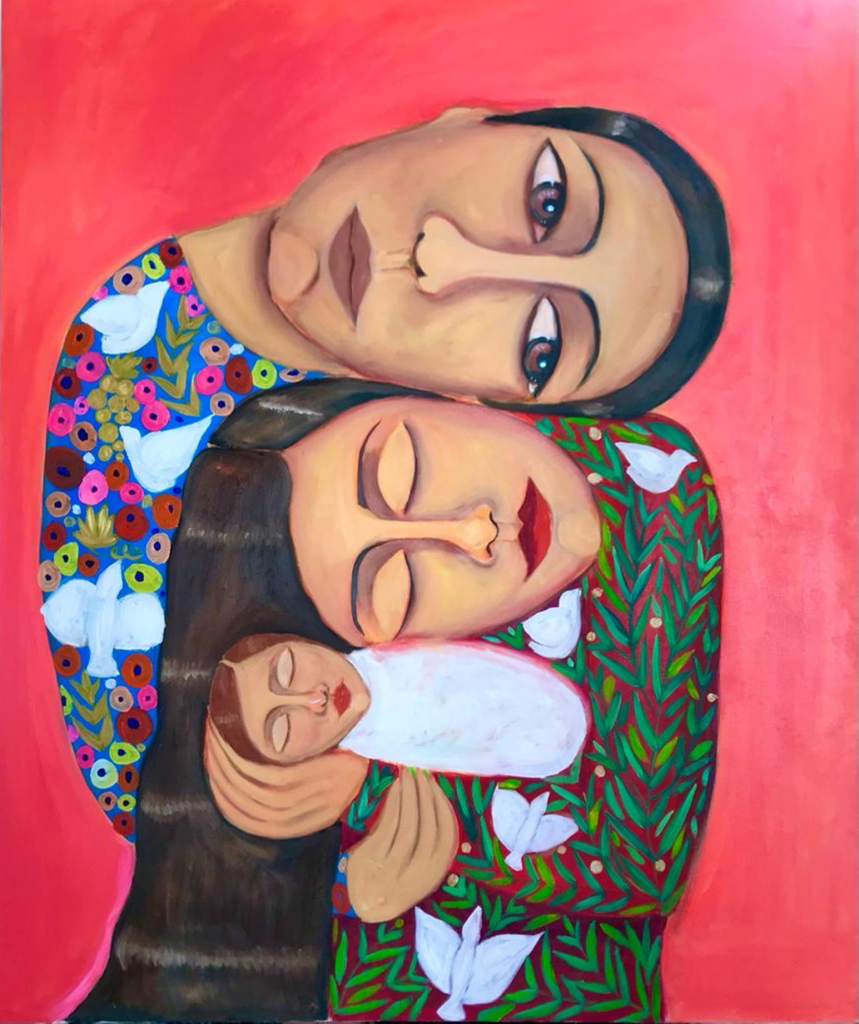
Obstetric, Maternal, and Reproductive Violence
During the first weeks of the post-October 7 attacks, Israeli army veteran Ezra Yachin declared: “We need to wipe their families, their mothers and their children. These animals must not be allowed to live any longer.”47 Women are facing a myriad of challenges related to sexual and reproductive health in Gaza, exacerbated by the siege and restricted access to medical treatment. The UN estimated that fifty thousand pregnant women lived in Gaza at the time of the initial siege in October of 2023, and close to 5,500 women gave birth each month (close to 183 women a day), 15 percent of whom were anticipated to require additional medical attention because of pregnancy or delivery-related problems.48 Miscarriages in Gaza have skyrocketed more than 300 percent.49 Malnutrition and a lack of prenatal supplements such as iron have made anemia deficiency endemic, increasing the risk of pre-term birth, low birth weight, and bleeding to death during labor. People who menstruate are infected at alarming rates due to Israel’s blockade of water and basic supplies, and many resort to making their own pads and tampons. Some girls as young as thirteen have taken birth control pills to halt their periods. What is left of the hospitals that Israel has raided or completely bombed have run out of fuel, electricity, access to clean water, and anesthetics. As a result, pregnant people are forced to give birth in overcrowded healthcare facilities, shelters, their homes, or on the streets, increasing the risk of infection and medical complications.50
Alongside starvation and the imminent threat of death and disease, pregnant Palestinians in Gaza are forced to undergo caesarean sections without anesthesia.51 Even after they have endured traumatic deliveries — like having seven layers of tissue cut with limited pain relief — they struggle to find baby formula, diapers, clean water, and sufficient food for breastfeeding. Breastfeeding mothers are advised to drink “at least three liters of water a day” and to eat well to produce enough milk, advice which has become increasingly impossible to follow as the siege continues.52 Conditions at hospitals are so overburdened that women are being discharged one day after delivering, often making them susceptible to infections. The UN agency has cited a “nightmarish” case of one woman discharged just three hours after giving birth.53 While the UN agency managed to deliver eight thousand post-birth kits to Gaza as of May 2025, this represents a small fraction of the actual need. Doctors are conducting mass hysterectomies after childbirth — the removal of patients’ uteruses — due to medical teams’ inability to provide the proper resources necessary to stop their bleeding. Along with these horrifying conditions, women still face the threat of airstrikes at any time. A woman named Um Raed from Beit Hanoun reveals: “Since the birth, I’ve not known whether I should be focusing on my contractions or the sound of warplanes overhead . . . You know, for such a young baby, he’s learned to recognize the sounds of bombing.”54 This is a form of militarized birth, where Palestinians are forced to endure pregnancy, labor, and delivery under extreme forms of military surveillance. The intense fear and trauma of a potential bomb falling upon them or anxieties about where and how they will deliver in a space with limited resources, including a lack of pain medication, can lead to premature delivery, which increases the risk of death for both mother and child.55
Before October 7, over 94,000 women and girls already lacked access to sexual and reproductive health services; this number rose to more than one million just in the first five months of Israel’s attack on Gaza.56 The blockade previously imposed a burden on Palestinian women’s reproductive health by restricting their movement inside Gaza, denying them access to specialized prenatal and postnatal health care outside of Gaza, and limiting food imports, leading to high rates of miscarriage and stillbirth. In 2008 and 2009, during Operation Cast Lead, the Israeli army produced and proudly wore a series of T-shirts calling for the execution of Palestinian children and pregnant people, and the sodomizing of Hamas leaders.57 One of the shirts included an image of a pregnant woman in crosshairs with the slogan “One shot, two kills,” written underneath, signifying that by targeting pregnant women they have eliminated two demographic threats to the Israeli state, the child and the mother, who is categorized as a vessel for territories.58 This dual annihilation is not simply symbolic. On May 21, 2025, far-right Israeli politician Moshe Feiglin declared that “the enemy is not Hamas . . . Every child in Gaza is the enemy. We need to occupy Gaza and settle it, and not a single Gazan child will be left there. There is no other victory.”59
Gaza’s carceral regime — created through the blockade, the militarization of the borders, and ongoing surveillance — impedes Palestinian women’s access to reproductive health and autonomy. These conditions of reproductive harm are not a consequence of the war but rather the point of the war and blockade: to prevent any hope for Palestinian futurity. The Israeli state actively produces the conditions in which Palestinian reproduction is made precarious, dangerous, or impossible as a means of eliminating Palestinian life capacity. This not only denies Palestinian women their reproductive autonomy and survival under human rights but also establishes a form of reproductive governance that manages which lives are allowed to live and which must die.60 But to recall Murphy, the notion of distributed reproduction helps us see that birth outcomes are not just automatic biological functions. Far from it: they rely on the infrastructures of and access to food systems, electricity, sewage, and mobility — all of which have been directly targeted, especially medical facilities.61
Hospitals and Homes Have Become Battlegrounds
The reproductive genocidal nature of the attacks on Gaza is not just documented in the growing number of deaths, and spaces and places bombed every day. Even so, body count is still essential, particularly in the intentional targeting of intimate spaces, reproductive life spaces, and survival spaces. Through both aerial and ground assaults, Israel has targeted homes, hospitals, ambulances, orphanages, playgrounds, schools, mosques, churches. The Israeli army cut off and targeted water lines, electricity, emergency services, and other crucial services.62 In 2023 and 2024, Israel destroyed over 25 percent of bakeries in Gaza — in one incident, Israel killed over a hundred Palestinians and injured one thousand more, targeting people simply waiting in line to receive food at a local grocery store.63 Even if Palestinians are not killed through aerial assault, the extent of destruction to property, institutions, and universities, as well as the militarization of homes, hospitals, and schools to produce “legitimate” targets are all part of a plan to make Gaza uninhabitable.
Within the past two years, Israel has destroyed over 90 percent of housing units and 70 percent of all structures. The airstrikes against residential buildings — mainly carried out in the middle of the night — are designed to kill entire families.64 Since October 2023, Israel has wiped out at least 2,200 families from the Palestine Civil Registry, completely erasing their bloodlines from existence.65 More than 6,350 Palestinians have been killed in airstrikes that entirely destroyed households, while another 5,120 families have been reduced to a lone survivor—acts that amount to collective erasure of entire family lines. One family, the Abu Salem family, once spanning four generations, was obliterated with over 270 family members killed.66 During one strike, pediatrician Dr. Alaa Al-Najjar lost nine of her ten children and her husband, while her only surviving son was left in critical condition.67 Such indiscriminate killings have given rise to a new term in Gaza — ‘WCNSF’ (Wounded Child, No Surviving Family) — to capture the countless cases where entire households are erased, leaving behind traumatized orphans. This relentless violence reshapes family structures and the very capacity to parent.
More precisely, Israel is not simply concerned with killing individual lives but erasing collective lives, histories, futures, and memories — a genocidal method to erase Palestinians as an indigenous presence known as the “logic of elimination.”68 In the Palestinian context, home is far more than a private space; for Palestinians, home is a place of continuity and memory.69 Families are transmitters of language, rituals, and land-based knowledge. Following the displacement of Palestinians after the Nakba, the Palestinian home became a political site — a space that “is the sphere of the private but is always already connected with the collective Palestinian history of the homeland.”70 The bombing of homes in Gaza is thus part of an intentional effort to erase intergenerational memory and resistance from the home — what Palestinian scholar Nadera Shalhoub-Kevorkian calls the “archive of the home.”71 This targeted erasure has the intent and effects of erasing Palestinian families and legacies, reducing Palestinians’ ability to reproduce themselves as a nation.
Targeting infrastructure in Gaza, especially healthcare, water, electricity, and sanitation systems, systematically destroys the conditions required for safe pregnancy, childbirth, and the survival of mothers and infants. Israeli bombings have crippled Gaza’s water and sewage systems, which have led to high rates of waterborne diseases for all, including pregnant women and newborns, such as dehydration, sepsis, and high rates of infection. Moreover, Israel has shelled, besieged, and raided all of Gaza’s medical infrastructure.72 Israel targets medical facilities and their personnel, on the claim that Hamas uses them for militant activity. Despite the lack of evidence for this claim, Israel continues to wage war on all essential life-saving civilian infrastructure in Gaza.73 Many hospitals served as sites of refuge and shelter for Palestinians whose homes had been destroyed. During their ground invasion of Al-Shifa hospital, one of Gaza’s largest hospitals, the Israeli army raided, destroyed medical equipment and machinery, and demolished most of its buildings, including the emergency department and neonatal intensive care unit, rendering the hospital non-functional and severely limiting access to life-saving maternal and infant care. In the early months of the genocide, Israel also raided the Al-Nasr Children’s Hospital in Northern Gaza, forcing medical personnel, patients, and hospital staff to evacuate as the military continued its ground invasion of northern Gaza. Amid heavy gunfire and shelling, staff concluded that they could not safely evacuate five premature babies in the NICU who were placed on oxygen machines.74 The Israeli military had left them to decompose in their beds due to lack of oxygen.
Beyond direct attacks on healthcare facilities and medical personnel, Israeli forces have systematically destroyed key reproductive healthcare facilities in Gaza, including maternity wards, IVF centers, and clinics. In December 2023, an Israeli shell hit Gaza City’s largest fertility clinic, the Al-Basma IVF center, “blasting the lids off five liquid nitrogen tanks stored in the corner of the embryology unit” and destroying more than 4,000 embryos.75 In a single strike, thousands of potential future lives were lost. This further limited people from seeking options for fertility. The attack on Palestinian reproductive bodies is enacted indirectly as well, through Israel’s deployment of new weaponry and nuclear bombings, such as white phosphorus, that will inevitably create consequences for fertility for future generations. Al Jazeera reported that the vast number of Israeli bombs on Gaza created so much asbestos that it will cause not only cancer but also issues around fertility and fetal defects for decades, which will impact generations even after the bombs stop.76 These outcomes are not accidental: they are structurally produced by the conditions imposed through the blockade and the war, designed to “prevent births within a group.”77 When Israel targets hospitals, maternity wards, IVF centers, and clinics, either through airstrikes, siege conditions, or blockade, it is not simply impeding healthcare access: it is enacting another form of reproductive genocidal violence aimed at preventing Palestinian births, increasing maternal and infant deaths, and disrupting generational continuity.
The targeting of maternity wards and hospitals in Gaza manifests a violent convergence of carcerality and reproductive control. In Gaza, reproductive injustice is not only symptomatic of war: it is a weapon of war, designed to sever generational continuity and extinguish Palestinian futurity. The destruction of medical infrastructure dismantles the systems necessary for Palestinians to sustain themselves, to reproduce safely, to raise healthy children, and to reproduce Palestinian histories, memories, and futures. Abolishing carcerality in Gaza is not only about the end of physical confinement, then, but the “building of life-affirming institutions” and the preservation of life-sustaining systems where Palestinian mothers can birth, live, and thrive free from militarized repression.78
“Wake up, world, our children are being slaughtered.”
In May 2025, a Palestinian boy was asked, “What do you want to be when you grow up?” He said, “Children in Gaza don’t grow up.”79 Palestinian children are never perceived as children, but from the womb are figured as a demographic and terrorist threat to Jewish civilization. Images of babies and children charred, burned, and maimed continue to circulate without any significant outcry by Western media. One of the T-shirts discussed above depicted a bullseye aimed at the heart of a Palestinian child, including the caption, “The smaller they are, the harder it is.”80 Children are not simply collateral damage for Israel’s bombings against Gaza: they are actively being targeted because they are the literal embodiment of Palestinian futurity and generationality.81 This stripping of Palestinians of their status as children performs what Shalhoub-Kevorkian refers to as “unchilding.”82 Unchilding is “the state-sponsored process of systematically erasing the innocence, vulnerability, and status of Palestinian children . . . the goal is to render the future of Palestinian life disposable.”83 As she explains, this tactic is key to making them killable, jailable, and surveillable. Unchilding is thus a further form of reproductive genocide because it targets not just the child but the possibility of a future Palestinian life. The construction of Palestinian children as potential threats, combatants, or enemies justifies their incarceration, targeted killings, or surveillance under security pretexts, reflecting a carceral logic that criminalizes and dehumanizes children.84
Immediately after the October 7th attacks in 2023, Israel instituted a starvation campaign on the strip, prohibiting the entry of food, fuel, and other essential resources. Since the temporary ceasefire dissolved between Israel and Hamas back in February 2025, Israel has imposed a full blockade on food and medicine into Gaza, using starvation as a weapon of war. This is supported by so-called activists in Israeli civil society who attempt to block aid trucks into Gaza, setting some of the trucks on fire.85 The blockade created extreme shortages, pushing Gaza’s already fragile population into severe hunger and dehydration. This state-sponsored famine has been detrimental, especially to children. As of August 17, 2025, the Palestinian Health Ministry reported that 263 Palestinians died from malnutrition, including 112 children.86
Not only is Israel intentionally starving the population, but its systematic maiming of Palestinian children through indiscriminate attacks is also part of the broader strategy of reproductive genocide. Israel created one of the “biggest cohorts of pediatric amputees in history” not incidentally but intentionally.87 In January 2025, the Gaza Ministry of Health announced a recorded 4,500 amputations since October 7, 2023, including eight hundred children.88 The deliberate restriction of essential goods and services — ranging from caloric limits to the denial of clean drinking water to the withholding of electricity — constitutes what Ghassan Abu-Sittah terms the “titration of life.”89 These measures produce widespread conditions of debilitation that not only erode everyday survival but also intensify existing medical conditions and obstruct their treatment. Palestinian doctors perform surgeries on children, including amputations, without forms of anesthesia or pain relief.90 Many of them will not survive due to limited resources for proper treatment and are also unable to evacuate Gaza to receive life-saving care.91
Like the other forms of violence and injustice I have been tracing, the starving, maiming, and burning of Palestinian children in Gaza is not incidental but systemic. It marks a part of a broader strategy of reproductive genocide designed to disable the entire population, a slow form of genocide that does not rely solely on death but on rendering life impossible or unbearable. At the core of Israel’s governance and its unending politics of harm, suffering, and dispossession is the destruction of childhood and the transformation of children’s spaces into cages — death zones that put children on forced diets and deprive them of health services, schooling, and more. Conceptualizing childhood as a carceral space-time allows Israel to define and create the order of who is a human as well as who is a child. Once again, the process of unchilding constructs Palestinian children as “helpless, uncivilized, dangerous, and terrorist Other” to justify state violence and to create a binary between the Jewish Israeli child who must be protected versus the Palestinian unchild.92 This is further reinforced in the discourses after the world learned of the death of the youngest Jewish hostage, Kfir Bibas, who received international attention, sympathy, and solidarity.93 Israeli state discourses’ insistence on protecting Jewish children so that they do not have the same fate as Kfir Bibas justifies confinement, starvation, and mass death of Palestinian children.
The logic that “no child is innocent,” when applied uniquely to Palestinian children, operates as a central mechanism of elimination or reproductive genocide. To strip Palestinian children of innocence is to deny them recognition as lives worth protecting, thereby justifying their killing, maiming, or dispossession as inevitable and even necessary. This discourse does not merely reflect the impossibility of Palestinian parents raising children in conditions of safety; it actively works to sever the reproductive continuity of Palestinians as a people. If children embody the future of a community, then the refusal to grant them innocence is a refusal of that community’s right to a future. The structural dehumanization of Palestinian children collapses childhood as a category of protection and renders Palestinian reproduction a site of elimination. Through this logic, reproductive violence converges with genocidal intent: destroying not only existing generations but also foreclosing the possibility of intergenerational survival, kinship, and continuity.
Conclusion
In a space that has gone from an open-air prison to an open graveyard, a space often defined by death, destruction, and debilitation, what scenes of reproductive life emerge? In the words of scholars Loubna Qutami and Omar Zahzah, Palestinians “invent life where life is constantly under attack,” such that “if Palestinians can teach anything to the world, anything at all, it would be these techniques of creating, inventing, and salvaging life where it is never meant to exist.”94 Palestinian families are, and have always been, resisting through the teaching and creation of life. Amid treating the most vulnerable, Dr. Ghassan Abu-Sittah narrates a story of a nineteen-year-old pregnant woman who came into the besieged Al-Shifa screaming with shrapnel in her abdomen. With a glimpse of hope, they found an obstetrician who was able to perform a Caesarean to save her and her child. Abu-Sittah cries, “After all that death, to hear a child! You kind of just feel the sound of life for the first time in 40 days of death. You feel the sound of life.”95 The act of birthing in the face of genocide enacts an affirmation of life that refuses submission to the totalizing hold of Zionist brutality and stakes a claim to future existence. This affirmation of life is evident in Palestinians in Gaza who refuse to leave their homes, often paying the ultimate price for staying. It is evident in the communities that have stepped forward to care for the orphans left behind, taking them in as their own. It is evident in how the camps become sites of family life, social networks, and resistance.
Abolition is not only about ending death-making systems but about creating the conditions for life and the reproduction of life, for individuals and across generations. The Palestinian Feminist Collective defines motherhood not as a role but “an assertion of agency and practice — an act of defiance against the forces of oppression and violence that seek to diminish [Palestinians]. Our Palestinian mothers model resilience, teaching us that defiance is a revolutionary act, rooted in the very fabric of our home, families, and communities.”96 Gaza calls to abolitionist feminists as a critical, still-living site where the struggle against reproductive genocide is inseparable from the practice of freedom itself. To stand with Palestinians is to affirm that the defense of reproductive futurity — the ability to bear, raise, and sustain generations — is at the heart of any abolitionist feminist vision of justice.
Click here to read or download a designed-for-print version of this article.

Click here to download a print-and-fold booklet version of this article.
Endnotes
- Yasmine Hamdan, “They’re Dead:’ A Gaza Father Cries for the Loss of Wife, 4-Day-Old Twins, Killed in Israeli Airstrike,” CBC News, August 15, 2024. https://www.cbc.ca/news/world/gaza-airstrike-twins-1.7294710.[↑]
- Hamdan, “They’re Dead.”[↑]
- Euro-Med Monitor for Human Rights, “The Bloodiest Face of Its Genocide: Israel Has Killed 2,100 Palestinian Infants and Toddlers in Gaza,” ReliefWeb, August 14, 2024, https://reliefweb.int/report/occupied-palestinian-territory/bloodiest-face-its-genocide-israel-has-killed-2100-palestinian-infants-and-toddlers-gaza-enar.[↑]
- The Lancet Report released an article in July 2024 that estimated that the death toll is much higher than the numbers released by the Gaza Civil Ministry, close to 187,000 and as high as 335,500 by the end of 2024, because the numbers only account for Palestinians killed in direct attacks and reported in hospitals. The number does not account for Palestinians killed by starvation, disease, and illness, or the thousands still remaining under the rubble.[↑]
- List of Identified Victims, as Published by the Palestinian MoH in Gaza,” Airwars, https://airwars.org/moh-list/. Airwars, the civilian harm watchdog which monitors multiple conflicts globally, has stated that “Israeli officials have repeatedly disputed the MoH figures but most analyses, including by Airwars, have found the MoH lists to be broadly reliable.” Between July and August 2025, the New York Times, The Washington Post, and the Wall Street Journal have published articles detailing the large-scale killing of children in Gaza. The consensus among the American papers of record provides a brutal composite of images, names, and stories. These articles all cite the statistic of more than 18,000 children killed. See Patrick Kingsley and Bilal Shbair, “The Trauma of Childhood in Gaza,” New York Times, August 15, 2025, https://www.nytimes.com/2025/08/15/world/middleeast/gaza-children-school-play.html; Sammy Westfall et al., “60,000 Gazans Have Been Killed. 18,500 Were Children,” The Washington Post, July 30, 2025, https://www.washingtonpost.com/world/interactive/2025/israel-gaza-war-children-death-toll/; or Chao Deng, “How an Impossible Journey to the U.S. Gave an Injured Boy From Gaza a New Chance,” Wall Street Journal, August 18, 2025, https://www.wsj.com/world/middle-east/gaza-war-mother-hospital-amputation-e5ff22ed?reflink=desktopwebshare_permalink. On the overall death toll in Gaza and the cruel health impact on children, see United Nations Office for the Coordination of Humanitarian Affairs, Humanitarian Situation Updates, https://www.ochaopt.org/content/humanitarian-situation-update-345-gaza-strip.[↑]
- Beyza Binnur Donmez, “‘Do Not Call It War, It Is a Genocide in Gaza,’ Says UN Rapporteur,” Anadolu Agency, April 2, 2024, https://www.aa.com.tr/en/middle-east/-do-not-call-it-war-it-is-a-genocide-in-gaza-says-un-rapporteur/3384799.[↑]
- On September 12, 2025, the Middle East Monitor released a report, highlighting how the death toll in Gaza may be as high as 680,000 people, if we factor in those killed indirectly, including injury, starvation, and disease. See report: Richard Hil and Gideon Polya, “Skewering History: The Odious Politics of Counting Gaza’s Dead,” Arena Online, July 11, 2025, https://arena.org.au/politics-of-counting-gazas-dead/.[↑]
- Raz Segal, “A Textbook Case of Genocide,” Jewish Currents, October 13, 2023, https://jewishcurrents.org/a-textbook-case-of-genocide.[↑]
- Segal, “A Textbook Case of Genocide.”[↑]
- United Nations, Convention on the Prevention and Punishment of the Crime of Genocide, adopted December 9, 1948, United Nations Treaty Series, vol. 78, no. 1021, 277, https://www.un.org/en/genocideprevention/genocide-convention.shtml.[↑]
- Palestinian Feminist Collective, “The Palestinian Feminist Collective Condemns Reproductive Genocide in Gaza, https://palestinianfeministcollective.org/the-pfc-condemns-reproductive-genocide-in-gaza/.[↑]
- Palestinian Feminist Collective, “The Palestinian Feminist Collective Condemns.”[↑]
- Palestinian Feminist Collective, “The Palestinian Feminist Collective Condemns.”[↑]
- Palestinian Feminist Collective, “About Us,” https://palestinianfeministcollective.org/about-us/.[↑]
- See, among others, Combahee River Collective, The Combahee River Collective Statement (1977), reprinted in Keeanga-Yamahtta Taylor, ed., How We Get Free: Black Feminism and the Combahee River Collective (Chicago: Haymarket Books, 2017), 15–27; Loretta J. Ross and Rickie Solinger, Reproductive Justice: An Introduction (University of California Press, 2017).[↑]
- It is important to note that SisterSong’s statement in support of a ceasefire in Gaza came only after significant delay, reflecting its failure to take an early stance during the genocide and raising concerns about the limits of its commitment to global reproductive justice. See Nicole Froio, “SisterSong Ceasefire Gaza Board Resignations,” Prism Reports, March 5, 2024, https://prismreports.org/2024/03/05/sistersong-ceasefire-gaza-board-resignations/.[↑]
- Crystal M. Hayes, Carolyn Sufrin, and Jamilla B. Perritt, “Reproductive Justice Disrupted: Mass Incarceration as a Driver of Reproductive Oppression,” AJPH Perspectives 110, no. S1 (2020): 21.[↑]
- Ross and Solinger, Reproductive Justice.[↑]
- Harriet A. Washington, Medical Apartheid: The Dark History of Medical Experimentation on Black Americans from Colonial Times to the Present (Doubleday, 2006); Dorothy E. Roberts, Killing the Black Body (Pantheon Books, 1997).[↑]
- Omar Jabary Salamanca, Mezna Qato, Kareem Rabie, and Sobhi Samour, “Past Is Present: Settler Colonialism in Palestine,” Settler Colonial Studies 2, no. 1 (2012), https://doi.org/10.1080/2201473X.2012.10648823.[↑]
- Nicola Pratt et al., “Why Palestine is a Feminist Issue: A Reckoning with Western Feminism in a Time of Genocide,” International Feminist Journal of Politics 27, no. 1 (2025): 235.[↑]
- Noam Chomsky, “My Visit to Gaza, the World’s Largest Open-Air Prison,” Truthout, November 9, 2012, https://truthout.org/articles/noam-chomsky-my-visit-to-gaza-the-worlds-largest-open-air-prison/.[↑]
- Ruth Wilson Gilmore, Golden Gulag: Prisons, Surplus, Crisis, and Opposition in Globalizing California (University of California Press, 2007).[↑]
- On social reproduction theory, see Tithi Bhattacharya, ed., Social Reproduction Theory: Remapping Class, Recentering Oppression (Pluto Press, 2017).[↑]
- Roberts, Killing the Black Body, 92-97.[↑]
- Nira Yuval-Davis, Gender and Nation, (Sage Publishers, 2012).[↑]
- M. Murphy, The Economization of Life (Duke University Press, 2017), 141.[↑]
- M. Murphy, “Distributed Reproduction, Chemical Violence, and Latency,” The Scholar & Feminist Online 11, no. 3 (Summer 2013), https://sfonline.barnard.edu/distributed-reproduction-chemical-violence-and-latency/.[↑]
- Gilmore, Golden Gulag, 28.[↑]
- Tia Goldenberg, “Harsh Israeli Rhetoric Against Palestinians Becomes Central to South Africa’s Genocide Case,” Associated Press, January 17, 2024, https://apnews.com/article/israel-palestinians-south-africa-genocide-hate-speech-97a9e4a84a3a6bebeddfb80f8a030724.[↑]
- Nicolas Camut, “Israeli Minister Suspended after Saying Nuclear Bomb on Gaza Was ‘an Option,’” Politico, November 5, 2023, https://www.politico.eu/article/israel-minister-amichai-eliyahu-suspend-benjamin-netanyahu-nuclear-bomb-gaza-hamas-war/.[↑]
- [1] Judith Butler, Precarious Life: The Powers of Mourning and Violence (Verso, 2004).[↑]
- Jeremy Scahill, “Joe Biden Keeps Repeating His False Claim That He Saw Pictures of Beheaded Babies,” The Intercept, December 14, 2023, https://theintercept.com/2023/12/14/israel-biden-beheaded-babies-false/.[↑]
- Butler, Precarious Life.[↑]
- “What Is Gaza Strip, the Besieged Palestinian Enclave under Israeli Assault?”, Al Jazeera, October 11, 2023, https://www.aljazeera.com/news/2023/10/11/what-is-gaza-strip-the-besieged-palestinian-enclave-under-israeli-assault.[↑]
- Maryam Al Tibi and Alejandra Scampini, “Why Palestine’s Ongoing Genocide is a Feminist Issue,” ESCR-Net, March 8, 2024, https://www.escr-net.org/news/2024/why-palestine-ongoing-genocide-is-a-feminist-issue/.[↑]
- The “terra nullius” fallacy is a familiar trope across settler colonialist projects, from the occupied territories of the American plains to the Australian continent. See, among others, Aileen Moreton-Robinson, The White Possessive: Property, Power, and Indigenous Sovereignty (University of Minnesota Press, 2015); Patrick Wolfe, Settler Colonialism and the Transformation of Anthropology: The Politics and Poetics of an Ethnographic Event (Cassell, 1999).[↑]
- Gideon Levy, The Punishment of Gaza (Verso, 2010), 146.[↑]
- Sherene Seikaly, “Nakba in the Age of Catastrophe,” Jadaliyya, May 15, 2023, https://www.jadaliyya.com/Details/45037.[↑]
- Josh Ruebner, “Israel is threatening a second Nakba,” The Hill, November 17, 2023, https://thehill.com/opinion/international/4313276-israel-is-threatening-a-second-nakba-but-its-already-happening/[↑]
- I use the term “woman” in this article to remain consistent with numerous sources that document Israel’s targeting of those gendered as women to enact specific reproductive and gendered violence. This usage should not be read as foreclosing the experiences of trans and non-binary Palestinians who are likewise subjected to the carceral and genocidal logics of the Israeli state. Following scholars such as Jasbir Puar and Judith Butler, I recognize that gendered violence under settler colonialism does not operate exclusively through cis-heteronormative frameworks, but rather through broader regimes of power that regulate, discipline, and eliminate bodies marked as threats to the state. See, among others, Jasbir K. Puar, Terrorist Assemblages: Homonationalism in Queer Times (Duke University Press, 2007); Judith Butler, Frames of War: When Is Life Grievable? (Verso, 2009).[↑]
- See, among others, Nadera Shalhoub-Kevorkian, Sarah Ihmoud, and Suhad Dahir-Nasir, “Sexual Violence, Women’s Bodies, and Israeli Settler Colonialism,” Jadaliyya, November 17, 2014, https://www.jadaliyya.com/Details/31481/Sexual-Violence,-Women%E2%80%99s-Bodies,-and-Israeli-Settler-Colonialism.[↑]
- Rhoda Ann Kanaaneh, Birthing the Nation: Strategies of Palestinian Women in Israel (University of California Press, 2002).[↑]
- Devyn Rigsby, “‘Be Fruitful and Multiply:’ The Role of Israeli Pronatalist Policy in the Pursuit of Jewish Demographic Dominance in the Holy Land,” The Yale Review of International Studies, April 30, 2018, http://yris.yira.org/essays/2385.[↑]
- Bayan Abusneineh, “(Re)Producing the Israeli (European) Body: Zionism, Anti-Black Racism, and the Depo-Provera Affair,” Feminist Review 128, no. 1 (2021).[↑]
- Jasbir K. Puar, The Right to Maim: Debility, Capacity, Disability (Duke University Press, 2017).[↑]
- It is important to note that Ezra Yachin was involved in the Deir Yassin massacre on April 9, 1948, when Zionist militiamen belonging to the Lehi and Irgun groups went house to house, killing more than a hundred people — mostly women, children, and the elderly, in the small Palestinian village of Deir Yassin near Jerusalem. He referred to Deir Yassin as a “terrorist hideout” invoking the same language of women and children as combatants rather than civilians. See Rayhan Uddin, “Israel-Palestine war: Israeli veteran, 95, rallies troops to ‘erase’ Palestinian children,” Middle East Eye, October 14, 2023, https://www.middleeasteye.net/news/israel-palestine-war-veteran-ezra-yachin-soldiers-erase-children.[↑]
- UNICEF, UNDP, UNFPA, WFP, and WHO, “Joint Statement by UNICEF, UNDP, UNFPA, WFP and WHO on Humanitarian Supplies Crossing into Gaza,” UNICEF UK, November 4, 2023, https://www.unicef.org.uk/press-releases/joint-statement-by-unicef-undp-unfpa-wfp-and-who-on-humanitarian-supplies-crossing-into-gaza/.[↑]
- Human Rights Watch, “‘Five Babies in One Incubator’: Violations of Pregnant Women’s Rights Amid Israel’s Assault on Gaza,” January 28, 2025, https://www.hrw.org/report/2025/01/28/five-babies-one-incubator/violations-pregnant-womens-rights-amid-israels-assault.[↑]
- Hasan Naeem Jangda et al., “Unheard Voices: Addressing Sexual and Reproductive Health in Gaza’s Women,” International Journal of Gynecology & Obstetrics 166, no. 1 (July 2024): 139–140, https://doi.org/10.1002/ijgo.15596.[↑]
- “Pregnant Women and Mothers in Gaza Are Fighting to Keep Themselves and their Babies Alive amidst Healthcare Collapse,” International Rescue Committee, Press Release, April 2, 2024, https://www.rescue.org/press-release/pregnant-women-and-mothers-gaza-are-fighting-keep-themselves-and-their-babies-alive.[↑]
- Stephanie Hegarty, “Born on 7 October: Gaza Mum’s Fight to Feed Her Baby,” BBC News, March 4, 2024, https://www.bbc.com/news/world-middle-east-68542331.[↑]
- “War Brings Hell to Gaza’s Pregnant Women, Nursing Mums,” France 24, November 14, 2023, https://www.france24.com/en/live-news/20231114-war-brings-hell-to-gaza-s-pregnant-women-nursing-mums.[↑]
- “Trauma Replaces Joy for Mothers Giving Birth during Israel’s War on Gaza,” Al Jazeera, January 17, 2024, https://www.aljazeera.com/features/2024/1/17/trauma-replaces-joy-for-mother-giving-birth-during-israels-war-on-gaza. The Institute for Women Studies, Birzeit University, Collected testimonials of Palestinian women in Gaza. See more on testimonials of women in Gaza in Sarah Ihmoud, “Countering Reproductive Genocide in Gaza: Palestinian Women’s Testimonies,” Native American and Indigenous Studies 12, no. 1 (Spring 2025), https://dx.doi.org/10.1353/nai.2025.a957106.[↑]
- Hegarty, “Born on 7 October.”[↑]
- Amal Awadallah, “The Forgotten Women and Girls in Gaza: A Sexual and Reproductive Health Catastrophe,” Bond UK, February 29, 2024, https://www.bond.org.uk/news/2024/02/the-forgotten-women-and-girls-in-gaza-a-sexual-and-reproductive-health-catastrophe.[↑]
- See, among others, Rabab Abdulhadi, “Israeli Settler Colonialism in Context: Celebrating (Palestinian) Death and Normalizing Gender and Sexual Violence,” Feminist Studies 45, no. 2–3 (2019): 541–573, https://doi.org/10.1353/fem.2019.0025; Adam Horowitz, “Racist and Sexist Israeli Military Shirts Show the Mindset That Led to War Crimes in Gaza,” Mondoweiss, March 20, 2009, https://mondoweiss.net/2009/03/racist-and-sexist-military-shirts-show-the-fruits-of-israeli-militarism/.[↑]
- Horowitz, “Racist and Sexist Israeli Military Shirts.”[↑]
- NDTV News Desk, “Moshe Feiglin: ‘Every Baby In Gaza Is An Enemy’: Ex-Israeli Lawmaker’s Shocking Remarks,” NDTV, May 22, 2025, https://www.ndtv.com/world-news/moshe-feiglin-every-baby-in-gaza-is-an-enemy-ex-israeli-lawmakers-shocking-remarks-8477020.[↑]
- My understanding of the phrase “make live and let die” draws from Michel Foucault’s theorization of biopolitics, in which modern power operates through the regulation of life, and from Achille Mbembe’s concept of necropolitics, which extends this framework to account for the ways sovereignty is enacted through the systematic exposure of populations to death.[↑]
- M. Murphy, “Distributed Reproduction.”[↑]
- Union of Teachers and Employees of Birzeit University, “Statement by the Teachers and Employees of Birzeit University in Ramallah–Palestine,”https://www.californiaindianstudies.org/uploads/2/7/4/0/2740039/we_are_all_palestinians.pdf.[↑]
- Al Jazeera Staff, “‘Massacre’: Dozens Killed by Israeli Fire in Gaza While Collecting Food Aid,” Al Jazeera, February 29, 2024, https://www.aljazeera.com/news/2024/2/29/dozens-killed-injured-by-israeli-fire-in-gaza-while-collecting-food-aid.[↑]
- Imogen Foulkes and David Gritten, “Israel Has Committed Genocide in Gaza, UN Commission of Inquiry Says,” BBC News, September 16, 2025, https://www.bbc.com/news/articles/c8641wv0n4go.[↑]
- The New Arab Staff, “‘They Want to Erase Us’: Israel Wipes Out over 2,200 Palestinian Families in Gaza,” The New Arab, May 26, 2025, https://www.newarab.com/news/israel-wipes-out-over-2200-palestinian-families-gaza.[↑]
- The New Arab Staff, “‘They Want to Erase Us.’”[↑]
- Since then, Dr. Alaa Al-Najjar has evacuated Gaza with her son to Italy to seek medical attention. See Alys Davies, “Gaza Doctor Whose Nine Children Were Killed in Israeli Strike Evacuated with Son,” BBC News, June 11, 2025, https://www.bbc.com/news/articles/c8641wv0n4go.[↑]
- Sarah El Deeb, “The War in Gaza Has Wiped Out Entire Palestinian Families,” Los Angeles Times, June 17, 2024, https://www.latimes.com/world-nation/story/2024-06-17/the-war-in-gaza-has-wiped-out-entire-palestinian-families.[↑]
- Ahmad H. Sa’di and Lila Abu-Lughod, eds., Nakba: Palestine, 1948, and the Claims of Memory (Columbia University Press, 2007), 23.[↑]
- Nadera Shalhoub-Kevorkian, Incarcerated Childhood and the Politics of Unchilding (Cambridge University Press, 2019), 96.[↑]
- Shalhoub-Kevorkian, Incarcerated Childhood and the Politics of Unchilding.[↑]
- Ghassan Abu-Sittah, “‘Genocidal Machine’: Dr. Ghassan Abu-Sittah on Israel’s Destruction of Gaza’s Hospitals,” interview by Amy Goodman, Democracy Now!, April 1, 2024, video, 35 min., 37 sec., https://www.democracynow.org/2024/4/1/gaza_hospital_destruction_al_shifa.[↑]
- Moreover, the New York Times has reported the admission by senior Israeli officials that “there was no evidence that Hamas regularly stole from the United Nations.” Natan Odenheimer, “No Proof Hamas Routinely Stole UN Aid,” New York Times, July 26, 2025, https://www.nytimes.com/2025/07/26/world/middleeast/hamas-un-aid-theft.html.[↑]
- Yasmine Salam, Rima Abdelkader, and Matthew Mulligan, “Abandoned Babies Found Decomposing in Gaza Hospital Weeks After It Was Evacuated, ” NBC News, December 2, 2023, https://www.nbcnews.com/news/world/abandoned-babies-found-decomposing-gaza-hospital-evacuated-rcna127533.[↑]
- Arwa Mahdawi, “An Israeli Bomb Destroyed 4,000 Embryos at a Gaza IVF Centre. Where Is the Outrage?,” The Guardian, April 20, 2024, https://www.theguardian.com/commentisfree/2024/apr/20/israel-destroyed-embryos-bombing-ivf-center-gaza.[↑]
- Nils Adler, “’Death Sentence: Asbestos Released by Israel’s Bombs Will Kill for Decades,” Al Jazeera, October 8, 2024, https://www.aljazeera.com/news/2024/10/8/death-sentence-asbestos-released-by-israels-bombs-will-kill-generations.[↑]
- United Nations, Convention on the Prevention and Punishment of the Crime of Genocide, December 9, 1948, Article II(d), United Nations Treaty Series, vol. 78, p. 277, https://www.un.org/en/genocideprevention/genocide.shtml.[↑]
- Ruth Wilson Gilmore, Keynote Conversation, Making and Unmaking Mass Incarceration Conference, University of Mississippi, Oxford, MS, December 5, 2019.[↑]
- @jannahswaiting, “After 14 Hours of Fasting, a Family in Gaza Break Their Fast with Cooked Grass and Some Lemons,” Tumblr, May 28, 2025, https://www.tumblr.com/jannahswaiting.[↑]
- Horowitz, “Racist and Sexist Israeli Military Shirts.”[↑]
- Henry A. Giroux, “Israel’s War on Gaza is a War on Children,” Truthout, December 21, 2024, https://truthout.org/articles/israels-war-on-gaza-is-a-war-on-children/. [↑]
- Shalhoub-Kevorkian, Incarcerated Childhood and the Politics of Unchilding.[↑]
- Shalhoub-Kevorkian, Incarcerated Childhood and the Politics of Unchilding, 19.[↑]
- Just as white supremacist structures in the United States strip Black children — especially Black boys — of innocence and render them legitimate targets of policing and carceral violence, Israeli settler colonialism enacts a similar logic on Palestinian children. The often-repeated claim that “no child is innocent” when applied to Palestinians functions as a genocidal discourse that collapses childhood as a category of protection and legitimizes the killing of children as necessary for national security. This framing erases Palestinians’ ability to reproduce social continuity by marking their children as threats rather than futures. In both contexts, the denial of innocence operates as reproductive violence: it forecloses the intergenerational survival of a people by casting their children as disposable. In the US, as Ruth Wilson Gilmore demonstrates, carceral logics and reproductive control converge to mark Black children as criminal and expendable; Robin Bernstein demonstrates that this denial is not new but part of a longer genealogy in which “innocence” has been racialized and withheld from Black children since slavery, shaping cultural narratives that legitimize their subjection. The Movement for Black Lives has built on this scholarship and lived experience, documenting how contemporary policing and incarceration reproduce these historical logics by treating Black youth as disposable, criminal, and always already guilty. See Ruth Wilson Gilmore, Golden Gulag; Robin Bernstein, Racial Innocence: Performing American Childhood from Slavery to Civil Rights (New York University Press, 2011); and Movement for Black Lives, A Vision for Black Lives: Policy Demands for Black Power, Freedom, and Justice (Movement for Black Lives, 2016).[↑]
- Zeteo, “This Israeli Mother Has Made It Her Mission to Block Aid to Starving Babies in Gaza,” YouTube, 5 min., 59 sec., July 29, 2025, https://www.youtube.com/watch?v=3YmHUi8TdNc. The video documents an Israeli woman (who identifies as an Israeli mother) who has organized to obstruct humanitarian aid trucks from reaching Gaza, explicitly targeting the delivery of food and formula to starving infants.[↑]
- “Malnutrition Rates Reach Alarming Levels in Gaza, WHO Warns,” World Health Organization, 27 July, 2025, https://www.who.int/news/item/27-07-2025-malnutrition-rates-reach-alarming-levels-in-gaza–who-warns. These figures resist precise citation. Since the time of writing, Israel has sustained a fully sealed blockade, deliberately preventing food and humanitarian aid from entering Gaza. Starvation is here deployed as a weapon of war and method of elimination, in direct violation of international humanitarian law, including Article 54 of Additional Protocol I to the Geneva Conventions, which prohibits the starvation of civilians as a method of warfare. As a result, the number of Palestinians — particularly children — dying from hunger continues to rise.[↑]
- Eliza Griswold, “The Children Who Lost Limbs in Gaza,” The New Yorker, March 21, 2024, https://www.newyorker.com/news/dispatch/the-children-who-lost-limbs-in-gaza.[↑]
- Jasbir K. Puar, “On Amputation,” Policy Paper, Institute for Palestine Studies, March 5, 2025, https://www.palestine-studies.org/en/node/1657009#_edn5.[↑]
- Puar, “On Amputation.”[↑]
- “Longing for Gaza after Medical Evacuation: Abdul Rahman’s Story,” Doctors Without Borders / Médecins Sans Frontières, September 23, 2024, https://www.doctorswithoutborders.org/latest/longing-gaza-after-medical-evacuation-abdul-rahmans-story.[↑]
- On August 16, 2025, the US State Department suspended visa processing for Palestinians from Gaza, a policy that not only deepened the siege but also denied life-saving medical evacuations and specialized treatment abroad — turning bureaucratic restriction into another form of collective punishment. See Michael Rothman, “State Department Halts Visas for People from Gaza,” NPR, August 16, 2025, https://www.npr.org/2025/08/16/nx-s1-5504634/state-department-halts-gaza-visas.[↑]
- Shalhoub-Kevorkian, Incarcerated Childhood and the Politics of Unchilding, 16.[↑]
- Joseph Krauss, “For the Bibas Family, Closure Won’t Come until Shiri’s Body Is Returned,” Associated Press, February 18, 2025, https://apnews.com/article/israel-gaza-ceasefire-hostages-bodies-bibas-1d8718176c8d2564cf23c3e77f09ad72.[↑]
- Loubna Qutami and Omar Zahzah, “The War of Words: Language as an Instrument of Palestinian National Struggle,” Arab Studies Quarterly 42, no. 1-2 (2020), https://www.plutojournals.com/wp-content/uploads/Qutami-and-Zahzah.pdf.[↑]
- Sarah Dadoush, “A Doctor Went to Gaza to Help. What He Saw There Still Haunts Him,” Washington Post, December 23, 2023, https://www.washingtonpost.com/world/2023/12/15/gaza-ghassan-abu-sitta-recollections/.[↑]
- Palestinian Feminist Collective, “In commemoration of Arab Mother’s Day on March 21st, we salute the remarkable leadership and strength of our Palestinian mothers…,” Instagram post, March 21, 2024, https://www.instagram.com/p/C4y9mBqNbVy/?igsh=MW1pcmV6dHMwenRraA==. In commemoration of Arab Mother’s Day on March 21st in 2024, the Palestinian Feminist Collective released a statement honoring Arab mothers everywhere. They write: “You are caregivers and visionary creators, embodying courage and resilience in the face of unimaginable colonial and imperial violence. Our mother figures serve as the custodians of our traditions, the providers for our families, and the pillars of support and resistance in times of struggle.”[↑]