Stevie Wilson is an imprisoned Black, queer, abolitionist organizer and multi-genre writer from Philadelphia. His work interrogates the meanings of freedom, community, belonging, identity, and truth. Wilson has published numerous articles in print and online. His most recent work appears in Radical History Review, the Journal of American History, and the collection After Accountability: A Critical Genealogy of a Concept. He was a 2024 recipient of the Writing Freedom Fellowship by Haymarket Books.
In October 2024, Wilson spoke with special issue guest co-editor Emily Thuma about how and why kinship-building and collective care work are foundational to prison-industrial complex (PIC) abolition. This conversation has been lightly edited for length and clarity.
Emily Thuma: I understand that you’re working on a book of essays on HIV/AIDS and kinship, based on the many years you spent working in HIV/AIDS services. I also read that prison guards destroyed your manuscript, and so you are presently reconstructing the collection. Could you share a bit about this project — its central themes and ideas? How has your work around HIV/AIDS shaped your work around PIC abolition and vice versa?
Stevie Wilson: I never intended to write a collection. I was journaling as a way of meaning-making, making sense out of what I had been through. I was recently incarcerated and had time. I had been through a lot, and I didn’t have anyone around me I could speak to about these issues. And so, these were actually notes at first. I would think about certain things that had happened and write them down. The notes became long form journal entries that I then expanded into essays. These journal entries were my own way of healing, understanding what had happened to me, what happened to my community. I think it’s very important that we figure out what happened, why did that happen, what was going on. And when you get those answers, they help you move onto the path of healing.
Some of the essays took longer to write than others. The one about my father, for example, took eight years to write, because it was such an emotional piece that I sometimes needed to take a break from the revisiting I was doing. The word “essay” means to try, and when you’re in the trying of sense-making, of meaning-making, you discover new things. I was making connections as I wrote that would bring me back to the beginning again. As I began to write more, I found myself crossing the same terrain as far as the themes: identity, truth, kinship, Blackness, queerness, memory. Although I didn’t go in trying to explore these particular themes, every single piece wound up touching back on those areas. When thinking about Blackness, for example, I was working through what it meant that oftentimes when I saw Black people I didn’t see all my little hyphens represented. That’s how we get to identity. I hadn’t ever walked into a space that could hold all of me. Every time I walked into a room, there was some part of my identity that I had to leave at the door in order to enter. I had been searching for a space I could call home, into which I could bring all of myself, and not feel embarrassed or make excuses for bringing all of myself. The essay collection became a space where all of me could be there.
I had written a total of eight essays before they were destroyed by a prison guard in 2021. I had carried the essays with me — smuggled them, actually — from the county jail up to the state prison system in 2013. In Pennsylvania you’re not supposed to have any paper with you but legal paperwork, and so I had printed out some case law and copied the essays on the back so that it looked like legal paperwork when the officers checked it. I then carried them from prison to prison to prison — Graterford, Rockview, Smithfield — until they were destroyed at Fayette in 2021. It was so devastating. So much time had gone into them, and I had been carrying this stuff with me for over a decade.
As far as how my work around HIV/AIDS and in PIC abolition have informed each other, PIC abolition helped me understand my orientation toward the state. When I was out in the community, I knew the state’s position towards me. As a Black queer person in Black and brown queer and trans community, I knew how the state felt about me. I knew that they were not going to help me. I knew that they didn’t think I should exist. I knew that I could never look to the state to do right by me. That they were my antagonist. But I didn’t know my position towards the state — I knew how they felt about me, but I didn’t know what I felt about them. And that’s why we find ourselves constantly begging the state to accept us and begging the state to do this for us and do that for us. It’s like, wait a minute. What should my position be? And that’s what abolition gave me. So as I’m doing the work out in the AIDS Service Organizations (ASOs), I understand they’re not going to do shit for us; we have to do for ourselves. They don’t care about us. And so we just did the work as far as helping each other survive in whichever way we had to. There are certain principles in abolition: meeting people where they are, the radical yes, no one is disposable, making something out of nothing, being innovative. Improvising. These are all things that we had to do as a Ballroom community, and that we still do today as part of the community.
Studying abolition, and being in relationship and community with abolitionists, taught me my position towards the state. It was really perspective-shifting for me, reading books like Are Prisons Obsolete? and Golden Gulag, and materials on transformative justice that Mia Mingus sent me, and being in conversation with people like Jason Lydon (founder of Black & Pink) and Charlotte Pope (Critical Resistance, New York City).1 Before encountering abolition I had been conditioned to believe that you seek safety through the state and through biological family. And when I really looked at my life and got honest about it, I realized that both of those sites had been sites of suffering for me, and that the state was never going to keep me safe.
Abolition oriented me to look other places and see how safety was being produced, and care was happening, in my communities. We can actually remedy harm, and prevent harm, without going to the police. And I also realized that although I had never heard of transformative justice before, I had seen it before. On the ballroom scene, we don’t turn to the police. You had to work things out without going to the police. We didn’t have the option of calling the police because when you did, you were possibly subjecting yourself to state violence. And I will give you an example. One time I was in West Philadelphia and there was a situation taking place that was possibly involving gun violence. A Black trans woman called the police for help, and when they arrived, the two cishet males who were the perpetrators of the harm told the police that she was trans. After that, the police wouldn’t take her seriously, and nothing happened to these men. Her life was devalued by the state, and the police left her open to violence. And I witnessed this myself. So we know that when calling the police in, whatever threat you’re already trying to repel or harm you’re trying to avoid, you are actually opening yourself up to more harm. So what happens is we turn to our house members to help resolve an issue — this is where the Ballroom kinship network comes into play. You have the mother, father, and the uncles and aunts that younger people can turn to and share what’s going on, and these house members can step in and intervene. If someone stole something from you, you’ve got to go to that person and get it back. No one has to put their hands on you, you’re not getting kicked off the block, but we don’t do that here. Going to the police and getting that person locked up doesn’t benefit anyone. It’s the same in prison. We live on this block, we’re confined on this block together, and we have to find a way to live with each other and work with each other every single day. As an incarcerated person, a person on the Ballroom scene, and as a Black person, this is just what we did and what we do — I come from a lineage. I now see abolitionist practices and experiments that happened in the Ballroom community that I didn’t recognize as abolitionist when I was out there. So the experience was actually already there, and then the language came through study.
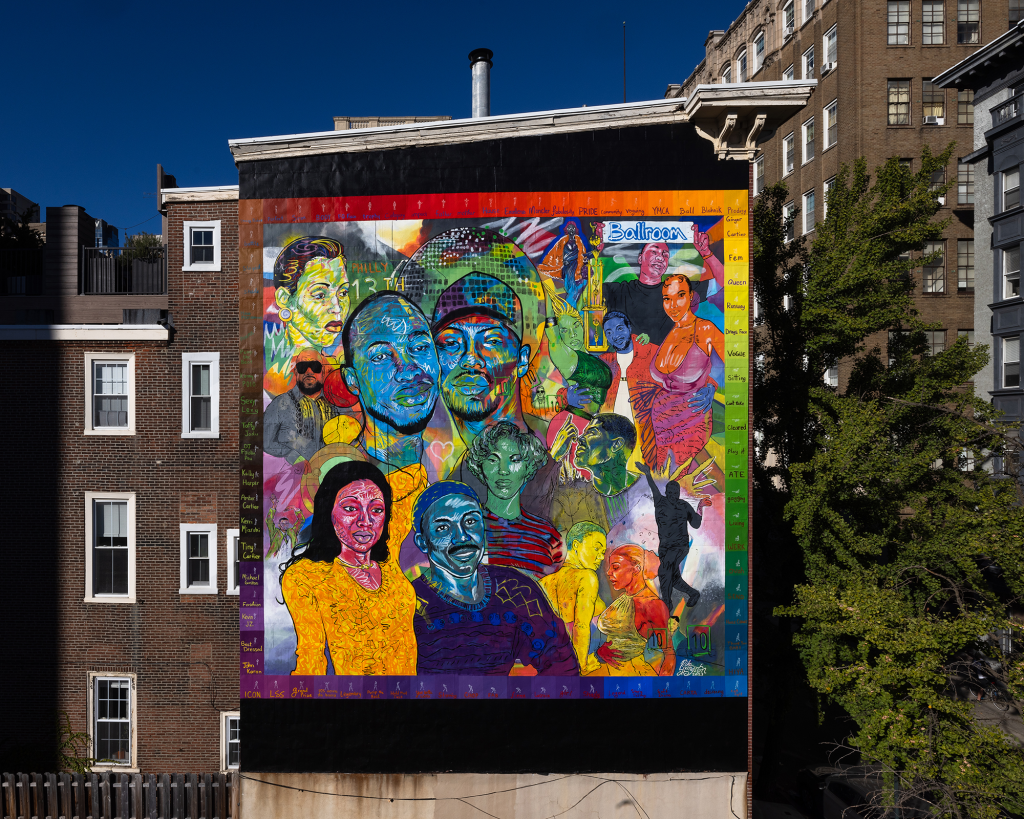
Abolition gave me a language as far as what happened to me and what happened to my community, which then created a space for me to be able to heal and to make sense of what took place. In one of the essays in my collection, for example, I talk about how downtown Philadelphia was gentrified. And when you see gentrification, you’re going to see policing. What they did to Black and brown queer and trans folk in Philadelphia — policing us, labeling everyone that was down there “a prostitute or a drug dealer,” locking everybody up, assaulting people — it was just running us out of the area. It’s so amazing, they call it the gayborhood now, and it was never there before until all of these little shops popped up and they ran us out. So we were seeing it happen in real time but we had no language for what was going on. I didn’t know what broken windows policing was. I didn’t know what neoliberalism was. I just knew that the public space, the public, Black and brown, queer, and trans space was being shrunken and destroyed. We were being erased. I knew it, but I didn’t know why and who was responsible for that. So if I don’t understand what’s happening, I really can’t fight against it. And then the pain and the suffering that I’m going through most likely is going to turn to lateral violence. And that’s why it’s so important to do the political education work in the community, because then we get answers — “Oh, that’s why, that’s what’s going on, and this is who’s responsible” — and then we know who the real enemy is, and who your allies, or potential allies, are…
I wrote a piece years ago about being a child and being sexually violated as a child and not having the language to articulate what happened to me. In that piece, I was talking about that language because I was about four and a half, almost five, and had been sexually victimized for almost six months by a live-in babysitter, actually. Terrorized by this person. I told my mother, “Kaselle is touching me.” My mother thought that I was saying she was hitting me and so she went to her and said, “Do not hit my child. If he does something wrong, just come back and tell me. I’ll correct him.” This only inflamed the abuser. And so for a while, it got even worse, until it ended. Reflecting back, I didn’t have the language to tell my mother what was happening to me. And so this is why, for me, language is so important because there were many times in my life when I had been in pain, I had been suffering, and I didn’t have the words to articulate what I was doing or going through. And for me, that caused me to think about self-harm and harming others. And so I really think it’s very important — once again, why the political education is so important — that we give people this language so they can speak about what’s happening, talk about what’s happening. They can make sense of their experiences. Because this is a path to healing. This is a path to building community and building real relationships. So for me, language was critical for getting to where I am today. If I didn’t have these words, then like bell hooks said, I felt mind-fucked. I just knew that something was wrong and I didn’t know what the hell was going on, or why it was happening. And the language is what really helped me heal. Abolition gave me that language. I was like, “Oh shit.” I was reading and saw: “That’s what happened to us! That’s what’s going on! That’s what happened. That’s what they call it?”
Another way in which I think both the Ballroom community and PIC abolition have mutually informed each other for me is that the Ballroom community taught me that you have to center everything in relationship. And that’s something that we emphasize in abolitionist work. But I don’t know if people really do it like we should. Right now, when I think about imprisoned people, how many people on the outside have direct relationships with people inside the prison? I’m not talking about family members who went to prison. I’m talking about: did you make an intentional effort to be directly connected to people inside? How can we talk about being partners with people we don’t have a relationship with? How can we talk about, “I’m really concerned about this person” if there’s no relationship with this person at all, if you don’t even know what they’re going through? And so I think that we talk about it a lot in abolitionist work, but in the Ballroom community I saw every day how important the relationships were, being able to depend upon each other, being there for each other, helping people survive however they need to survive — not just an ally, but even an accomplice. In abolitionist work, we talk about relationships but I don’t see people being intentional about relationship building with people who are inside, with imprisoned people. And that’s something we need to step up on.
ET: You are a founder and organizer of 9971, a network of prisoner-led abolitionist study groups in Pennsylvania. You’re also a regular columnist for Critical Resistance’s long running inside-outside newspaper, The Abolitionist, as well as a founder of the recently launched abolitionist publication, In the Belly. All three of these projects are examples of what you refer to as “mutual political education.” In what ways do you see mutual political education as a practice of radical care?
SW: First of all, I think that you can’t do the work without care. So I always say that care work is the work that makes the work possible. You can’t do the work without a relationship. I cannot sit down or call people to come sit with me and talk about these issues when they’re struggling to survive. If I do the care work, meeting the material needs of the people — this enables the work. To me, care work is grounded in helping people survive and getting to a place where they can thrive. Care work is also the emotional work where I am listening to someone, when someone is going through something. Remember how I said I was in prison and I didn’t have anyone to talk to and I was writing in my journal. People have things they want to talk about. People are going through things every single day here. And so being that ear and listening — that’s part of care work, just listening. I don’t have to have an answer. People just want to be heard — especially people in here. And so that’s part of it.
I always tell people that I can’t do political education without mutual aid; these things are connected. And so the care work is necessary for me to get to a point where I can practice mutual political education. It’s not just a theory or concept. For example, I’m doing this gun violence roundtable. Now, I have never authored gun violence. I’ve never experienced it personally. I’ve witnessed it, but I’ve never experienced it. And so I’m talking to a bunch of young Black men who have experienced, witnessed, and authored gun violence. And I have to sit down. When I say mutual political education, they’re teaching me also. They are teaching me and giving me a language to understand certain things, and answering questions that I had. I didn’t know this. I didn’t know that. How was this? Why is that? And so I’m giving them something, which is the space to be able to talk. I’m facilitating the discussion. I’m also giving them language to put to their experiences, but they’re also doing the same thing for me. They really are. I’m just blown away by these young men and how much they’ve been teaching me. And I always articulate to people that, yo, you have to come in as an organizer, not just ready to teach, but ready to learn, and to come in as a student. You have to be a noticer, and if you’re going to notice things, you have to sit back and watch for a minute, make yourself available to help, and just check out what’s going on.
And so, mutual political education is actually a practice. When you come into a setting, you are coming there as a student, even if you’re facilitating this work. Mutual political education has an orientation. Too often, organizers and activists come onto the scene acting like they have all the solutions. They already know what’s going on. People just need to listen to them: “We got the answers and know the way to do everything.” All those people have to do is let them facilitate and guide them to the answer. If you’re doing mutual political education, you don’t have that attitude. You come already thinking that there’s so much for me to learn here. And there’s so much I need to just notice and pick up on. If you go to a Ballroom community, everyone who enters will tell you how we enter. You’re just like, “Oh my God, there’s so much to learn.” We enter the scene, and there’s a language that we’re not used to. There are all of these different categories and ways that people talk to each other and relationships you have to learn. And so you come into this space knowing: I’m not here to tell you how to do anything. I’m here to learn from you. And if I’m going to be a part of this, I’ve got to learn. I got to sit back and be quiet and catch what’s going on. And I think for me, maybe the Ballroom scene is where I got it from. I never enter a space like I have all the answers. I’m coming to learn. I’m coming to notice what’s happening and then find out where I can be of assistance. And then whatever skills that I have that can help us reach that goal, I’m willing to do this. Whatever knowledge I may have that can help us understand and make meaning out of our experiences, I’m going to try to give it to you. But first I have to know your experiences, don’t I? First, I have to know what was happening here. First, I have to know the relationships that already exist here. I have to know how you are surviving already. I think too many people come into a situation or into political education with the answers already. They come in thinking they know and they’re there to guide people instead of saying, “I’m here to learn. Teach me.” And that’s why it becomes mutual — it goes both ways now.
ET: How do you think about the relationship between collective care labor — behind and across walls — and PIC abolition? What traditions of thought and praxis inform your thinking? Does the term “abolitionist care” resonate? If so, how?
SW: My practice is deeply influenced by Black anarchism. My practice is an extension of the work Martin Sostre did. My work has been influenced by Anakarta. Black anarchism has given me principles to return to the room to grow and extend the tradition itself. I think the term abolitionist care is redundant. I feel that abolition means you care. You’re going to have to do care work. If you’re an abolitionist, you should be doing care work. Care work is too often left on the shoulders of certain people. And I believe that we need to stop doing that because that’s how people get burned out. I think that we need to be aware and intentional that when we do care work, that we actually spread that out. According to capacity. I think we also need to bake it into our work. I think too often we’re so focused on the panel or the conference we’re organizing, for example, but not focused on the care work that makes that panel or that conference possible. And that care work is left to certain groups of people. We don’t really value care work on either side of the wall. Even behind the walls, the care work is done by the same people. And if they don’t do it, everything else falls apart. I find it tends to be very gendered. We need to be intentional about care work, and valuing it. And this is a major thing, a major issue.
I think we also need to understand that care work comes in many forms. And in here, for us, care work may be something as simple as feeding people. We are cooking meals and we’re feeding each other. And we’re making sure people have hygiene. And just being an ear sometimes for people. Sometimes somebody might not be good at writing letters, or writing requests, and just sitting down with them and helping them write this, or writing it for them. This is part of care work. It is the foundation of the political education and the movement building that we’re doing. Because if I don’t do this work, I can’t get to the next level. I can’t really sit down with this person and say, listen, “Oh, um, I want to talk to you about PIC abolition.” They’re like, “What? I’m hungry.”
We need to be intentional about care work. We need to value it, spread it out, do more of it, and recognize the many different ways it can happen. And according to our capacity, because everybody has different things they can do. But we need to be doing this. And if we do this, we will find that we will create more onramps for people to be involved in the actual work — whether it’s the political education, whether it’s being at a panel or a conference or at a rally or a protest or some direct action. More people could be involved If we invest more in care work. They can be.
We also need to recognize what isn’t care work. We have prisons creating programs around “care.” The motto of the corrections union in Pennsylvania is “Care, Custody, and Control.” They call it the three Cs. All care is not good care. We, as a movement, need to define what care is and what it isn’t. If we say “housing,” they will give us carceral shelters. We need to be specific in what our demands are. This is how we guard against cooptation.
ET: You wrote in a recent piece in Inquest about the ways that solitary confinement is a tool authorities use to “alienate and disconnect” imprisoned people from one another, and from their families and communities on the outside.2 And as organizations you’ve worked with, such as Black & Pink and the Sylvia Rivera Law Project, have long drawn attention to, queer and trans people are disproportionately subjected to solitary confinement, often under the rationale of “protecting” them from other imprisoned people. As the prison is an engine of family separation and kin-breaking, what is the relationship between kin-making and PIC abolition — particularly for queer and trans people?
SW: I think that kinship making is the counter to the PIC. And I said that in the Inquest piece — stay connected. Build these relationships. They want to isolate; they want to alienate so they can destroy. Kinship making is the antidote to that. Like we say: “What is the antidote to harm? Care.” And this is so beautiful with queer and trans folk behind the wall. You can be on one side of the compound. I can be on the other side of the compound. We spot each other. Automatically, we kin. “What’s going on?” We talk to each other. It is really beautiful in the face of all that’s happening. To have other people who see you and value you. It is so very important.
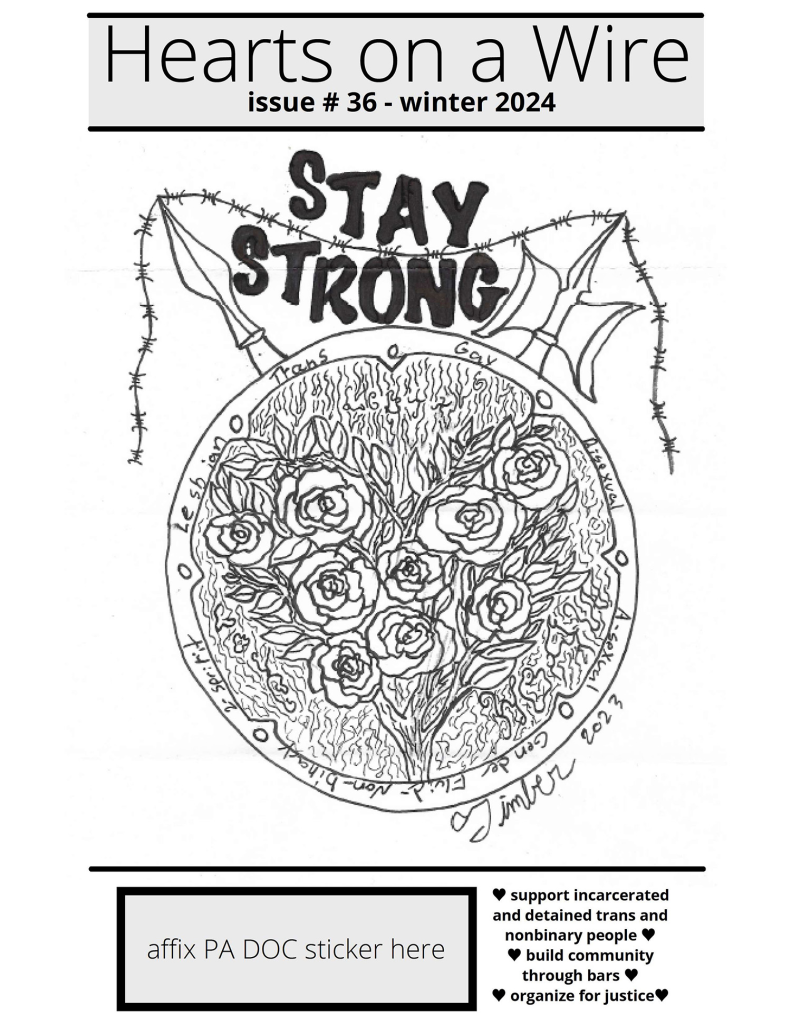
There is a publication that comes out in Pennsylvania called Hearts on a Wire. And it does a lot of what Black & Pink does as far as sharing the letters from different people around the country — queer and trans folk who are incarcerated. I just love reading Hearts on a Wire because 80 percent of it is queer and trans folk just shouting out other queer and trans folk where they are and in other Pennsylvania prisons, letting people know this is where I am, this is going on with me, shout out to so-and-so, I miss you, don’t do that, this is what’s happening here. It really is amazing. And so if you read it, you will see how — my brother so-and-so, or my sister this and that, my son this, my daughter so-and-so, my other kings and queens — it’s a family. Even though we are separated, spread out across Pennsylvania, we are family. And when you are family, when I say this person is my family member — whether I was in a Ballroom team out there in the House of Prodigy or I’m in here — when you say this is your family member, that means you have a bond with them that is unbreakable. Regardless of whatever happens, whatever we go through, we’re still family. We may not like each other all the time. We may not get along all the time, but we’re family. And that means I’ve got to be here for you and I’m going to stand with you. And that’s what it means to us behind these walls, to have somebody that is there with you, an ally — more than that, an accomplice. And that’s so important. And it’s the same thing out there. When I’m in the Ballroom community, I have house brothers and sisters. I also have what we call gay or queer brothers and sisters who are people outside of my house. And throughout all these decades, they are still with me. They still love me. “What’s going on? Tell my brother this-and-that, keep his head up, we love you, we miss you.” And it’s years later — someone I haven’t seen in fifteen years, and they’re still there. And so that’s very important.
Hearts on a Wire also has a video visiting team. You don’t have to go anywhere but your own house and you can sign up to visit somebody who is in prison — a queer or trans person in Pennsylvania in prison — and spend time with them, forty-five minutes on a Zoom visit talking about what’s going on. Even committing to visiting a person twice a month through video means so much to someone inside who’s queer or trans who may be going through that period where people are trying to isolate them and alienate them. So I just think that finding all the different ways that we can — a mail night — be involved on a very personal level is so important. I’m thinking to myself that I’ve been in a lot of prisons in Pennsylvania. And — this is amazing — this past week three people came onto my block and I had been in different prisons with them. As soon as they saw me, they ran up to me and gave me a hug like, “Oh my God, what’s going on? Oh my goodness!” And to me, it was a testament that they knew the work. They knew me. They built a relationship with me. I cared for them. And I’m like, “You need anything?” “Oh no, I don’t need anything, but I know if I did you got me. Thank you so much.”
I think when we say “kinship-making,” or “kinship,” it’s so hard to really express to people what that means to me as a Black queer man who was on the Ballroom scene and how it translates in here. But anybody that I know to be queer in this facility, it’s automatically like, I’m concerned about that person. Automatically I want to make sure you’re okay. Because I know what it gives in here. I know how they want to isolate you, I know how they want to treat you, I know they want to destroy you. So know that you got me as your friend, your partner, on this whole adventure, this whole journey. “I’m here with you. I got you. You need. I got you.” I’m going to stand up with you and stand up for you. And so that’s part of what kinship making is about behind the wall. I have been on blocks that were — when I was in the county jail — 50 percent queer and trans. And we were a community that was very strong. We went through stuff, but we stayed there for each other.
So I think kinship making starts in relationships. But it has this, I guess you would say, expectation that you’re going to be there for me through thick and thin. And that’s how it is. We may not get along all the time, but we’re still going to be there for each other and support each other because that’s how brothers and sisters are. You don’t always get along. And so we say it and it really means something. I can’t walk away from these people. This is not how it goes. And I am concerned about everything that’s happening in their lives. And so I think that this is something that quickly happens in the Ballroom community. But I’d like to see more of that happening in abolitionist circles, in abolitionist movement. More of that investment in the relationship and enough to feel like I can’t walk away from this. When you think about yourself, the relationships where you say, I can’t walk away from this relationship. I just couldn’t cut this off. There’s something you have with that person — that’s where you begin the kinship making. We have made that commitment to be in this. So that’s important.
Click here to read or download a designed-for-print version of this article.

Click here to download a print-and-fold booklet version of this article.
Endnotes
- Angela Davis, Are Prisons Obsolete? (Seven Stories Press, 2003); Ruth Wilson Gilmore. Golden Gulag: Prisons, Surplus, Crisis, and Opposition in Globalizing California. (University of California Press, 2007).[↑]
- Stephen Wilson, “Unsettled People,” The Inquest, July 11, 2024, https://inquest.org/unsettled-people/.[↑]