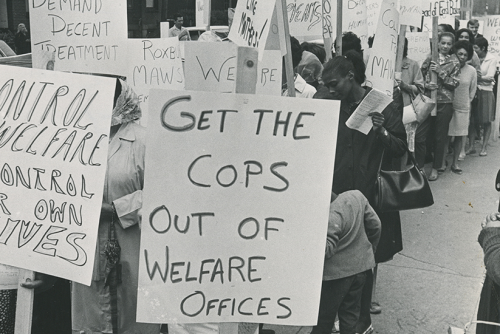
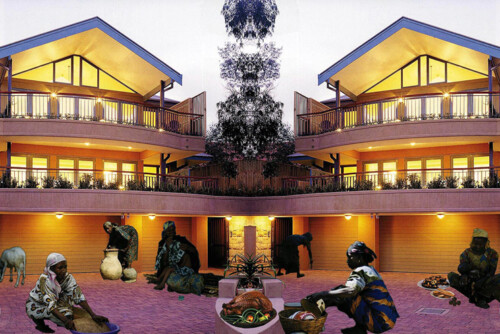
The new issue of S&F Online brings together timely contributions within the emergent intersection of abolition feminism and social reproduction at a moment when carcerality continues to proliferate under new guises. This framework makes visible the carceral state’s imbrication in the maintenance of everyday life while insisting on the long genealogy of feminist struggles that have always understood abolition as a reproductive question. Guest editors Sarah Haley and Emily Thuma gather these contributions to examine how gendered, racialized, and classed forms of life are both sustained and constrained by carceral systems, and how abolitionist praxis reimagines and rebuilds the reproduction of the social otherwise. Abolition feminism here operates as analytic and an ethic: a refusal of state violence with a commitment to building alternative infrastructures of care, safety, and survival.
From historical and ethnographic analyses to conversations among both incarcerated and non-incarcerated organizers, writers, and scholars, the pieces invoke long histories of collective resistance. Themes include policing, mass incarceration (and “benevolent” decarceration), genocidal violence, and reproductive injustice as well as forms of resistance in family- and kinship-making, self-defense, and collective survival. Some of the pieces foreground real-time theorizing, analysis, and denunciation (Abusneineh; Burton, Haley, King, Schept, and Stockton; Wilson; and Harris). Others take a more extended view, offering longer-term analyses through case studies or reflections on sustained collective organizing projects (Bierria, Matthiesen, Martensen). Placed in conversation, these works amplify one another: the immediacy of lived struggle deepens the insights of historical and ethnographic work, while those grounded, longer perspectives sharpen our understanding and analysis of the present moment.
This issue vibrates with the ever-present tension between the need (and demand) for visibility and the risks of surveillance. To be seen is a precursor to being recognized, to being counted as a member of a community, of society, indeed, even as human. On the flipside, carceral institutions and power structures violently demand full visibility: at the most visceral level, “the count” is a daily ritual to which incarcerated people must submit. At the narrative level, the testimonies crafted and circulated by incarcerated people are powerful resistance against the isolation and disappearances that are enacted by imprisonment — even as those same testimonies are circumscribed by state surveillance. The contributions to this issue model forms of collaboration, solidarity, and imagination necessary to sustain abolitionist feminist thought and practice across and against the contradictions of the reproduction of carcerality.
The issue builds on the long history of S&F Online and BCRW on prison-industrial complex abolition and abolition feminism over the years. Our 2007 issue, “Women, Prisons and Change,” building on programs such as the 2006 Scholar and Feminist Conference, “Engendering Justice: Prisons, Activism and Change,” traced the history of mass incarceration and its relation to immigration, education, and gender violence. BCRW has continued to produce projects centered around this work, such as the series No One Is Disposable and I Use My Love to Guide Me with CeCe McDonald, Tourmaline, and Dean Spade in 2014; the Interrupting Criminalization: Research in Action initiative alongside Andrea J. Ritchie and Mariame Kaba in 2018; or the two-day symposium of the same year “Invisible No More: Resisting Police Violence against Black Women and Women of Color in Troubled Times,” which became a special issue in 2019 titled, “Unraveling Criminalizing Webs: Building Police Free Futures,” guest edited by Ritchie and Levi Craske. “Abolition Feminism and the Politics of Reproduction” will continue to model and carry forward our commitment to feminist prison abolition research and action.
To build solidarity across walls and with incarcerated readers, this issue has also been designed for print — a first in the history of S&F Online. If you would like a copy of the full special issue to be sent to an incarcerated friend or loved one inside for free, please make a request here through Haymarket Books’ Books Not Bars program via this link . Each individual contribution to the issue is also available for downloading as a printable, foldable booklet, via a link at the end of each article. The print version of the issue was beautifully crafted by Mitch Wiesen, and Dana Blanchard has generously coordinated distribution through Haymarket. We owe deep appreciation to the guest editors for centering this accessibility effort from the very beginning of the issue’s conceptualization, and we extend particular recognition to Emily Thuma, who managed the print production and distribution process. The move toward print also builds on BCRW’s ongoing commitment to accessibility and collective knowledge production, and reflects our desire to think expansively about how feminist publishing can circulate beyond academic and digital spaces in this moment.
We are deeply grateful to the guest editors for their visionary curatorial and editorial work, and to all the contributors who took part in the intellectual milestone that this special issue embodies. The BCRW editorial team has also worked relentlessly to publish the most compelling and rigorous version of the issue. Special thanks to Sarah Ross, our associate editor, and Kelsey Kitzke, Ruben Carter, and Lea Salim for their work on the contributions.